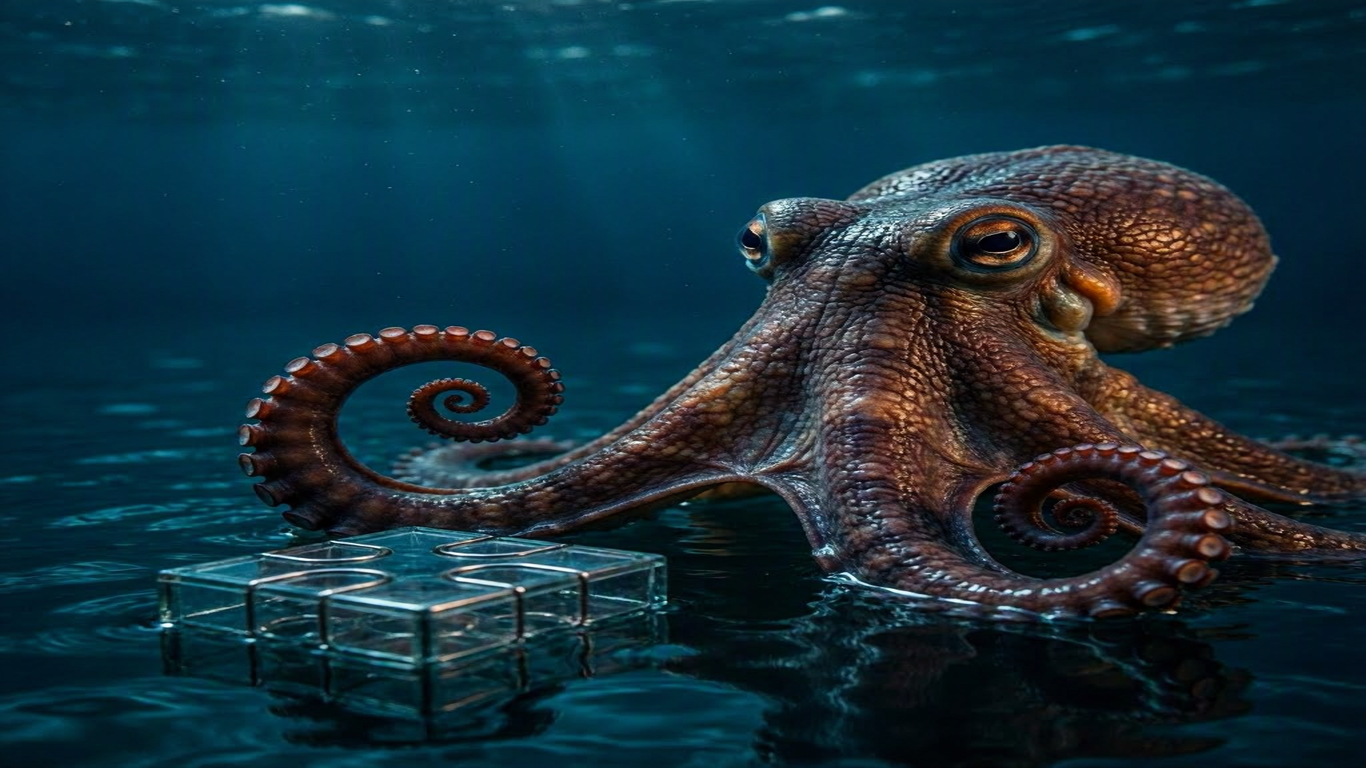
When people think of intelligent animals, creatures like dolphins, chimpanzees, elephants, and crows usually come to mind. Octopuses, however, are often overlooked despite possessing some of the most remarkable cognitive abilities in the animal kingdom. Hidden beneath the waves, these soft-bodied marine animals continue to surprise scientists with behaviors that challenge traditional ideas about intelligence.
What makes octopuses especially fascinating is that they evolved along a very different path from mammals and birds. Their intelligence developed independently, meaning they arrived at many impressive problem-solving abilities through an entirely separate evolutionary journey. As a result, studying octopuses offers a unique window into how intelligence can emerge in nature.
Over the years, researchers have documented countless examples of octopus behavior that suggest these animals are far more mentally capable than many people realize. Here are seven compelling clues that reveal just how smart octopuses truly are.
1. They Can Solve Complex Problems
One of the strongest signs of intelligence is the ability to solve unfamiliar problems, and octopuses excel in this area.
In research settings, octopuses have successfully opened jars, navigated mazes, manipulated latches, and figured out puzzles designed to test their reasoning skills. Unlike simple instinctive behaviors, these tasks often require experimentation and adaptation.
Scientists have observed octopuses trying multiple approaches before finding a successful solution. This kind of trial-and-error learning demonstrates flexibility and problem-solving abilities that are commonly associated with highly intelligent animals.
Their willingness to explore different options suggests they can analyze situations rather than relying solely on instinct.
2. They Use Tools in Surprising Ways
Tool use was once considered a uniquely human trait. Later, researchers discovered it in several birds and mammals. More surprisingly, octopuses joined that list as well.
Some species have been observed collecting discarded coconut shells and carrying them across the ocean floor. When needed, they assemble the shells into protective shelters.
Others use rocks, shells, and surrounding objects to create barriers around their dens. These actions require planning because the materials are often gathered before they are immediately needed.
The ability to use tools demonstrates foresight, adaptability, and an understanding of how objects can be manipulated to achieve specific goals.
3. They Have Exceptional Memory
Memory plays a critical role in intelligent behavior, and octopuses appear to possess impressive recall abilities.
Studies suggest they can remember solutions to problems and apply that knowledge later. Once an octopus learns how to complete a task, it often performs the same task more efficiently in future attempts.
In the wild, memory helps octopuses locate food sources, remember safe hiding places, and avoid dangerous situations. Their ability to retain information over time gives them a significant survival advantage.
This capacity for learning and remembering experiences is one of the hallmarks of advanced cognition.
4. They Display Individual Personalities
For many years, scientists assumed animals of the same species behaved in largely predictable ways. Research on octopuses has challenged that assumption.
Different individuals often exhibit distinct personality traits. Some octopuses appear bold and curious, eagerly investigating new objects. Others are more cautious and prefer to remain hidden.
Researchers have observed consistent behavioral differences among individual octopuses, suggesting they are not simply responding to instincts in identical ways.
The presence of personality indicates a level of behavioral complexity that is often associated with intelligent species.
5. Their Nervous System Is Unlike Any Other
Part of what makes octopus intelligence so remarkable is the unusual way their nervous system works.
Unlike humans, whose brains control most functions centrally, octopuses distribute much of their neural processing throughout their bodies. In fact, a large portion of their neurons are located in their arms rather than in their central brain.
This allows each arm to perform complex movements and respond independently to environmental information. Scientists sometimes describe octopus arms as possessing a degree of local decision-making ability.
The result is a highly flexible and efficient system that enables extraordinary control, exploration, and problem-solving capabilities.
6. They Are Masters of Observation and Learning
Octopuses are highly observant creatures.
In both laboratory and natural settings, they carefully examine their surroundings, gathering information before taking action. Researchers have found evidence that octopuses can learn through observation, a trait commonly associated with advanced intelligence.
Rather than relying solely on direct experience, they often study objects, environments, and potential threats before responding.
This cautious yet curious approach allows them to adapt quickly to changing conditions and unfamiliar challenges.
The ability to learn from observation is a powerful cognitive skill that reduces risk and improves survival.
7. They Constantly Adapt to New Situations
Perhaps the strongest clue of all is the octopus’s remarkable adaptability.
The ocean is a dynamic environment where conditions can change rapidly. Octopuses regularly encounter new predators, shifting habitats, and unfamiliar obstacles. To survive, they must respond creatively rather than relying on rigid behavioral patterns.
Their famous camouflage abilities are a perfect example. Octopuses can instantly alter their color, texture, and posture to match their surroundings. While camouflage is partly instinctive, deciding when and how to use it effectively often requires interpreting environmental information in real time.
This flexibility allows octopuses to thrive in a wide range of situations and demonstrates an impressive capacity for behavioral adjustment.
Why Octopus Intelligence Fascinates Scientists
Octopuses challenge many traditional assumptions about how intelligence develops.
Most highly intelligent animals belong to groups that share close evolutionary relationships with humans, such as mammals or birds. Octopuses, however, are cephalopods—a lineage that diverged from our own hundreds of millions of years ago.
Despite this distant relationship, they independently evolved sophisticated problem-solving abilities, advanced sensory systems, and complex behaviors. This suggests that intelligence may arise in multiple ways under the right environmental pressures.
For scientists, octopuses provide valuable insights into alternative forms of cognition.
The Role of Curiosity in Their Survival
One recurring theme in octopus behavior is curiosity.
These animals frequently investigate unfamiliar objects, explore new environments, and interact with their surroundings in ways that appear deliberate and purposeful.
Curiosity plays an important role in learning because it encourages exploration and information gathering. In the case of octopuses, this behavior may help them discover food sources, identify safe shelters, and develop solutions to new challenges.
Their inquisitive nature is one reason they continue to impress researchers studying animal intelligence.
Intelligence Beyond the Human Perspective
One reason octopus intelligence is often underestimated is that it differs significantly from human intelligence.
People tend to recognize traits that resemble their own abilities, such as language, social structures, or tool-making traditions. Octopuses demonstrate intelligence in ways that are adapted to their unique lifestyle and environment.
They rely on problem-solving, flexibility, sensory awareness, and rapid adaptation rather than social cooperation or verbal communication.
Understanding this broader view of intelligence helps us appreciate the many forms cognition can take throughout the natural world.
What Octopuses Teach Us About Nature
The story of octopus intelligence offers a powerful reminder that remarkable minds can emerge in unexpected places.
Nature does not follow a single blueprint for success. Different species develop different solutions to the challenges they face. Octopuses show that advanced cognition can evolve in creatures that look, move, and live very differently from humans.
Their abilities encourage us to approach wildlife with greater curiosity and humility, recognizing that intelligence often exists in forms we do not immediately recognize.
Final Thoughts
Octopuses are among the most extraordinary animals on Earth. Their problem-solving skills, tool use, memory, adaptability, and unique nervous systems reveal a level of intelligence that continues to surprise scientists and animal lovers alike.
The seven clues explored here offer only a glimpse into what makes these marine creatures so fascinating. As research continues, new discoveries are likely to reveal even more about how octopuses think, learn, and interact with their world.
Ultimately, these remarkable animals remind us that intelligence is not limited to creatures that resemble us. Sometimes, some of the most impressive minds on the planet are hidden beneath the ocean’s surface, quietly solving problems in ways we are only beginning to understand.