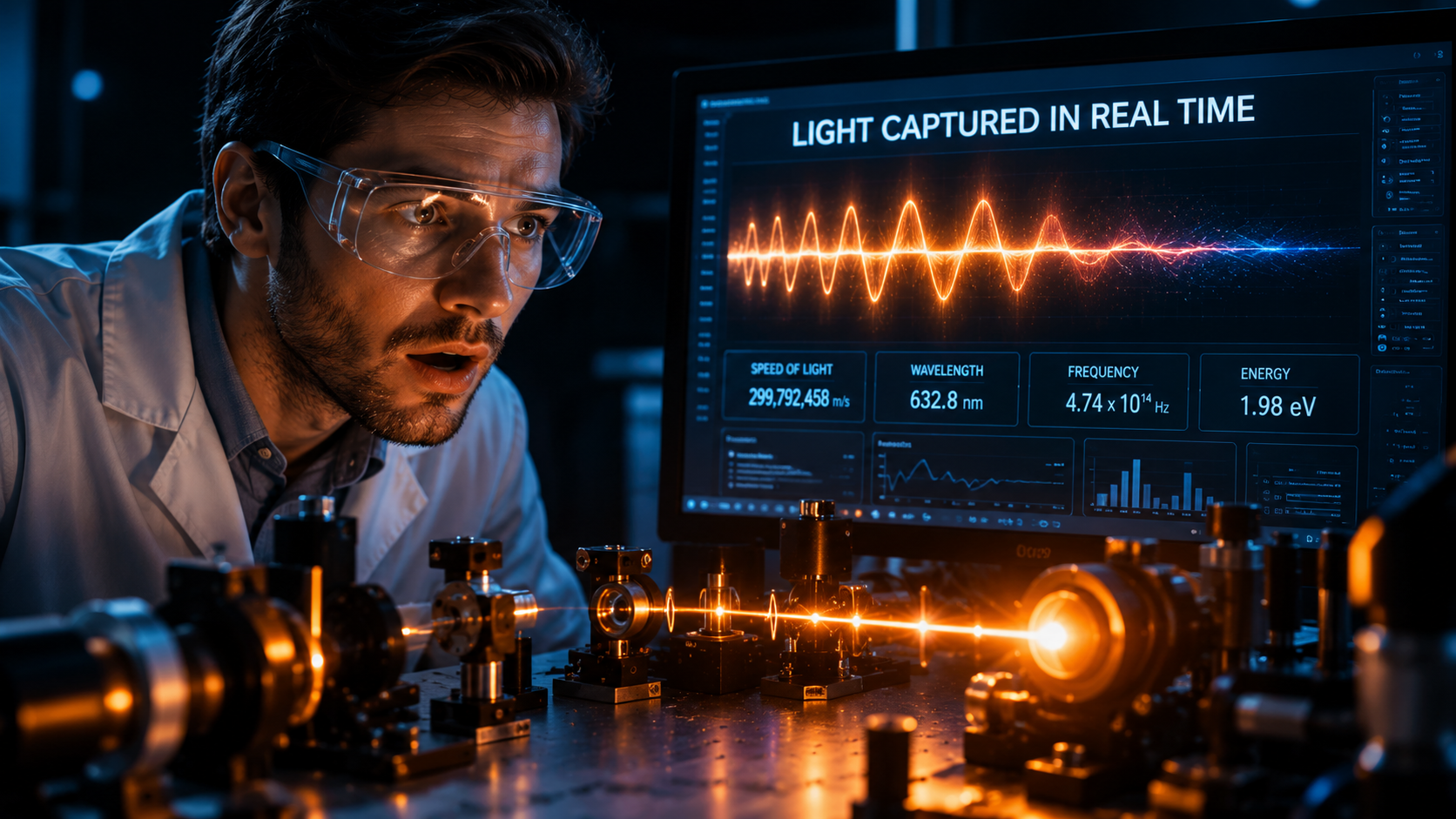
For centuries, light has fascinated scientists, philosophers, and inventors. It illuminates our world, carries information across vast distances, and plays a critical role in everything from photography to modern communications. Yet despite its importance, one challenge seemed almost impossible: actually watching light move.
The problem is simple. Light travels at roughly 186,000 miles per second (300,000 kilometers per second). At that speed, it can circle Earth more than seven times in a single second. Human eyes—and even traditional cameras—are far too slow to observe its motion directly.
That changed when researchers developed ultra-fast imaging technologies capable of capturing light as it travels. Using sophisticated laser systems and high-speed cameras, scientists were finally able to create visual recordings of light moving through space and interacting with objects.
These groundbreaking experiments didn’t just produce stunning videos. They opened a new window into the behavior of light itself, helping researchers better understand some of the most fundamental processes in physics.
Here are seven fascinating things scientists learned after successfully capturing light moving in real time.
1. Light Doesn’t Always Travel the Way We Imagine
Most people picture light moving in perfectly straight lines from one point to another. While that’s often true in simple situations, real-world environments tell a more complicated story.
When scientists recorded light traveling through different materials and spaces, they observed how frequently photons interact with their surroundings. Light can scatter, reflect, refract, and change direction depending on the medium it encounters.
Even seemingly transparent materials affect the path of light in subtle ways.
Watching these interactions unfold frame by frame helped researchers visualize processes that were previously described only through mathematical models. Instead of relying entirely on theory, scientists could actually observe how light behaves as it navigates complex environments.
The result was a deeper appreciation for the dynamic nature of light propagation.
2. Seeing Light in Motion Revealed Hidden Details About Reflection
Reflection is something we experience every day. We see ourselves in mirrors, notice sunlight bouncing off water, and rely on reflective surfaces in countless technologies.
Yet before ultra-fast imaging became possible, reflection happened too quickly to observe directly.
When researchers captured light moving across reflective surfaces, they discovered intricate patterns that are invisible to the naked eye. Tiny differences in texture, angle, and material composition produced subtle changes in how light behaved.
These observations provided valuable information about surface properties and optical performance.
The findings have practical applications as well. Improved understanding of reflection can help engineers design better imaging systems, optical devices, and advanced materials.
Sometimes, slowing down a familiar process reveals complexities we never realized were there.
3. Light Can Be Used to See Around Corners
One of the most surprising discoveries emerging from these experiments involves indirect vision.
By carefully tracking how light bounces off multiple surfaces, researchers found ways to reconstruct objects that aren’t directly visible to a camera.
Imagine standing in a hallway and identifying something hidden around a corner without physically looking at it.
This sounds like science fiction, but advanced imaging systems can accomplish something remarkably similar.
Scientists analyze scattered light reflections and use sophisticated algorithms to recreate hidden scenes.
Capturing light in motion helped make these techniques possible by providing detailed information about how photons travel through an environment.
Potential applications include autonomous vehicles, search-and-rescue operations, robotics, and medical imaging technologies.
4. It Improved Our Understanding of How Information Travels
Light serves as one of the most important carriers of information in the modern world.
Fiber-optic cables transmit internet traffic, phone calls, videos, and data using pulses of light. Satellites communicate using electromagnetic signals. Scientific instruments rely on light-based measurements.
By directly observing light’s movement, researchers gained valuable insights into how information travels through optical systems.
They could study signal behavior, identify sources of distortion, and better understand how data propagates through various media.
These findings contribute to the development of faster communication networks and more efficient information technologies.
The ability to watch light in action offers a powerful tool for improving systems that billions of people depend on every day.
5. Light Interacts with Materials in Unexpected Ways
One of the most important lessons from high-speed imaging is that materials and light influence each other constantly.
Different substances absorb, transmit, reflect, and scatter light differently. Some interactions are obvious, while others occur on scales too small or fast for ordinary observation.
Capturing light in real time revealed previously hidden details about these interactions.
Researchers observed how photons move through liquids, pass through biological tissues, interact with nanoparticles, and respond to microscopic structural features.
These observations have broad scientific value.
Understanding light-material interactions helps improve solar panels, medical diagnostics, sensors, optical computing systems, and countless other technologies.
The more scientists learn about these relationships, the more effectively they can engineer new materials and devices.
6. Ultra-Fast Imaging Opened New Possibilities for Medical Research
Many medical imaging techniques depend on light.
Doctors and researchers use optical methods to study tissues, monitor biological processes, and diagnose diseases. However, biological environments are often extremely complex, making it difficult to understand exactly how light behaves within them.
Real-time imaging of light movement provided new insights into these challenges.
Scientists can now analyze how light travels through skin, organs, blood vessels, and other tissues with unprecedented precision.
This knowledge supports improvements in non-invasive diagnostic tools and advanced imaging systems.
Future applications may include earlier disease detection, more accurate medical scans, and better monitoring of biological changes inside the human body.
In this way, a breakthrough in physics has direct implications for healthcare and medicine.
7. It Changed How Scientists Visualize the Invisible
Perhaps the most profound lesson from capturing light in motion is philosophical as much as scientific.
Many natural processes occur beyond the limits of human perception. We cannot see atoms vibrating, tectonic plates moving, or photons racing through space.
Technology allows us to extend our senses beyond those limits.
When scientists first produced videos showing light traveling through a scene, they transformed something abstract into something tangible. Concepts that once existed primarily in equations suddenly became visible.
This shift has educational value, scientific value, and cultural value.
People can now witness one of nature’s fastest phenomena unfolding before their eyes.
Seeing the invisible often changes how we think about reality itself.
How Scientists Captured Light Moving in the First Place
The achievement of recording light in motion required extraordinary innovation.
Traditional cameras capture images at rates measured in frames per second. Even high-end consumer cameras operate thousands or millions of times too slowly to record light directly.
Researchers overcame this limitation by developing specialized imaging systems capable of capturing events occurring within trillionths of a second.
These systems often combine ultra-short laser pulses with advanced computational techniques. Instead of recording a scene conventionally, they gather tiny pieces of information from repeated experiments and reconstruct the movement afterward.
The resulting videos may appear simple, but they represent enormous technological accomplishments.
Each frame reflects years of engineering, physics, and computational research.
Why This Discovery Matters Beyond Physics
At first glance, recording light moving through space might seem like a purely scientific curiosity.
In reality, the implications extend far beyond laboratory experiments.
The techniques developed for these studies influence fields including telecommunications, medicine, manufacturing, astronomy, robotics, security, and artificial intelligence.
Many modern technologies depend on precise control of light. Better understanding its behavior allows engineers to design more effective systems.
History shows that breakthroughs in fundamental science often lead to practical innovations decades later.
Just as early research into electricity eventually transformed civilization, advances in optical science may drive future technological revolutions.
The Future of Ultra-Fast Imaging
Scientists continue pushing the limits of imaging technology.
New systems are becoming faster, more sensitive, and more accurate. Researchers are now studying phenomena that occur on even shorter timescales and smaller spatial scales.
Future technologies may allow scientists to observe chemical reactions as they unfold, monitor quantum processes in real time, and explore previously inaccessible aspects of the physical world.
As imaging capabilities improve, our understanding of nature will likely expand as well.
The ability to observe what was once invisible remains one of science’s most powerful tools.
What Capturing Light Teaches Us About Discovery
There is something inspiring about the idea of watching light move.
For generations, scientists knew it happened but lacked the tools to witness it directly. They relied on mathematics, indirect observations, and theoretical models to describe its behavior.
Eventually, technology caught up with curiosity.
The success of these experiments demonstrates an important truth about scientific progress: many mysteries remain hidden not because they are unknowable, but because we have not yet developed the right tools to explore them.
Every new instrument expands the boundaries of human knowledge.
What seems impossible today may become routine tomorrow.
Final Thoughts
Capturing light moving in real time stands as one of the most remarkable achievements in modern imaging science. By slowing down one of nature’s fastest phenomena, researchers gained unprecedented insight into the behavior of light and its interactions with the world around us.
From revealing hidden details of reflection and material interactions to improving medical imaging and communication technologies, the discoveries extend far beyond physics laboratories.
Perhaps most importantly, these experiments remind us that the universe contains countless processes occurring beyond the limits of ordinary perception. Through innovation and persistence, scientists continue finding ways to make the invisible visible.
And in doing so, they help us see the world—and the fundamental forces that shape it—in entirely new ways.