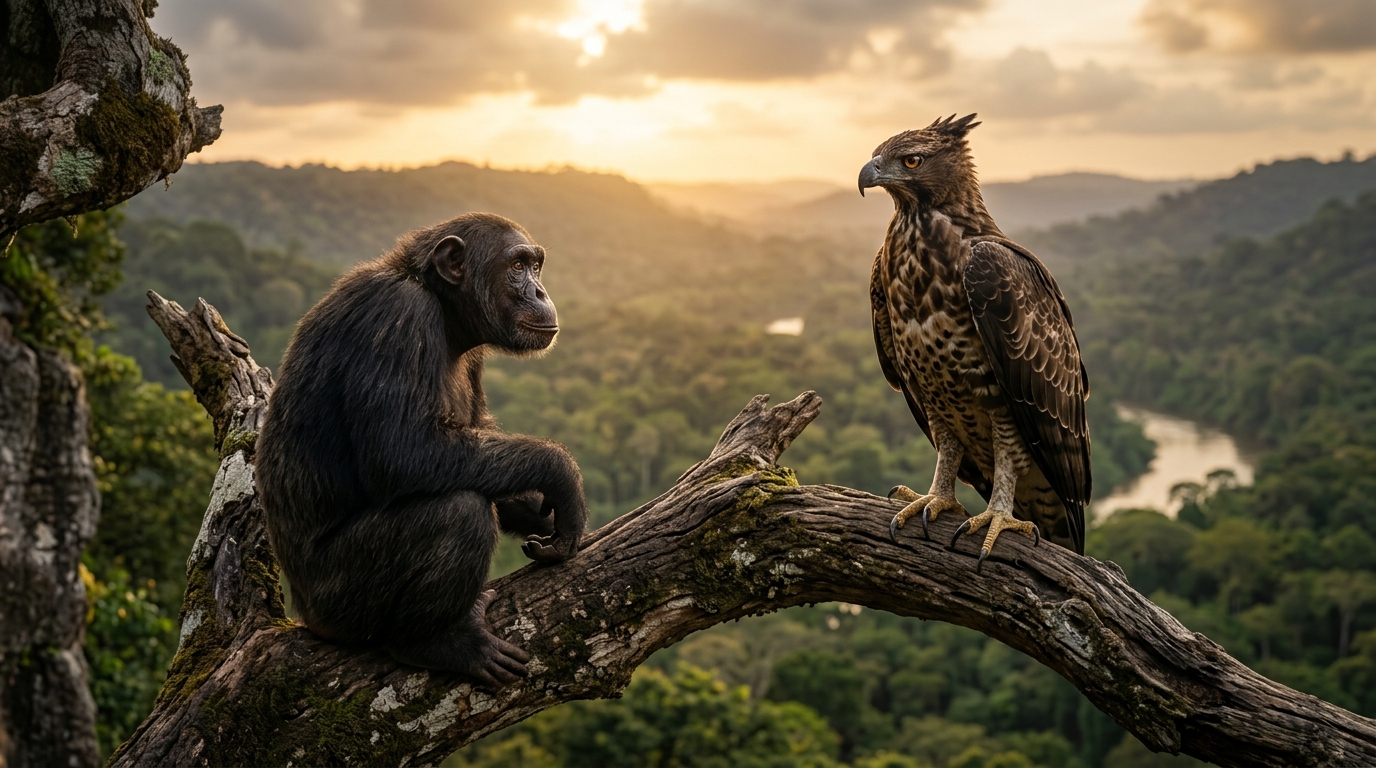
The natural world is full of surprising encounters, but few capture scientific attention quite like unexpected interactions between two very different species. Recently, observations of chimpanzees and eagles sharing the same space have sparked curiosity among researchers and wildlife enthusiasts alike. At first glance, these animals seem to inhabit completely different worlds—one is a highly intelligent primate that spends much of its time in trees and on the ground, while the other is a powerful bird of prey known for soaring high above forests and open landscapes.
Yet unusual sightings involving chimps and eagles have raised fascinating questions about animal behavior, ecological relationships, and the complexity of life in the wild. Scientists are eager to understand what these encounters might reveal about both species and the environments they share.
While many details remain under investigation, the observations have already provided valuable opportunities to explore how animals interact in ways that challenge expectations. Here are seven reasons scientists are intrigued by chimps seen with eagles.
1. The Encounters Challenge Traditional Expectations
One reason these sightings have attracted so much attention is that they do not fit neatly into what many people expect.
Chimpanzees and eagles occupy different ecological niches and rely on very different survival strategies. Because of these differences, most people assume the two species would rarely interact in any meaningful way.
When researchers observe unexpected behavior, it often signals an opportunity to learn something new.
The chimp-eagle encounters challenge assumptions and encourage scientists to investigate what factors may be bringing these animals together.
Nature frequently proves more complicated than simple textbook descriptions suggest.
2. Chimpanzees Are Highly Curious Animals
Chimpanzees are widely recognized for their intelligence and curiosity.
Researchers have documented chimps investigating unfamiliar objects, observing other animals, and experimenting with their environment in ways that demonstrate sophisticated cognitive abilities. Their curiosity often leads them to interact with species that might otherwise be ignored.
If an eagle enters a chimpanzee’s environment, it is not surprising that the primates might pay close attention.
Understanding how chimps respond to unusual wildlife encounters can provide insights into their learning processes and social behavior.
Their reactions may reveal how they gather information about the world around them.
3. Eagles Are Powerful Predators
Eagles occupy an important position within many ecosystems.
As apex or near-apex predators, they influence prey populations and contribute to ecological balance. Their presence often affects the behavior of other animals, including mammals, birds, and reptiles.
Scientists are interested in understanding how chimpanzees perceive large birds of prey.
Do chimps view eagles as potential threats, competitors, neutral neighbors, or simply interesting animals?
Answering these questions could help researchers better understand how primates assess risk in complex environments.
4. The Sightings Offer Insights Into Ecosystem Dynamics
Wildlife interactions often reveal important information about ecosystems.
Every species exists within a network of relationships involving predators, prey, competitors, and environmental factors. Observing unexpected encounters can help scientists identify ecological connections that might otherwise go unnoticed.
The chimp-eagle observations provide an opportunity to study how different species share resources and respond to one another’s presence.
Even brief interactions can offer valuable clues about ecosystem structure.
Researchers often learn the most from events they did not anticipate.
5. Animal Behavior Is More Flexible Than Once Believed
For many years, scientists tended to view animal behavior as relatively predictable.
Modern research has shown that behavior is often highly flexible and influenced by individual experiences, environmental conditions, and social dynamics. Animals regularly adapt to changing circumstances in creative ways.
The interactions between chimps and eagles may represent another example of this flexibility.
Studying such encounters helps researchers understand how animals respond when faced with unfamiliar situations.
Behavioral adaptability is one of the most important survival tools in nature.
6. The Encounters Raise Questions About Communication
Whenever two species interact, scientists become interested in the possibility of communication.
Communication does not necessarily involve language in the human sense. Instead, it can include body posture, vocalizations, movement patterns, and responses to behavior.
Researchers may examine whether chimps and eagles alter their actions in response to one another’s presence.
Even indirect communication can influence how animals share space and resources.
Understanding these dynamics contributes to broader knowledge about interspecies interactions.
7. They Highlight How Much We Still Have to Learn
Perhaps the most important reason scientists are intrigued is that the observations serve as a reminder of how much remains unknown about wildlife.
Despite decades of research, new behaviors and unexpected interactions continue to emerge. Every unusual sighting has the potential to expand scientific understanding and challenge existing theories.
The chimp-eagle encounters underscore the value of careful observation and long-term field studies.
Nature continues to reveal surprises, even among species that have been studied extensively.
That sense of discovery is one of the driving forces behind wildlife research.
Why Chimpanzees Fascinate Scientists
Chimpanzees are among humanity’s closest living relatives and have been the focus of scientific research for decades.
Researchers study chimpanzees because they exhibit many behaviors once thought to be uniquely human, including:
- Tool use.
- Problem-solving.
- Cooperation.
- Social learning.
- Complex communication.
Their intelligence makes them especially valuable for understanding cognition and behavior.
Observations involving chimps often provide insights that extend far beyond a single species.
The Ecological Importance of Eagles
Eagles are among the most recognizable birds of prey in the world.
These powerful hunters help regulate ecosystems by influencing populations of smaller animals. Their role as predators contributes to ecological balance and biodiversity.
In many habitats, eagles also serve as indicators of environmental health.
Because they occupy high positions within food webs, changes affecting eagle populations can signal broader ecological shifts.
Their interactions with other species are therefore of considerable scientific interest.
What Researchers Look for During Wildlife Encounters
When scientists observe unusual animal interactions, they focus on several key questions:
- How often do the encounters occur?
- Which individuals are involved?
- What behaviors are displayed?
- Are resources involved?
- Do interactions change over time?
- What environmental factors influence the behavior?
Answering these questions helps researchers distinguish between isolated incidents and meaningful behavioral patterns.
Long-term observation is often essential.
Why Interspecies Interactions Matter
The study of interspecies interactions has become an increasingly important area of research.
Animals rarely live in isolation. Instead, they exist within complex ecological communities where interactions can influence survival, reproduction, and behavior.
By examining relationships between different species, scientists gain a more complete understanding of ecosystems.
Unexpected encounters often reveal connections that would otherwise remain hidden.
The chimp-eagle observations fit within this broader scientific effort.
Lessons From Unexpected Wildlife Discoveries
Many important scientific discoveries begin with something unexpected.
Researchers who remain open to surprising observations are often able to identify new questions and avenues for investigation. Nature frequently behaves in ways that challenge established assumptions.
The encounters between chimps and eagles remind scientists not to overlook unusual events.
Sometimes the most valuable insights come from observations that initially seem difficult to explain.
Curiosity remains one of science’s most powerful tools.
Final Thoughts
The sightings of chimpanzees and eagles sharing space have generated excitement because they highlight the complexity and unpredictability of the natural world. What might appear to be a simple encounter between two species has raised fascinating questions about behavior, ecology, communication, and adaptation.
The seven reasons explored here reveal why researchers are paying close attention to these observations. From the intelligence of chimpanzees and the ecological importance of eagles to the broader lessons about wildlife interactions, each factor contributes to a deeper understanding of nature.
Most importantly, these encounters remind us that even well-studied species can still surprise us. The more scientists observe animals in their natural environments, the more they discover that the natural world remains filled with mysteries waiting to be explored. In that sense, every unexpected encounter is an opportunity to learn something new about life on Earth.







