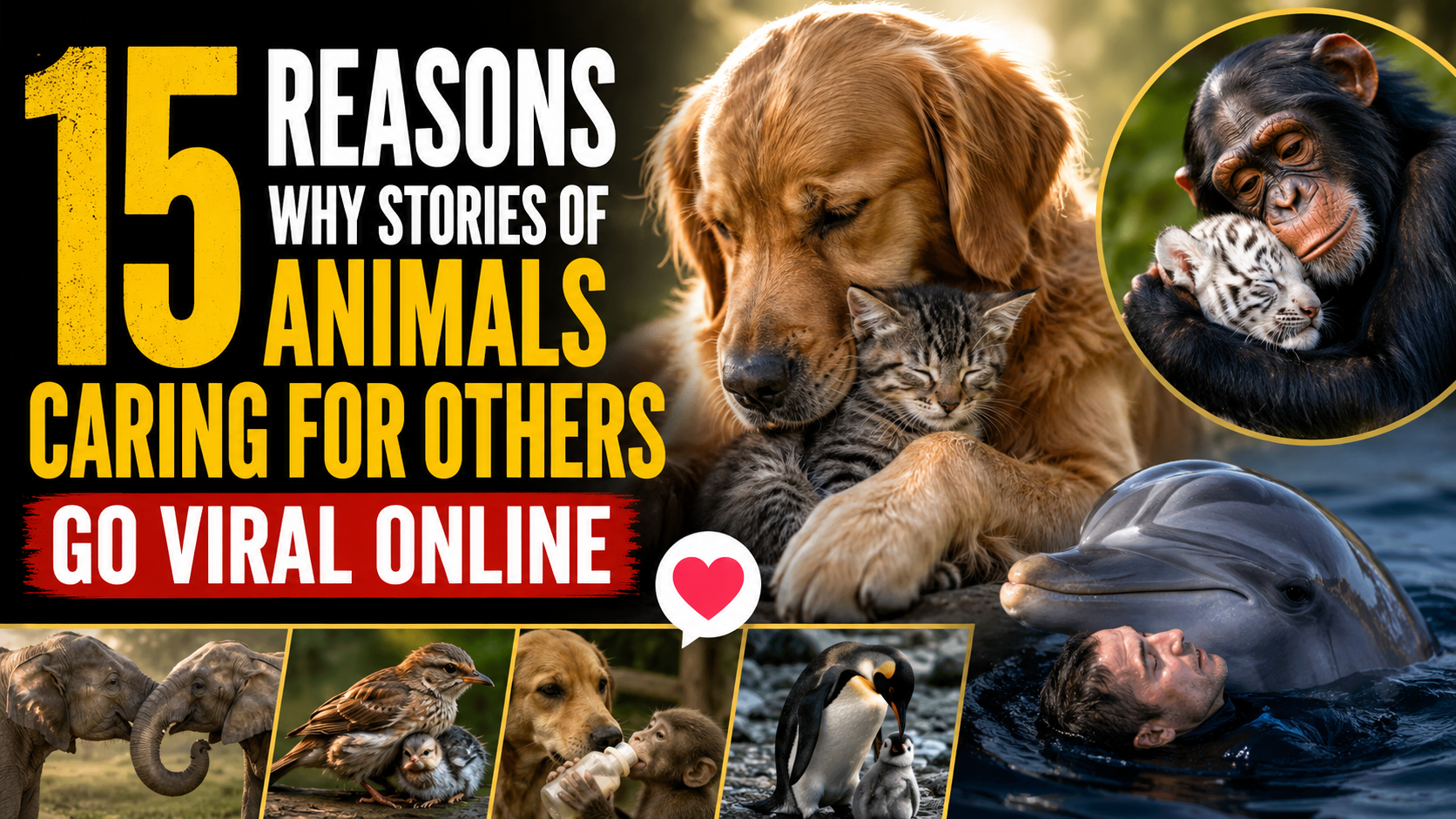
Every so often, a story appears online that captures millions of hearts in a matter of hours: a dog rescuing a kitten, a dolphin protecting a swimmer, a gorilla gently interacting with a human child, or even unexpected bonds between different animal species. These moments spread rapidly across social media, shared by people who may never have met but feel emotionally connected to the same story.
But why do these particular stories go viral so easily? What makes animal “acts of care” so powerful in the digital world?
The answer lies in psychology, storytelling structure, emotional resonance, and how humans naturally interpret animal behavior. Below are 15 detailed reasons why stories of animals caring for others consistently go viral online.
1. Humans Are Hardwired to Respond to Caregiving Behavior
At a biological level, humans are deeply responsive to caregiving behavior. When we see one being helping or protecting another, our brains activate empathy-related regions.
Animal caregiving stories trigger this instinct strongly because they resemble human nurturing behavior, making them instantly emotionally engaging.
2. Animals Break Expectations of “Wildness”
People often expect animals—especially wild ones—to behave according to survival instincts alone. So when they appear gentle, protective, or nurturing, it challenges those expectations.
This surprise factor makes the content more memorable and more likely to be shared.
3. Emotional Contrast Increases Engagement
Stories of animal care often involve contrast: danger vs. safety, fear vs. comfort, or isolation vs. companionship.
This emotional contrast heightens attention and makes viewers feel a stronger emotional shift, which encourages sharing.
4. Visual Evidence Makes the Story Feel Real
Unlike text-based stories, animal caregiving moments are often captured on video or photography. Seeing the behavior directly increases credibility and emotional impact.
People are far more likely to believe and share what they can visually confirm.
5. Anthropomorphism Helps Humans Connect Emotionally
Humans naturally attribute human emotions to animals, a process known as anthropomorphism.
When an animal appears to comfort another, people interpret it as kindness, love, or empathy—even if the actual behavior may be instinctive or situational.
This interpretation strengthens emotional attachment to the story.
6. Stories Fulfill a Deep Desire for Positivity
Social media is often filled with negative news. Animal caregiving stories provide a refreshing emotional break.
They offer hope, kindness, and emotional relief, which encourages users to engage and share them widely.
7. Simple Narratives Are Easier to Share
Most viral animal stories are simple: an animal helped another animal or a human in need.
This simplicity makes them easy to understand quickly, increasing the likelihood of sharing without needing explanation.
8. Emotional Contagion Drives Virality
Emotional contagion is the phenomenon where people “catch” emotions from others.
When someone watches a heartwarming animal interaction, they often feel the same warmth or happiness, motivating them to pass it along.
9. Animals Represent Innocence and Purity
In many cultures, animals are associated with innocence. When they behave in caring ways, it reinforces the idea of natural goodness.
This perception makes the story feel more meaningful and emotionally powerful.
10. Social Media Algorithms Favor Emotional Content
Platforms like Facebook, Instagram, TikTok, and YouTube prioritize content that generates strong reactions—likes, shares, comments, and watch time.
Animal caregiving stories naturally perform well in these metrics, helping them spread rapidly.
11. Cross-Species Interaction Feels Extraordinary
When animals care for different species—such as a dog nurturing a cat or a lion interacting peacefully with a human—it feels extraordinary and rare.
This uniqueness increases curiosity and engagement, fueling virality.
12. Stories Trigger Protective Instincts
Humans have a natural protective response toward vulnerable beings, including animals.
When a story shows animals helping each other, it activates the same emotional systems involved in caregiving and protection.
13. They Offer a Sense of Hope About the World
In a fast-paced and often stressful digital environment, people crave uplifting content.
Animal caregiving stories suggest that kindness still exists in nature, which provides emotional reassurance and optimism.
14. They Are Easily Repackaged and Shared
These stories are highly adaptable. A single clip can be turned into memes, short videos, articles, or reposts with captions.
This flexibility helps them spread across multiple platforms quickly.
15. They Reinforce Belief in Emotional Intelligence in Animals
Many people already believe that animals are emotionally intelligent. Stories of caregiving reinforce this belief, making them more engaging and satisfying to consume.
When content aligns with existing beliefs, people are more likely to share it.
Why These Stories Resonate So Deeply
Animal caregiving stories are more than just viral content—they connect with something fundamental in human psychology. They combine emotion, curiosity, and storytelling in a way that feels universal.
These stories remind us that compassion is not exclusive to humans. Whether instinctive or learned, the appearance of care in the animal world creates a powerful emotional bridge between species.
The Role of Storytelling in Viral Spread
Another key factor is storytelling structure. Most viral animal caregiving stories follow a natural arc:
- A situation of vulnerability or danger
- An unexpected act of care or protection
- A resolution that feels emotionally satisfying
This structure mirrors traditional storytelling formats, making the content more engaging and memorable.
Emotional Relief in a Digital World
In an online environment filled with conflict, stress, and negativity, animal caregiving stories serve as emotional relief. They act as small moments of comfort that people can experience instantly.
This emotional “pause” is one of the main reasons users keep engaging with similar content.
Final Thoughts
The virality of animal caregiving stories is not accidental—it is deeply rooted in human psychology, emotional processing, and digital behavior.
From empathy and curiosity to visual storytelling and algorithmic amplification, many factors work together to make these stories spread rapidly across the internet.
Ultimately, these moments remind us of something simple yet powerful: compassion resonates universally. Whether between humans or animals, the idea of caring for one another is something that continues to capture hearts around the world.







