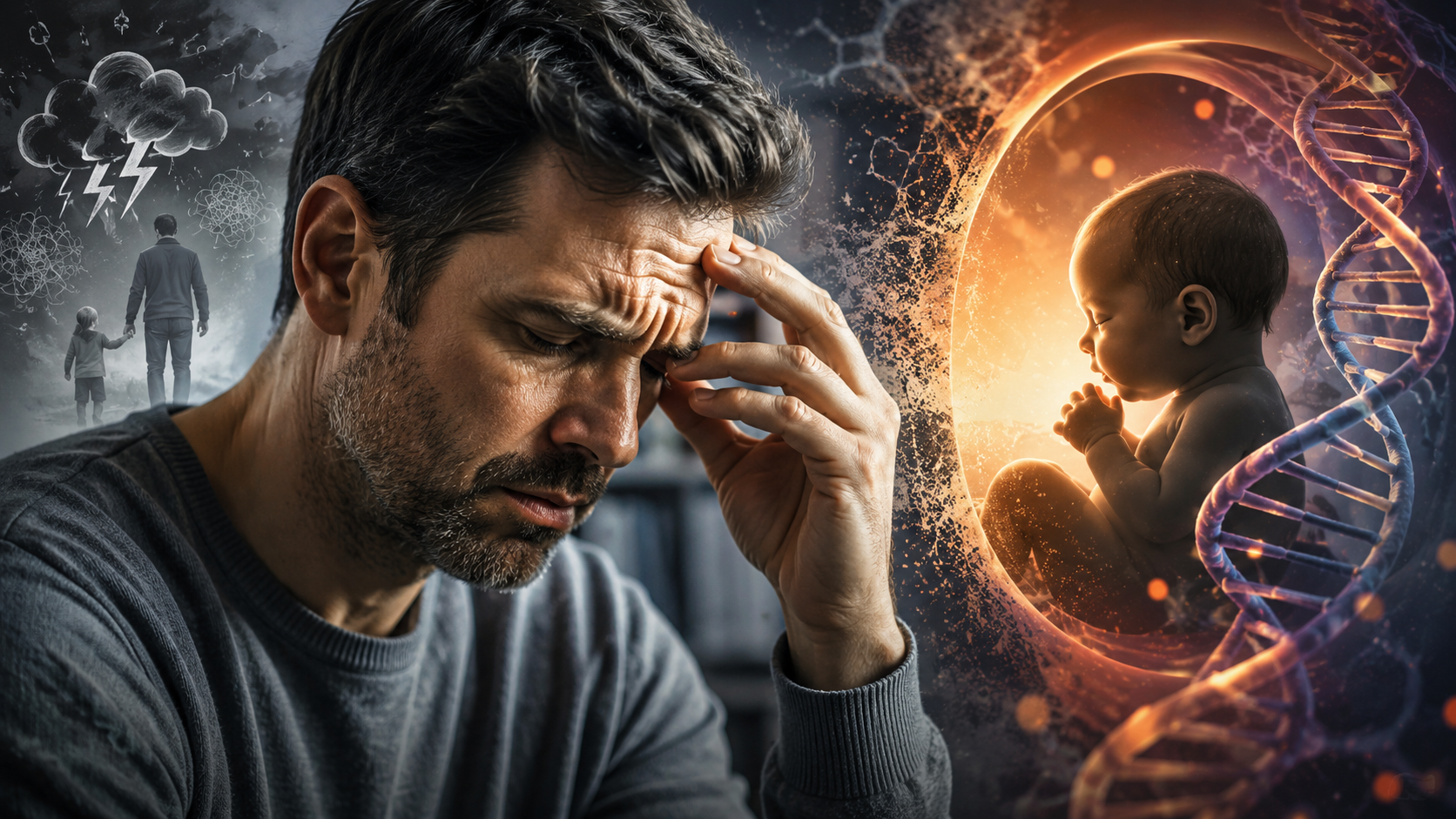
For decades, discussions about prenatal health and child development focused primarily on mothers. Researchers examined how a mother’s nutrition, lifestyle, emotional well-being, and environment could influence a baby’s development before birth. While these factors remain critically important, scientists are increasingly discovering that fathers may also play a larger role than previously understood.
Emerging research in genetics and epigenetics suggests that a father’s experiences before conception—including chronic stress—may leave biological marks that influence future children. This doesn’t mean a stressful week at work will determine a child’s future. Rather, studies indicate that prolonged or severe stress may affect biological processes in ways that can potentially influence offspring development.
The science is still evolving, and many questions remain unanswered. However, the findings have opened an exciting new area of research that is reshaping how scientists think about inheritance, health, and family well-being.
Here are 10 surprising facts about how a father’s stress may affect future children.
1. Stress May Influence More Than Just Mental Health
Most people think of stress as an emotional or psychological issue, but its effects extend throughout the body.
When a person experiences ongoing stress, the body releases hormones such as cortisol and adrenaline. These chemicals help the body respond to challenges, but prolonged exposure can affect numerous biological systems.
Researchers have found that chronic stress may influence immune function, metabolism, cardiovascular health, and even reproductive biology. Because sperm cells develop continuously throughout a man’s life, they may be affected by the body’s physiological environment.
This has led scientists to investigate whether stress-related biological changes could potentially be passed to future generations.
2. Epigenetics Is Changing What Scientists Know About Inheritance
One of the most important discoveries behind this research is epigenetics.
Genes contain the instructions that guide development and biological function. Epigenetics refers to chemical modifications that influence how those genes are expressed without changing the DNA sequence itself.
Think of genes as the words in a book and epigenetic markers as notes that help determine which sections are emphasized or ignored.
Research suggests that experiences such as diet, exercise, environmental exposures, and stress may influence these epigenetic markers. Some of these changes may be present in reproductive cells, raising questions about how parental experiences could affect offspring development.
This field has dramatically expanded our understanding of heredity.
3. Sperm Cells Appear to Respond to Environmental Conditions
Scientists once believed sperm functioned primarily as carriers of genetic information.
Modern research has revealed a more complex picture. Sperm cells also contain molecular signals that may help influence early embryonic development.
Studies have shown that environmental factors—including stress, nutrition, and lifestyle habits—can alter certain biological components within sperm. Researchers are particularly interested in small molecules known as non-coding RNAs, which appear capable of influencing gene activity.
These findings suggest that sperm may carry information about a father’s environment in ways scientists are only beginning to understand.
4. Animal Studies Have Produced Intriguing Results
Much of what researchers currently know comes from animal studies.
In laboratory experiments, male animals exposed to chronic stress sometimes produced offspring that displayed differences in stress responses, behavior, metabolism, or brain development compared with control groups.
These findings do not necessarily mean the same effects occur in humans, but they provide valuable clues about potential biological mechanisms.
Animal research allows scientists to examine processes that would be difficult or impossible to study directly in people, making it an important first step in understanding these complex relationships.
5. Stress May Affect Future Stress Responses
One of the most frequently studied areas involves how offspring respond to stress.
Researchers have found evidence suggesting that paternal stress before conception may influence the development of stress-regulation systems in offspring.
The body’s primary stress-regulation network, known as the hypothalamic-pituitary-adrenal (HPA) axis, helps determine how individuals react to challenges and recover from stressful experiences.
Some studies indicate that paternal experiences could potentially affect the programming of this system during early development.
Scientists are still investigating the extent and significance of these effects in humans.
6. The Timing of Stress May Matter
Not all stress exposures appear to have the same impact.
Researchers believe timing may play an important role because sperm cells undergo continuous production and maturation. This process takes several weeks and involves multiple stages of development.
Stress experienced during certain periods may affect biological processes differently than stress experienced at other times.
Understanding when reproductive cells are most sensitive to environmental influences is an active area of scientific investigation and may help explain variations seen across different studies.
7. Not All Stress Is Harmful
When discussing stress, it is important to distinguish between normal life challenges and chronic or severe stress.
Short-term stress is a natural part of life and can even be beneficial in some situations. It helps individuals stay alert, motivated, and prepared to respond to important demands.
Researchers are generally more concerned with prolonged stress that remains unresolved for extended periods. Chronic stress can place persistent strain on biological systems and may be more likely to influence physiological processes.
The goal is not to eliminate stress entirely but to manage it effectively and maintain overall well-being.
8. Lifestyle Factors Often Work Together
Stress rarely acts in isolation.
People experiencing chronic stress may also experience changes in sleep quality, physical activity, nutrition, and social behaviors. These factors can interact in complex ways, making it difficult for researchers to identify the effects of stress alone.
For example, poor sleep and inadequate nutrition can influence hormone levels, inflammation, and metabolic health—all of which may affect reproductive biology.
Scientists increasingly recognize that overall lifestyle patterns may be just as important as individual factors when studying parental influences on future generations.
9. Human Research Is Growing Rapidly
Although much of the early evidence comes from animal studies, human research in this area is expanding.
Scientists are examining large populations, tracking family health histories, and analyzing biological markers to better understand potential links between paternal experiences and child outcomes.
While researchers have identified intriguing associations, establishing direct cause-and-effect relationships remains challenging. Human development is influenced by genetics, environment, parenting, social factors, and countless other variables.
As research methods improve, scientists hope to gain a clearer picture of how paternal health and stress may contribute to child development.
10. A Father’s Health Before Conception Matters More Than Once Thought
Perhaps the most important takeaway from this growing body of research is that paternal health appears to matter.
Historically, preconception health discussions focused largely on mothers. Today, many experts believe both parents contribute important biological influences before conception occurs.
Maintaining physical health, managing stress, getting adequate sleep, exercising regularly, and following healthy lifestyle habits may benefit not only prospective fathers themselves but potentially future children as well.
While many questions remain unanswered, researchers increasingly view paternal well-being as an important part of reproductive and family health.
Understanding the Science Behind Epigenetic Inheritance
One reason these findings have attracted so much attention is that they challenge traditional ideas about inheritance.
For generations, scientists believed biological inheritance depended almost entirely on DNA sequences passed from parents to children. Epigenetics has revealed a more dynamic system in which environmental experiences may influence how genes function.
Importantly, epigenetic changes do not rewrite DNA. Instead, they affect how genetic instructions are used within cells.
This means that experiences may leave biological traces without altering the underlying genetic code itself.
The field remains complex, and researchers continue working to determine which changes are temporary, which persist, and how they may influence future generations.
What Prospective Fathers Can Do
Although scientists are still learning about the relationship between paternal stress and child development, many of the recommendations for supporting reproductive health are straightforward.
Healthy habits include:
- Managing chronic stress through healthy coping strategies
- Getting sufficient sleep
- Exercising regularly
- Maintaining a balanced diet
- Avoiding excessive alcohol consumption
- Not smoking
- Seeking support for mental health concerns
- Building strong social connections
- Practicing relaxation techniques when needed
These habits support overall health and may contribute to healthier reproductive outcomes.
Important Limitations to Keep in Mind
The topic of paternal stress and future children often generates attention-grabbing headlines, but the science is more nuanced than many reports suggest.
Researchers have not concluded that a father’s occasional stress will determine a child’s personality, intelligence, or future success. Human development is extraordinarily complex and influenced by countless genetic and environmental factors.
Most findings involve subtle biological influences rather than direct predictions.
Scientists continue studying the magnitude, mechanisms, and long-term significance of these effects to better understand their real-world implications.
Final Thoughts
The growing field of epigenetics is transforming how researchers think about inheritance and human development. Evidence increasingly suggests that a father’s experiences before conception may influence biological processes that help shape future offspring.
While many questions remain unresolved, studies indicate that chronic stress can affect the body in ways that extend beyond immediate health and may leave molecular signatures in reproductive cells.
These discoveries do not imply that parents control every aspect of a child’s future. Instead, they highlight the remarkable ways in which biology, environment, and experience interact across generations.
As scientists continue exploring this fascinating field, one message is becoming increasingly clear: caring for physical and mental health before conception is not only beneficial for individuals—it may also contribute to the well-being of generations to come.