“Birth Keeper” Claims She Had No Duty to Call Help as Mother Died After Home Birth in Australia
A coroner’s court in Australia has heard dramatic testimony from a self-described “birth keeper” who insisted she had no responsibility to call emergency services when a mother suffered a fatal complication following an at-home birth.
The case has reignited debate around unregulated birth support, “free birth” practices, and the blurred line between emotional support and medical responsibility.
A Paid Home Birth That Ended in Tragedy
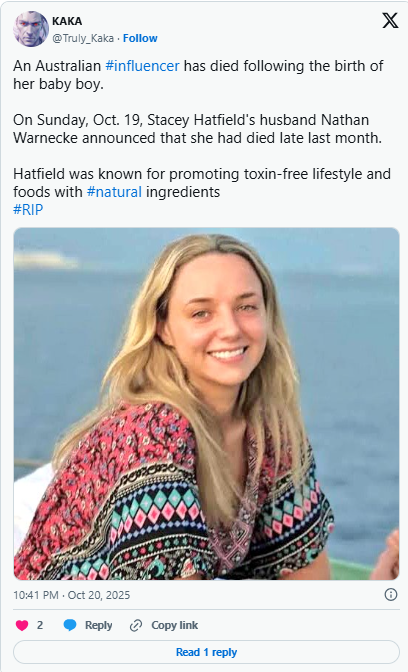
The woman at the centre of the case, influencer Stacey Warnecke, 30, died in September last year from severe complications linked to postpartum hemorrhage, just hours after giving birth to a healthy baby boy named Axel.
She had chosen to deliver at home without licensed medical staff present, a decision commonly referred to as a “free birth.”
During the inquest, the court heard that Emily Lal—who operated under the name The Authentic Birth Keeper—was hired to provide non-medical support during the birth. She was paid approximately A$6,000 (about US$4,200) for her services.
Emergency Call Played in Court
A key moment in the hearing involved a recorded emergency call made by Warnecke’s partner, Nathan, as the situation deteriorated and she struggled to breathe.
When the phone was handed to Lal, she reportedly introduced herself simply as a “friend,” rather than a professional caregiver.
The recording and subsequent testimony became central to questions about why an ambulance was not called sooner.
“I Had No Obligation,” Says Birth Keeper
Under questioning, Lal told the court she did not believe she had any responsibility to intervene medically or override the wishes of the mother.
She explained her role as purely supportive, not clinical.
“If she wanted support, I would call an ambulance if that’s what she wanted,” she said. “If she said no, then that’s the answer.”
When asked whether she had a duty to seek help once Warnecke became unable to make decisions, Lal responded: “I don’t think I have an obligation.”
She added that responsibility lay with the family present, suggesting that a husband or relatives could have contacted emergency services if they chose to do so.
Not a Medical Professional, She Tells Court
Lal repeatedly emphasized that she was not medically trained and did not consider herself responsible for assessing emergencies.
She described her work as “woman-to-woman support,” comparing it to the role of a friend or “big sister.”
According to her testimony, she did not check vital signs, measure blood loss, or intervene in clinical decisions.
“I’m not there to make a birth safer,” she told the court.
The Rise of “Free Birth” Practices
The court also heard context around the growing popularity of so-called “free births,” where women choose to deliver at home without doctors, midwives, or licensed medical supervision.
Supporters of the practice often cite autonomy, privacy, and a desire to avoid medical intervention.
However, experts have repeatedly warned that removing medical oversight during childbirth can significantly increase risks in emergencies such as hemorrhage.
Debate Over Responsibility and Duty of Care
Counsel assisting the coroner, Rachel Ellyard, raised concerns about whether charging thousands of dollars for birth support created an implied responsibility to act in emergencies.
She suggested that mothers may reasonably rely on someone in Lal’s position for guidance during critical moments.
Lal rejected that interpretation, insisting she only provided emotional presence and support.
She maintained that she did not view clients as depending on her for medical decision-making.
Medical Emergency and Hospital Response
The inquest heard that paramedics were called approximately ten minutes after emergency services were finally contacted.
When they arrived, Warnecke was found on the floor, gasping for air and showing signs of severe distress.
She was rushed to Frankston Hospital, where doctors reportedly used all available supplies of her blood type in an attempt to save her life.
Despite their efforts, she died shortly afterward.
Disputed Timeline of Ambulance Call
Lal told the court she had asked Warnecke three times whether she wanted an ambulance and only placed the call once the mother agreed while already in critical condition.
“I don’t know how many times I need to reiterate this,” she said during testimony. “There was no way I was going to call an ambulance against her wishes.”
This statement has become a focal point of the investigation into whether earlier intervention could have changed the outcome.
Privacy, Records, and Evidence Concerns
The court also heard that Lal no longer had text messages exchanged with the family, claiming she had changed phones.
Additionally, she admitted disposing of a blood-stained carpet from the birth, saying she believed that was what Warnecke would have wanted.
These details have raised further questions during the inquest regarding documentation and accountability.
Previous Controversies
Lal had previously gained a significant online following, charging thousands of dollars for her services and increasing her fees over time.
She was also linked to another free birth case in which a baby died, although she denied any direct involvement beyond renting equipment such as a birth pool.
“It was a birth that had absolutely nothing to do with me,” she told the court, criticizing media coverage she felt unfairly associated her with that tragedy.
Ongoing Inquest
The coroner’s investigation into Warnecke’s death is still ongoing, with further findings expected as testimony continues.
The case has sparked widespread discussion about the boundaries between emotional birth support, medical responsibility, and the legal expectations placed on unregistered practitioners.
A Case Raising Difficult Questions
Beyond the courtroom, the case has touched a deeper societal debate: how far personal choice in childbirth should extend when emergencies arise.
It also raises questions about regulation, informed consent, and the role of non-medical birth supporters in high-risk situations.
As the inquest continues, the focus remains on understanding what happened in those critical final moments—and whether the tragedy could have been prevented.