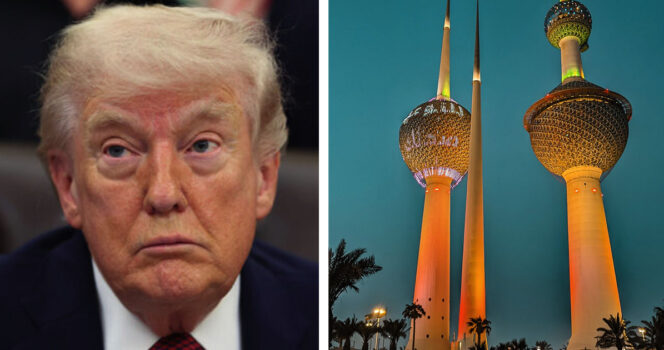
The conflict between Iran and the United States intensified dramatically early Sunday after Iran launched missile and drone attacks targeting Bahrain and Kuwait, marking one of the most significant escalations in the region in recent weeks.
Both Gulf nations confirmed that they came under attack during the early morning hours, triggering air defense responses and raising fresh concerns about the possibility of a wider regional conflict.
Air Defenses Activated
Kuwait announced that its military intercepted two ballistic missiles aimed at its territory, while Bahraini authorities reported that an Iranian drone struck a residential building, sending smoke into the air and prompting emergency crews to respond.
Although officials have not released a complete assessment of the damage or possible casualties, the attacks have heightened security throughout the Gulf region.
Iran’s Islamic Revolutionary Guard Corps later acknowledged responsibility for the operation, stating that U.S. military installations in Bahrain and Kuwait were among its intended targets, including the headquarters of the U.S. Navy’s Fifth Fleet in Bahrain.
Strait of Hormuz at the Center of the Dispute
The latest military exchanges are closely tied to growing tensions surrounding the strategically important Strait of Hormuz, one of the world’s busiest oil shipping routes.
Iran has insisted that commercial vessels use navigation routes closer to its coastline, while many international shipping companies have continued using alternative passages.
The dispute intensified after Iran allegedly attacked a Singapore-flagged cargo vessel last week. The United States responded with strikes against Iranian military infrastructure, prompting retaliatory attacks from Tehran. Since then, both sides have exchanged military action, placing a fragile diplomatic process under increasing pressure.
Trump Issues Stark Warning
Following the attacks, President Donald Trump responded with a strongly worded statement on Truth Social, warning that the United States could dramatically expand its military response if hostilities continue.
“There may come a point when we are no longer able to be reasonable, and will be forced to militarily complete the job,” Trump wrote.
He added that if such action became necessary, “the Islamic Republic of Iran will no longer exist.”
The statement underscores the increasingly confrontational rhetoric emerging from both governments as diplomatic efforts struggle to contain the crisis.
Iran Defends Its Position
Iranian officials have maintained that the country has the right to control activity in the Strait of Hormuz, arguing that outside military involvement has only increased instability.
Iran’s foreign minister said Tehran alone controls the strategic waterway and warned that continued foreign interference would worsen regional tensions rather than resolve them.
Peace Talks Face New Challenges
Despite the latest exchange of attacks, diplomatic negotiations have not completely collapsed.
Officials from both countries continue to pursue talks aimed at reducing tensions, although progress has reportedly been slow. Discussions are expected to resume in the coming days as negotiators attempt to prevent the conflict from expanding further.
Analysts caution that each new military exchange makes a lasting agreement more difficult to achieve, while increasing concerns about global energy markets and regional security.
Regional and Global Concerns
The Strait of Hormuz remains one of the world’s most critical maritime chokepoints, with a significant share of global oil exports passing through the narrow waterway each day.
Any prolonged disruption could have far-reaching consequences for international trade, fuel prices, and regional stability.
With military activity continuing and diplomatic negotiations still underway, governments around the world are closely monitoring developments in hopes of preventing a broader conflict that could involve additional countries across the Middle East.