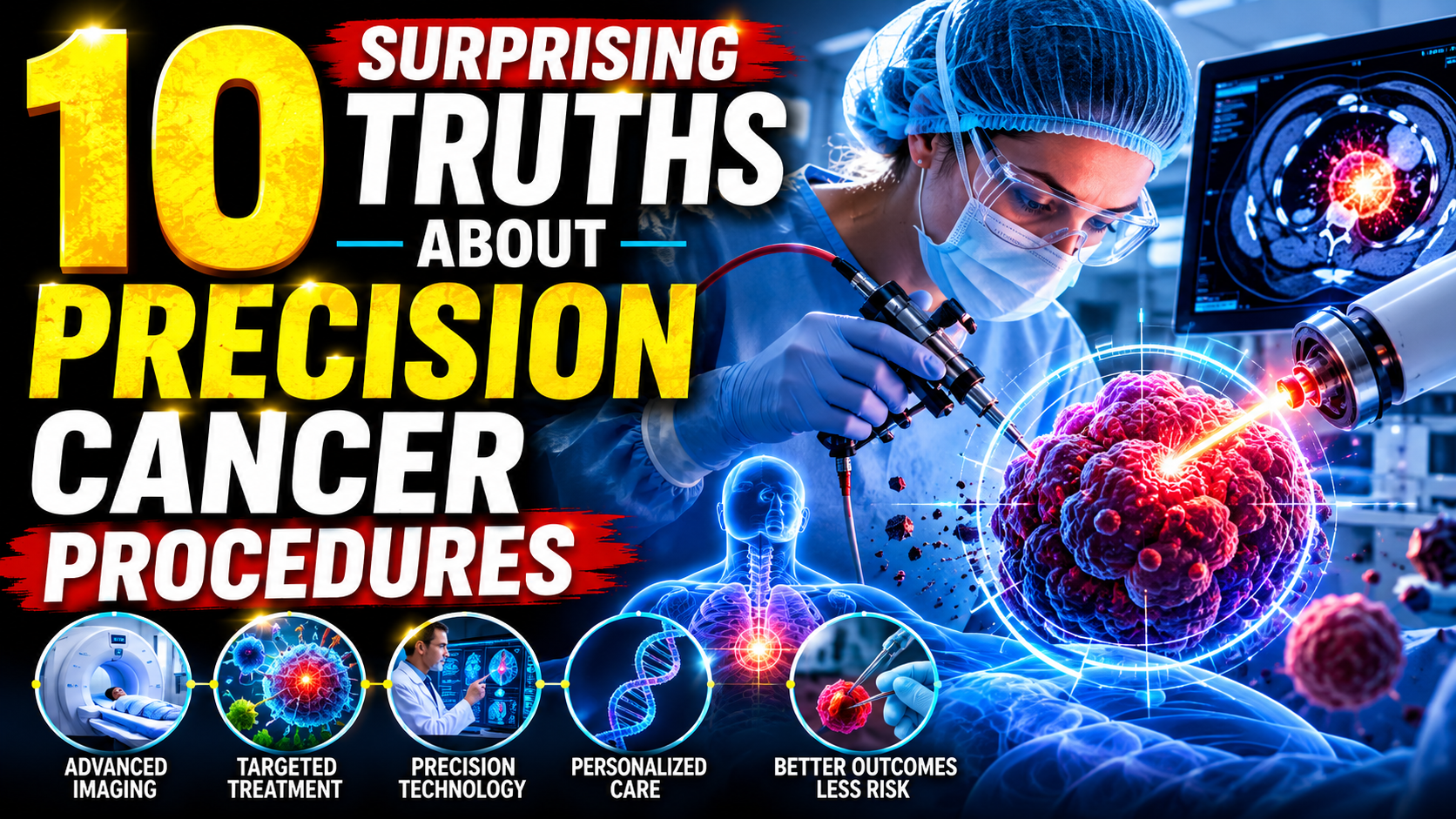
Cancer treatment has changed dramatically over the past few decades. In the past, doctors often relied on broad treatment approaches designed to attack cancer wherever it appeared in the body. While these methods have helped millions of patients, advances in technology and medical research have opened the door to something more targeted: precision cancer procedures.
Today, researchers and healthcare professionals are increasingly focused on treatments that can identify, monitor, and target cancer with greater accuracy than ever before. These innovations aim to improve outcomes while reducing unnecessary effects on healthy tissues.
From advanced imaging systems and targeted therapies to personalized medicine and minimally invasive techniques, precision oncology is becoming one of the most exciting areas in modern healthcare.
Yet despite growing public interest, many people still misunderstand what precision cancer procedures actually involve.
Here are ten surprising truths about these rapidly evolving medical approaches and why they are attracting attention from scientists around the world.
1. Precision Cancer Treatment Is About Accuracy, Not Just Technology
When people hear the word “precision,” they often imagine futuristic machines or cutting-edge equipment.
While advanced technology certainly plays a role, precision oncology is ultimately about making more informed treatment decisions.
Doctors and researchers use detailed information about a patient’s cancer to guide treatment strategies. This may include genetic data, imaging results, molecular characteristics, and other biological markers.
The goal is simple: understand the disease as accurately as possible and use that knowledge to guide care.
In many cases, precision comes from information rather than machinery alone.
2. No Two Cancers Are Exactly the Same
One of the biggest discoveries in oncology is that cancers can differ significantly from one patient to another.
Even tumors that originate in the same organ may behave very differently.
For example, two patients diagnosed with the same type of cancer may have tumors driven by completely different genetic changes.
These differences can influence:
- Growth patterns
- Treatment response
- Disease progression
- Risk factors
Understanding these distinctions helps researchers develop more individualized approaches to care.
This realization has transformed the way scientists think about cancer treatment.
3. Imaging Technology Has Become Remarkably Sophisticated
Medical imaging has evolved far beyond simple scans.
Modern imaging systems can provide detailed views of tumor location, size, structure, and behavior.
Advanced imaging technologies help physicians:
- Locate tumors precisely
- Monitor treatment response
- Guide procedures
- Track disease progression
These tools improve decision-making and allow clinicians to gather valuable information without invasive interventions.
Many precision procedures would not be possible without these imaging advances.
4. Personalized Medicine Is Reshaping Oncology
Personalized medicine has become one of the most influential concepts in cancer research.
Rather than applying identical treatments to every patient, researchers increasingly examine individual biological differences.
Factors that may influence treatment decisions include:
- Genetic variations
- Molecular markers
- Tumor characteristics
- Immune system activity
- Overall health status
This approach recognizes that each patient presents a unique clinical picture.
As scientific understanding grows, personalization is becoming a central part of modern oncology.
5. Some Procedures Can Be Performed With Minimal Invasion
Historically, many cancer treatments involved extensive surgical procedures.
Today, certain precision techniques allow doctors to target specific areas while minimizing disruption to surrounding tissues.
Researchers continue studying approaches that use:
- Advanced imaging guidance
- Focused energy
- Specialized probes
- Targeted delivery systems
These methods may reduce recovery time and improve procedural accuracy in appropriate situations.
While not suitable for every case, minimally invasive options continue expanding as technology advances.
6. Genetics Plays a Bigger Role Than Most People Realize
One of the most important developments in modern oncology is the ability to analyze cancer at the genetic level.
Scientists can now identify specific mutations and molecular changes that influence how tumors develop and behave.
Genetic information can help researchers:
- Understand disease mechanisms
- Identify treatment targets
- Predict responses
- Guide future research
The rapid growth of genetic sequencing technologies has accelerated this area dramatically.
As costs decrease and accessibility improves, genetics continues to play an increasingly important role in precision oncology.
7. Artificial Intelligence Is Becoming a Valuable Research Tool
Artificial intelligence is beginning to influence many aspects of healthcare, including cancer research.
AI systems can analyze enormous amounts of data and identify patterns that might be difficult for humans to detect.
Researchers are using AI to assist with:
- Medical imaging analysis
- Treatment planning
- Data interpretation
- Research discovery
While AI does not replace physicians, it serves as a powerful tool that may improve efficiency and support decision-making.
Many experts believe artificial intelligence will play an even larger role in future oncology innovations.
8. Precision Procedures Focus on Protecting Healthy Tissue
One major objective of precision medicine is reducing unnecessary effects on healthy parts of the body.
Traditional treatments sometimes affect both cancerous and healthy cells because distinguishing between them can be challenging.
Modern precision approaches aim to improve targeting accuracy.
Researchers continue developing methods that help clinicians identify cancerous tissue more precisely while preserving surrounding structures whenever possible.
This focus on accuracy has become a major driver of innovation throughout oncology.
9. Research Is Moving Toward Real-Time Monitoring
Another fascinating development involves the ability to monitor disease activity more closely than ever before.
Researchers are studying technologies that may provide real-time insights into treatment responses and biological changes.
These tools could help clinicians:
- Track progress more effectively
- Adjust treatment plans
- Identify emerging challenges
- Improve individualized care
Real-time monitoring represents an important step toward more responsive and adaptive healthcare strategies.
10. The Future of Oncology May Be More Individualized Than Ever
Perhaps the most surprising truth is how personalized cancer care may become in the future.
Researchers increasingly envision treatment strategies based on a combination of:
- Genetic information
- Molecular analysis
- Advanced imaging
- Immune system profiling
- Lifestyle considerations
Rather than categorizing patients into broad groups, future oncology may focus on creating highly individualized treatment plans.
This shift reflects one of the most important transformations occurring in medicine today.
Why Precision Oncology Matters
The growing interest in precision procedures stems from their potential to improve both understanding and treatment of cancer.
Traditional approaches remain valuable and continue helping patients worldwide.
However, precision oncology offers additional opportunities to:
- Improve targeting
- Enhance personalization
- Reduce unnecessary interventions
- Increase diagnostic accuracy
- Expand treatment options
Researchers see these innovations as tools that complement existing medical practices rather than replace them entirely.
Common Myths About Precision Cancer Procedures
Despite increasing awareness, several misconceptions remain common.
Myth 1: Precision Means Perfect
No medical procedure is flawless.
Precision procedures aim to improve accuracy, but challenges and uncertainties still exist.
Myth 2: Every Patient Receives a Completely Unique Treatment
While personalization is growing, many patients still receive established treatments that have proven effective through research.
Myth 3: Newer Automatically Means Better
Every treatment must be evaluated carefully through clinical studies.
Innovation is important, but evidence remains essential.
Myth 4: Technology Alone Solves Problems
Advanced equipment is valuable, but successful treatment depends on skilled healthcare professionals, research evidence, and individualized decision-making.
The Role of Clinical Trials
Clinical research remains the foundation of oncology progress.
Before new procedures become widely adopted, researchers evaluate them through carefully designed studies.
Clinical trials help answer important questions about:
- Safety
- Effectiveness
- Long-term outcomes
- Patient experience
- Treatment comparisons
Without clinical research, precision medicine would not continue advancing.
These studies play a crucial role in transforming promising ideas into practical healthcare solutions.
Emerging Areas of Research
Scientists continue exploring exciting developments that may influence future cancer care.
Current areas of investigation include:
- Personalized vaccines
- Immune-based therapies
- Molecular imaging
- Liquid biopsies
- AI-assisted diagnostics
- Regenerative technologies
- Advanced genomic analysis
Each of these fields contributes valuable insights that help shape the future of oncology.
Looking Ahead
The next decade is expected to bring even greater advances in precision medicine.
As technology improves and researchers gain deeper understanding of cancer biology, treatment strategies may become increasingly targeted and individualized.
Many experts believe future progress will come from combining multiple disciplines, including genetics, artificial intelligence, imaging science, immunology, and molecular biology.
This integrated approach may provide new opportunities to improve diagnosis, treatment planning, and long-term care.
Final Thoughts
Precision cancer procedures represent one of the most significant shifts in modern oncology. By combining advanced technology, genetic insights, sophisticated imaging, and personalized treatment strategies, researchers are developing approaches that aim to understand cancer more accurately than ever before.
Although many innovations remain under study, the overall direction is clear: cancer care is becoming increasingly focused on the individual patient rather than broad disease categories. This evolution reflects decades of scientific progress and continued collaboration among researchers, clinicians, engineers, and healthcare professionals.
As precision oncology continues to advance, it offers an encouraging glimpse into a future where treatments are guided by deeper biological understanding, improved accuracy, and a commitment to delivering more personalized care.







