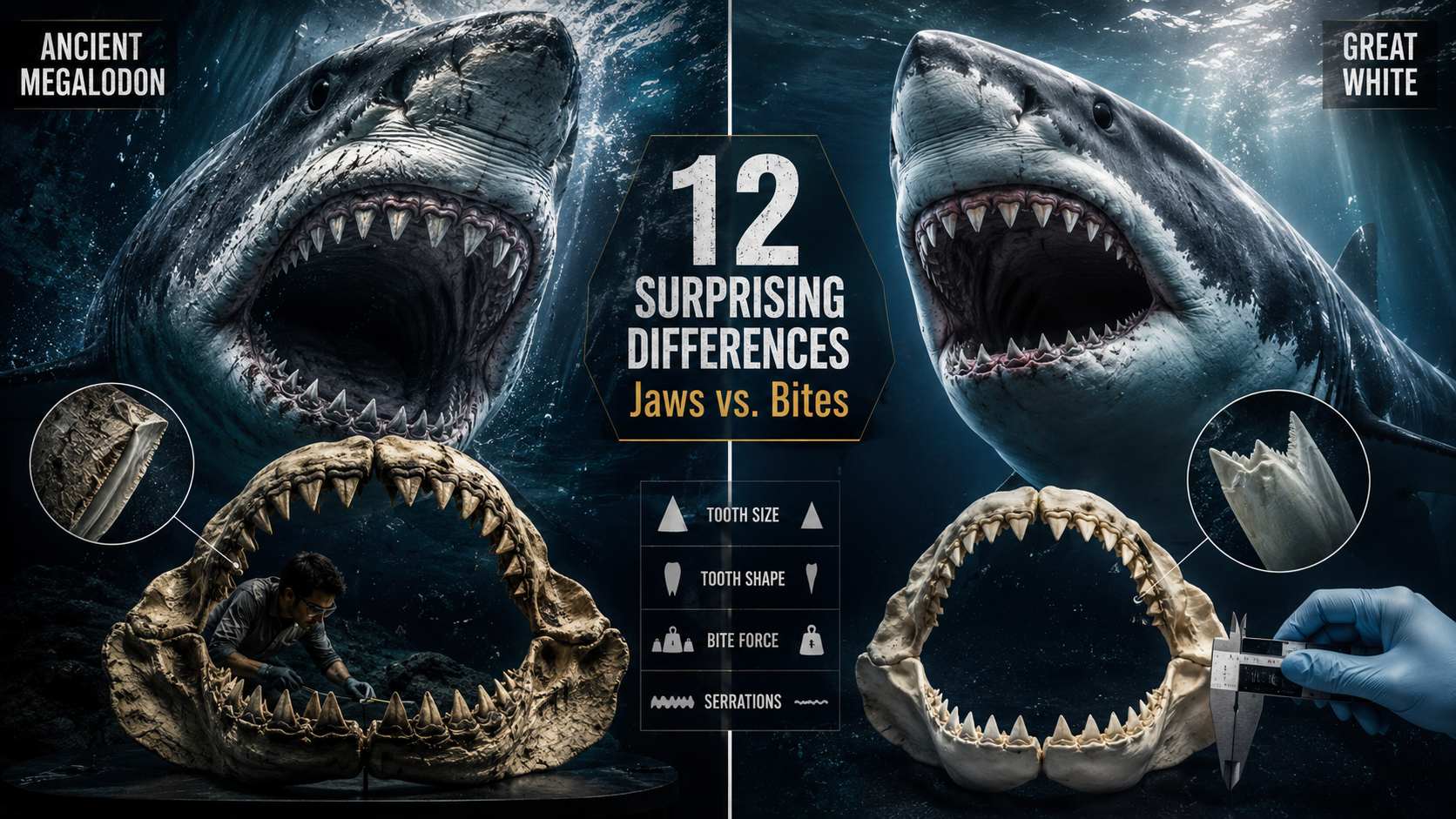
Few comparisons in natural history spark as much curiosity as the ancient Megalodon versus the modern great white shark. The Megalodon, which lived millions of years ago, is often imagined as a gigantic version of today’s apex predator. While both creatures share similarities in their role as ocean hunters, their jaws and bite mechanics reveal some truly striking differences.
Fossil evidence, modern shark biology, and computer modeling have helped scientists better understand how these two predators compare. What emerges is not just a difference in size, but in structure, feeding strategy, and evolutionary adaptation.
Here are 12 surprising differences between ancient Megalodon jaws and great white bites.
1. Megalodon Jaws Were Far Larger in Absolute Size
The most obvious difference is scale.
Megalodon jaws could span over two meters wide, large enough to swallow a modern great white shark almost whole.
In contrast, great white sharks have significantly smaller jaws, adapted for more precise biting rather than massive engulfment.
The size difference alone changes how each predator interacted with its environment.
2. Tooth Size Reveals a Massive Evolutionary Gap
Megalodon teeth could exceed 18 centimeters in length—nearly three times larger than those of a great white shark.
Great white teeth, while still formidable, are designed for slicing rather than sheer crushing power.
This difference reflects distinct hunting and feeding strategies between the two species.
3. Bite Force Estimates Differ Dramatically
Scientific models suggest Megalodon had one of the most powerful bite forces in history, far exceeding that of any modern shark.
Its jaws were built to crush bone and immobilize large prey in a single strike.
Great whites also have strong bite force, but their strategy relies more on repeated bites and tearing rather than one overwhelming impact.
4. Jaw Shape Reflects Different Feeding Styles
Megalodon jaws were broader and more robust, designed for capturing large marine mammals such as whales.
Great white jaws are more streamlined, supporting quick attacks on agile prey like seals and fish.
This difference highlights how each predator adapted to its available food sources.
5. Megalodon Relied on Massive Prey Capture
Evidence suggests Megalodon targeted extremely large prey, including ancient whales.
Its jaw structure allowed it to disable prey quickly through devastating bites.
Great whites, on the other hand, often use a “hit-and-retreat” strategy, biting and waiting for prey to weaken.
These contrasting methods reflect different ecological roles.
6. Tooth Arrangement Shows Functional Variation
Megalodon teeth were arranged in multiple rows designed for continuous replacement and heavy-duty biting.
Great white sharks also have multiple rows, but their teeth are more specialized for cutting rather than crushing.
The arrangement reflects differences in feeding pressure and diet specialization.
7. Jaw Flexibility Differs Between Species
Great white sharks have highly flexible jaws that allow them to extend forward when striking prey.
This mobility helps them catch fast-moving targets with precision.
Megalodon jaws, while powerful, were likely less flexible due to their massive size and structural demands.
This trade-off favored strength over agility.
8. Skull Structure Supports Different Hunting Mechanics
The Megalodon’s skull was heavily reinforced to support extreme bite forces.
Great white sharks have lighter skull structures optimized for speed and maneuverability.
This difference highlights two very different evolutionary strategies for survival in marine environments.
9. Bite Marks on Fossils Tell Different Stories
Fossilized whale bones show deep, crushing bite marks attributed to Megalodon.
These marks suggest overwhelming force and rapid immobilization.
Great white bite marks, in comparison, tend to show slicing patterns and repeated attack points.
This distinction helps paleontologists reconstruct ancient predator behavior.
10. Energy Consumption Influenced Jaw Design
Megalodon’s massive size required enormous energy intake, meaning its jaw was optimized for high-calorie, large prey.
Great whites balance energy needs by targeting smaller but more frequent meals.
Their jaw structures reflect these different survival strategies.
11. Evolution Favored Speed in Modern Sharks
Over time, evolutionary pressures favored speed, agility, and efficiency in modern sharks like the great white.
This resulted in more refined jaw mechanics and faster attack cycles.
Megalodon, by contrast, evolved in a different ocean ecosystem where sheer size was a dominant advantage.
12. Extinction Shaped the Great White’s Design
The disappearance of Megalodon millions of years ago likely reshaped marine predator evolution.
Without such a dominant giant, smaller apex predators like the great white adapted to fill ecological gaps.
Its jaw structure represents a more versatile and sustainable hunting system in modern oceans.
Why This Comparison Fascinates Scientists and the Public
The comparison between Megalodon jaws and great white bites continues to fascinate because it connects imagination with science.
It allows researchers to explore evolutionary biology while also satisfying public curiosity about ancient ocean giants.
These differences also highlight how ecosystems shape the physical traits of apex predators over time.
Final Thoughts
While Megalodon and great white sharks share a distant evolutionary connection, their jaws reveal two very different approaches to survival in the ocean.
One was built for overwhelming power and massive prey, while the other evolved for agility, precision, and adaptability.
Together, they offer a fascinating glimpse into how nature designs predators for different eras and environments.
In the end, their jaws are not just tools for feeding—they are records of evolution written in bone and tooth.







