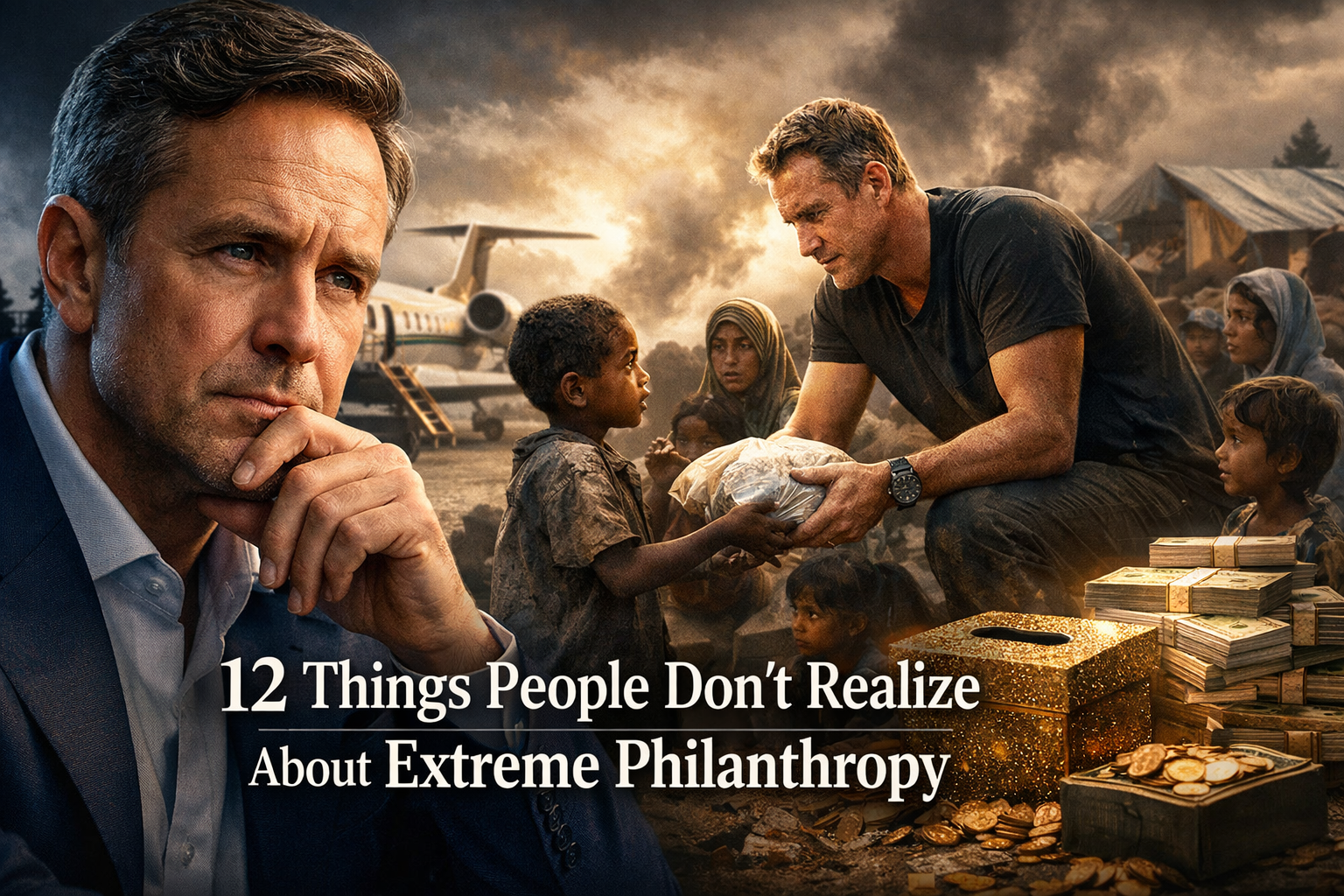
When people hear about someone donating millions—or even billions—of dollars to charitable causes, the reaction is often a mix of admiration, curiosity, and disbelief. Headlines about massive donations can make extreme philanthropy seem straightforward: wealthy individuals give away large sums of money, and important problems get solved.
The reality is far more complex.
Extreme philanthropy—the practice of committing extraordinary amounts of wealth, time, or resources to charitable causes—operates on a scale that most people rarely encounter. It involves difficult decisions, long-term planning, ethical considerations, and challenges that often remain invisible to the public.
While generous giving is widely celebrated, many misconceptions surround what large-scale philanthropy actually looks like and how it affects society.
Understanding these realities provides a more balanced perspective on the opportunities and challenges associated with extraordinary charitable efforts.
Here are 12 things many people don’t realize about extreme philanthropy.
1. It’s About More Than Writing Large Checks
One of the biggest misconceptions is that extreme philanthropy simply involves transferring money from one account to another.
In reality, large-scale giving often requires extensive planning and strategy.
Major philanthropists frequently spend years researching social issues, evaluating organizations, consulting experts, and determining how resources can create meaningful impact.
A billion-dollar donation may attract headlines, but behind that gift often lies months or even years of preparation.
Effective philanthropy requires thoughtful decision-making because large resources can create both positive opportunities and unintended consequences.
The challenge is not merely giving money away—it’s ensuring the money achieves its intended purpose.
2. Solving Big Problems Is Usually More Difficult Than It Appears
Many social challenges are deeply interconnected.
Issues such as poverty, education, healthcare access, environmental sustainability, and housing often involve economic, political, cultural, and institutional factors.
As a result, even substantial financial resources cannot instantly solve these problems.
Extreme philanthropists frequently discover that progress requires patience, collaboration, and long-term commitment.
Large donations can accelerate solutions, but they rarely provide immediate answers.
Meaningful change often takes years, decades, or even generations to achieve.
3. The Best Philanthropy Focuses on Systems, Not Symptoms
Providing immediate assistance is important.
However, many large-scale philanthropists increasingly focus on addressing root causes rather than temporary symptoms.
For example, helping people facing hunger is valuable. Investing in agricultural innovation, food distribution systems, or economic development may create longer-lasting impact.
This systems-oriented approach aims to create sustainable change.
Rather than continuously responding to problems, it seeks to reduce the likelihood that those problems will persist in the future.
The most effective philanthropy often operates behind the scenes, improving structures rather than generating visible short-term results.
4. Impact Is Often Difficult to Measure
Businesses can usually evaluate success through revenue, profits, or growth.
Philanthropy operates differently.
How do you accurately measure improved quality of life, stronger communities, better educational outcomes, or increased opportunity?
Many charitable initiatives produce benefits that unfold gradually and cannot be captured through simple metrics.
As a result, philanthropists often face significant challenges when assessing effectiveness.
Determining whether a program truly works requires ongoing research, data collection, and evaluation.
The process is rarely as simple as it appears from the outside.
5. Large Donations Can Attract Criticism
Many people assume generous giving receives universal praise.
In reality, major philanthropic efforts often face scrutiny from multiple directions.
Critics may question priorities, motivations, methods, or outcomes. Others may debate whether private individuals should wield significant influence over public issues.
These discussions reflect broader questions about wealth, power, accountability, and social responsibility.
Extreme philanthropists frequently operate under intense public attention, with their decisions examined by supporters and critics alike.
Generosity does not automatically eliminate controversy.
6. Philanthropy Often Involves Significant Personal Sacrifice
Public attention tends to focus on the financial value of major donations.
What receives less attention is the personal commitment that often accompanies large-scale giving.
Many philanthropists devote enormous amounts of time, energy, expertise, and emotional investment to the causes they support.
They attend meetings, evaluate projects, build partnerships, and engage directly with complex social challenges.
In some cases, individuals commit substantial portions of their wealth that could otherwise be used for personal or family purposes.
Extreme philanthropy is often far more demanding than people realize.
7. Collaboration Usually Matters More Than Individual Effort
Popular narratives often portray philanthropists as lone visionaries changing the world through personal generosity.
The reality is typically much more collaborative.
Large-scale impact usually requires partnerships among nonprofit organizations, governments, researchers, businesses, community leaders, and local stakeholders.
No single donor, regardless of wealth, can solve complex global challenges alone.
Successful philanthropy often depends on building networks and supporting collective efforts.
The most meaningful progress usually emerges from cooperation rather than individual action.
8. Not Every Well-Intentioned Initiative Succeeds
Good intentions do not guarantee positive outcomes.
Some philanthropic projects fail to achieve their goals despite substantial resources and sincere efforts.
Programs may encounter unexpected obstacles, cultural misunderstandings, implementation challenges, or changing circumstances.
This reality highlights an important lesson:
Philanthropy involves experimentation and learning.
Many successful initiatives emerge only after organizations refine their approaches through experience.
Failure is sometimes part of the process of discovering what works.
9. Extreme Giving Can Influence Future Generations
One of the most overlooked aspects of philanthropy is its long-term influence.
Large charitable commitments often affect not only current beneficiaries but also future generations.
Investments in education, public health, scientific research, environmental protection, and community development may continue producing benefits decades after the original donation.
This long-term perspective distinguishes many large-scale philanthropic efforts.
Rather than focusing exclusively on immediate outcomes, philanthropists often seek lasting change that extends beyond their own lifetimes.
10. Generosity Can Be Strategic Without Being Selfish
Some people mistakenly believe that strategic philanthropy is less genuine than emotional giving.
In reality, thoughtful planning can increase impact.
Strategic philanthropists carefully evaluate where resources can create the greatest benefit. They consider effectiveness, scalability, sustainability, and measurable outcomes.
This approach does not necessarily reduce compassion.
Instead, it reflects a desire to maximize positive results.
Effective philanthropy often combines empathy with careful analysis.
Both elements play important roles.
11. The Most Important Contributions Aren’t Always Financial
Money is powerful, but it is not the only resource capable of creating change.
Many philanthropists contribute expertise, leadership, networks, mentorship, advocacy, and influence alongside financial support.
These non-financial contributions can sometimes prove equally valuable.
A connection between organizations, a policy recommendation, or guidance from experienced leaders may create opportunities that money alone cannot provide.
Extreme philanthropy frequently involves far more than financial generosity.
12. Legacy Is Often the Real Goal
While media coverage tends to emphasize donation amounts, many philanthropists are motivated by a broader vision.
They want their resources to create lasting improvements that continue long after they are gone.
For some, this means supporting medical research. For others, it involves education, environmental protection, poverty reduction, or community development.
The common theme is legacy.
Rather than focusing solely on personal recognition, many philanthropists seek to leave behind systems, institutions, and opportunities that improve lives for future generations.
Their goal is not simply to give—it is to create enduring impact.
Why Extreme Philanthropy Matters
Large-scale philanthropy plays a significant role in addressing challenges that governments, businesses, and communities may struggle to solve independently.
Philanthropic funding has contributed to breakthroughs in medicine, educational access, scientific research, disaster relief, environmental conservation, and countless other areas.
While philanthropy is not a substitute for public policy or economic development, it can provide flexibility and innovation that other institutions sometimes lack.
Because philanthropic organizations are often willing to fund experimental ideas and long-term initiatives, they can help accelerate progress in important fields.
Their influence extends across sectors and continents.
The Ongoing Debate Around Philanthropy
It is important to recognize that extreme philanthropy remains a subject of ongoing discussion.
Supporters argue that large donations create opportunities for innovation and positive change. Critics raise questions about accountability, influence, and the concentration of wealth.
Both perspectives contribute to a valuable conversation.
Understanding philanthropy requires moving beyond simplistic assumptions.
Large-scale giving is neither a perfect solution nor an inherently flawed practice.
Like many powerful tools, its effectiveness depends on how it is applied.
Thoughtful analysis is often more useful than unquestioning praise or criticism.
What Everyday People Can Learn From Philanthropy
Most people will never donate billions of dollars.
However, the principles behind effective philanthropy remain relevant.
These include:
- Thinking long term.
- Addressing root causes rather than symptoms.
- Measuring results whenever possible.
- Collaborating with others.
- Investing in education and opportunity.
- Supporting sustainable solutions.
- Using resources intentionally.
- Recognizing that small contributions can create meaningful change.
The scale may differ, but the mindset can apply to individuals, businesses, and communities alike.
Final Thoughts
Extreme philanthropy is often viewed through the lens of extraordinary wealth, but its most important lessons have little to do with money alone.
Behind every major donation lies a complex process involving strategy, collaboration, experimentation, and long-term thinking. Large-scale giving reveals both the possibilities and limitations of using resources to improve society.
It shows that solving significant problems requires more than generosity—it requires patience, knowledge, partnership, and a willingness to learn.
Perhaps the biggest misconception about extreme philanthropy is that it is simply about giving away money. In reality, it is often about building systems, creating opportunities, and investing in a future that may not fully materialize for years to come.
And that long-term commitment to positive change is what makes extraordinary philanthropy so fascinating—and so influential.







