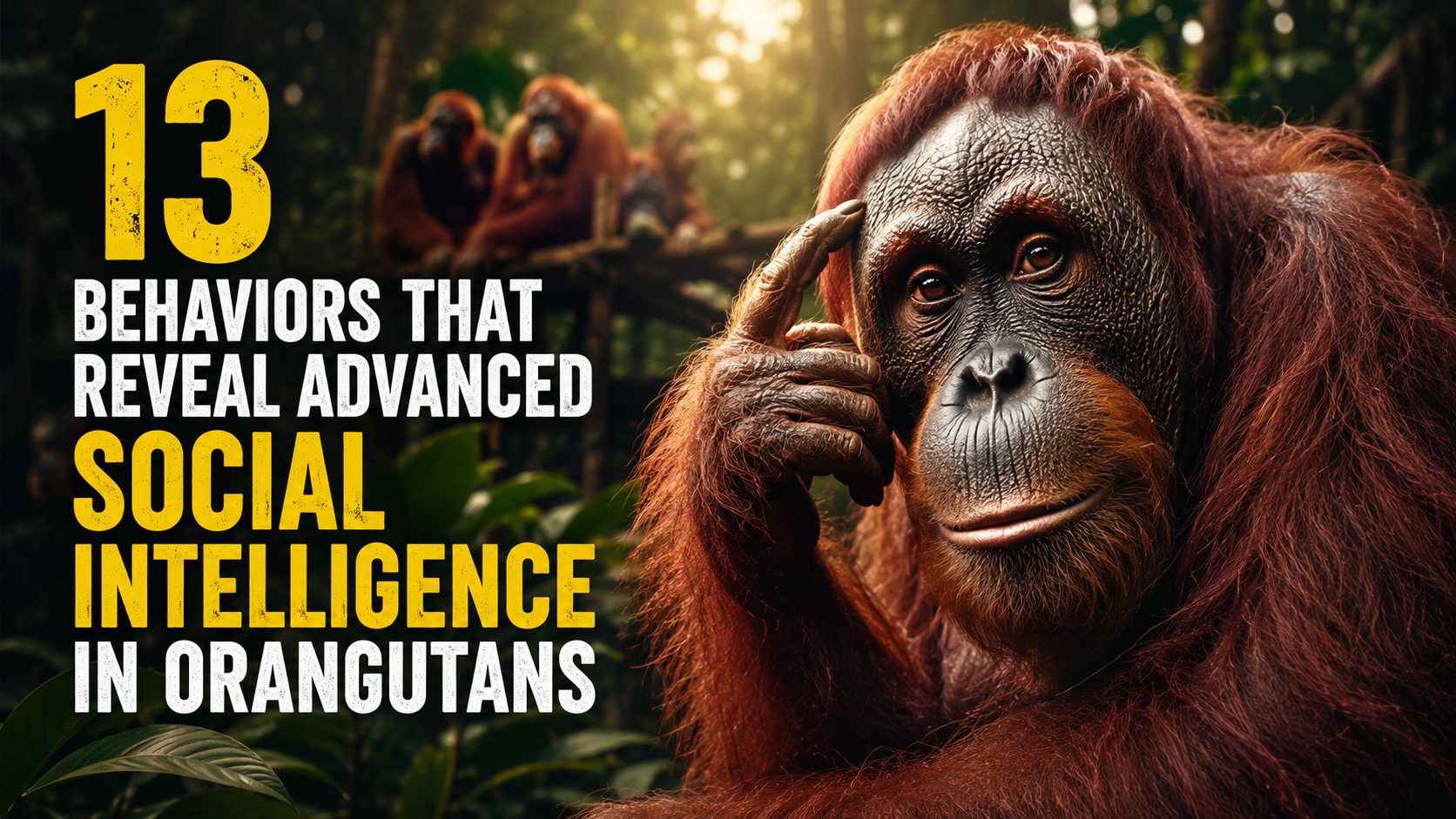
Among the great apes, orangutans are often portrayed as quiet and solitary compared to chimpanzees or gorillas. While it is true that they spend much of their time alone, this image can be misleading. Decades of research have revealed that orangutans possess a remarkable level of social intelligence that rivals some of the most sophisticated minds in the animal kingdom.
Native to the rainforests of the islands of Borneo and Sumatra, orangutans face complex environmental and social challenges that require flexible thinking, communication skills, and long-term learning. Their interactions may be less frequent than those of some other primates, but they are often rich in meaning and reveal impressive cognitive abilities.
From teaching their young to navigating intricate social relationships, orangutans display behaviors that suggest a deep understanding of the world around them. Here are 13 fascinating behaviors that reveal just how socially intelligent these great apes really are.
1. They Learn by Carefully Observing Others
One of the strongest indicators of social intelligence is the ability to learn from observation.
Young orangutans spend years watching their mothers perform daily tasks, including finding food, building nests, identifying safe plants, and avoiding dangers. Rather than relying solely on instinct, they acquire many skills through observation and imitation.
This capacity for social learning allows knowledge to be passed from one generation to the next, much like cultural traditions in human societies.
2. Mothers Invest Years in Teaching Their Offspring
Orangutans have one of the longest childhoods in the animal kingdom.
A young orangutan may remain closely associated with its mother for seven to nine years or even longer. During this period, the mother provides not only protection and nourishment but also extensive guidance about survival.
The length and complexity of this teaching relationship suggest advanced social and cognitive development. Few animals devote so much time to educating their offspring.
3. They Display Cultural Differences Between Populations
Researchers have discovered that orangutan groups living in different regions often exhibit unique behaviors.
Some populations use specific tools, feeding techniques, or communication methods that are not observed elsewhere. These differences cannot always be explained by environmental factors alone.
Instead, they appear to reflect socially transmitted traditions, a hallmark of culture. The existence of cultural variation is considered one of the strongest signs of advanced intelligence in animals.
4. They Communicate Through Complex Vocalizations
Orangutans use a variety of sounds to communicate information.
These vocalizations can signal danger, express discomfort, maintain contact with others, or communicate social intentions. Adult males are especially known for producing long calls that can travel significant distances through the forest.
These calls may help establish territory, attract females, and inform other orangutans about the caller’s presence.
The ability to use different sounds for different purposes demonstrates sophisticated communication skills.
5. They Use Gestures to Express Intentions
Communication among orangutans extends beyond vocal sounds.
Researchers have documented a wide range of gestures, including reaching, pointing, touching, and body movements that appear to convey specific messages. These gestures are often adjusted depending on the situation and the response of the other individual.
Such flexibility suggests intentional communication rather than simple instinctive behavior.
The use of gestures is considered an important indicator of advanced social cognition.
6. They Understand the Value of Cooperation
Although orangutans are less social than some other primates, they still engage in cooperative behaviors when circumstances require it.
Individuals may tolerate one another while feeding, share information about food sources indirectly, or coordinate activities in ways that reduce conflict.
This ability to balance independence with occasional cooperation demonstrates an understanding of social relationships and mutual benefit.
7. They Build and Maintain Social Relationships
Even animals that spend significant time alone can form meaningful social bonds.
Orangutans often recognize familiar individuals and adjust their behavior accordingly. Relationships between mothers and offspring, siblings, and neighboring individuals can persist over extended periods.
Remembering social partners and modifying behavior based on past interactions requires considerable mental sophistication.
8. They Show Signs of Empathy
Evidence suggests that orangutans may possess a capacity for empathy.
Researchers and caregivers have observed behaviors that appear to reflect concern for others, including comforting gestures, attention to distressed individuals, and protective responses toward vulnerable group members.
While interpreting animal emotions requires caution, these observations indicate a level of social awareness that goes beyond simple self-interest.
Empathy is widely regarded as an important component of social intelligence.
9. They Adapt Communication to Their Audience
One particularly impressive trait is orangutans’ ability to modify communication depending on who is receiving the message.
Studies suggest they may alter gestures, vocalizations, or behavior based on the attentiveness and understanding of another individual.
This flexibility resembles a basic form of audience awareness—a skill that requires recognizing that others possess their own perspectives and levels of knowledge.
10. They Solve Social Problems Strategically
Life in the rainforest often presents social challenges, including competition for food, access to mates, and interactions with neighboring individuals.
Orangutans frequently respond to these situations with remarkable flexibility. Rather than relying on a single strategy, they adjust their behavior depending on circumstances.
This problem-solving ability reflects a sophisticated understanding of social dynamics and consequences.
11. They Demonstrate Exceptional Memory
Social intelligence depends heavily on memory.
Orangutans are known for remembering the locations of fruiting trees, seasonal food sources, travel routes, and social relationships over long periods.
This impressive memory helps them navigate both physical and social environments effectively.
Remembering who individuals are, how they have behaved in the past, and what relationships exist among them contributes significantly to successful social interaction.
12. They Learn New Behaviors Throughout Life
Unlike animals whose behavior remains relatively fixed, orangutans continue learning throughout their lives.
They explore new solutions, experiment with objects, and adapt to changing circumstances. This lifelong learning allows them to respond effectively to environmental and social challenges.
The ability to acquire and refine knowledge over time is a key characteristic of advanced intelligence.
13. They Pass Knowledge Across Generations
Perhaps the most remarkable sign of social intelligence is the transmission of knowledge from one generation to the next.
Young orangutans inherit far more than genes from their mothers. They also acquire skills, habits, preferences, and survival strategies through observation and interaction.
This transfer of information creates continuity within populations and allows valuable knowledge to persist long after individual animals are gone.
The existence of such learning traditions places orangutans among the most cognitively sophisticated animals on Earth.
Why Orangutan Intelligence Matters
Understanding orangutan intelligence helps scientists gain insight into the evolution of cognition, communication, and social behavior.
As one of humanity’s closest living relatives, orangutans offer valuable clues about how advanced mental abilities may have developed over time. Their behavior demonstrates that complex thinking is not unique to humans and can emerge in different forms across the animal kingdom.
These discoveries also strengthen arguments for protecting orangutans and their habitats.
The Conservation Connection
Unfortunately, orangutans face significant threats from habitat loss, deforestation, and illegal wildlife trade.
As researchers learn more about their intelligence and social complexity, the importance of conservation becomes even clearer. Protecting orangutans means preserving not only a species but also unique cultures, learning traditions, and social systems that have developed over countless generations.
Every orangutan population represents a wealth of knowledge that cannot be replaced once lost.
Final Thoughts
Orangutans may not live in large groups like some other primates, but their behavior reveals a remarkable level of social intelligence. Through teaching, communication, empathy, cultural learning, and strategic problem-solving, they demonstrate cognitive abilities that continue to amaze scientists.
These thirteen behaviors highlight the richness of orangutan social lives and challenge outdated assumptions about what it means to be intelligent. Far from being simple forest dwellers, orangutans are thoughtful, adaptable, and socially aware individuals with complex relationships and traditions.
The more we learn about them, the clearer it becomes that protecting these extraordinary great apes is not only a conservation priority but also an opportunity to preserve one of nature’s most fascinating expressions of intelligence.







