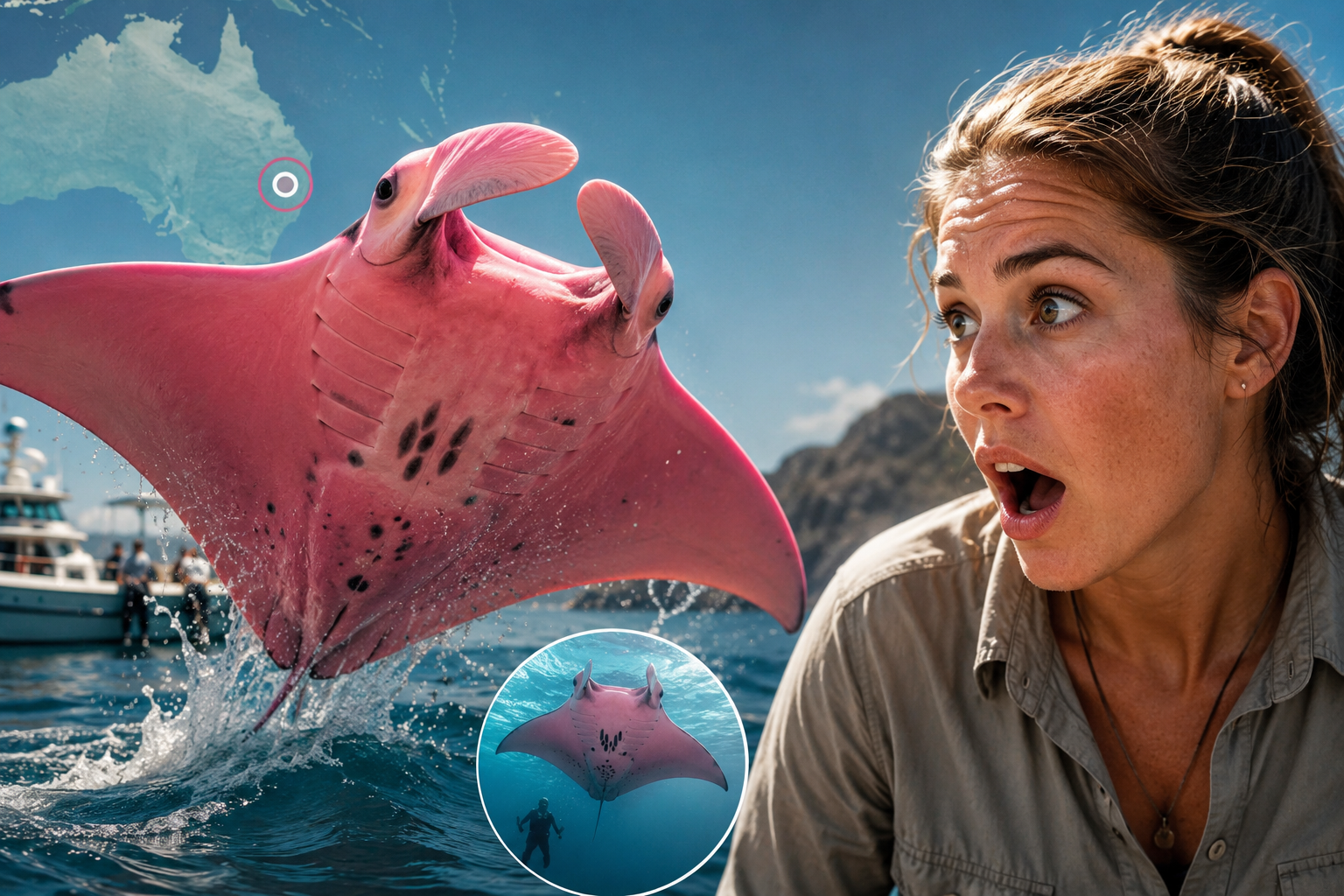
The oceans are filled with extraordinary creatures, but few have captured global attention quite like the rare pink manta ray spotted off the coast of Australia. With its striking rosy coloration and graceful movements, this unusual animal has become one of the most famous manta rays ever documented.
First observed near Australia’s eastern coastline, the pink manta ray quickly sparked curiosity among marine biologists, photographers, divers, and conservationists. Unlike the familiar black, white, and gray patterns seen in most manta rays, this individual stood out immediately due to its remarkable coloration.
Scientists have spent years studying the phenomenon, trying to understand what makes this manta ray so unique. Along the way, researchers have uncovered fascinating insights into manta ray biology, genetics, behavior, and conservation.
Here are 15 fascinating discoveries about the rare pink manta ray near Australia.
1. The Pink Manta Ray Is One of the Rarest Marine Animals Ever Observed
While unusual color variations occur occasionally in nature, a bright pink manta ray is extraordinarily rare.
Researchers have identified only a handful of similarly colored marine animals worldwide. The Australian manta ray’s distinctive appearance makes it one of the most recognizable rays ever recorded.
Its rarity is one reason it immediately attracted international attention when photographs first surfaced.
2. It Was First Spotted Near Australia’s Great Barrier Reef
The famous pink manta ray was discovered in waters associated with Australia’s renowned reef ecosystems.
The sighting occurred during marine observation activities, and photographs quickly spread through scientific and public communities. Divers who encountered the animal were astonished by its vivid coloration.
The discovery highlighted how even well-studied marine environments can still produce surprising findings.
3. Scientists Nicknamed the Ray “Inspector Clouseau”
The manta ray became widely known by the nickname “Inspector Clouseau.”
The playful name was inspired by the famous Pink Panther film series and helped the animal gain worldwide recognition. The nickname made the ray an instant celebrity among marine enthusiasts.
Today, many people recognize the animal by its nickname as readily as by its scientific significance.
4. Its Color Is Not Caused by Diet
When unusual colors appear in wildlife, diet is often considered a possible explanation.
However, scientists studying the pink manta ray found no evidence suggesting that food sources were responsible for its coloration. Unlike flamingos, whose coloration is influenced by pigments in their diet, the manta ray’s pink appearance appears to originate from different biological factors.
This finding helped narrow the search for explanations.
5. The Ray Appears Healthy Despite Its Unusual Appearance
One of the most encouraging discoveries is that the manta ray appears to be thriving.
Researchers have observed normal swimming behavior, feeding patterns, and physical condition. The unusual coloration does not appear to negatively affect the animal’s overall health.
This suggests that whatever causes the pink color is not necessarily harmful to the ray.
The animal continues to serve as an example of the incredible diversity found in nature.
6. Genetics May Play an Important Role
Scientists believe genetics likely contribute to the ray’s unique appearance.
Certain rare genetic variations can influence pigmentation in animals, leading to unusual colors that differ from typical populations. While researchers have not fully identified the exact mechanism, genetic factors remain one of the leading explanations.
The case highlights how small genetic differences can create extraordinary visual effects.
7. Manta Rays Are Among the Largest Rays on Earth
The pink manta ray’s coloration often steals the spotlight, but the species itself is impressive regardless of color.
Manta rays can reach wingspans exceeding 20 feet (6 meters) and are among the largest ray species in the world. Their size, combined with graceful movement, makes them one of the ocean’s most iconic animals.
The pink individual’s unusual appearance simply makes an already remarkable creature even more extraordinary.
8. Manta Rays Possess Remarkable Intelligence
Research suggests manta rays are among the most intelligent fish species.
Scientists have documented advanced problem-solving abilities, social behaviors, and impressive learning capabilities. Their relatively large brains have attracted significant scientific interest.
The pink manta ray therefore represents not only a visual curiosity but also a member of one of the ocean’s most cognitively advanced groups of fishes.
9. The Discovery Increased Public Interest in Marine Conservation
The pink manta ray became an unexpected ambassador for ocean conservation.
Its unique appearance captured media attention worldwide, introducing many people to manta ray biology and conservation issues for the first time. Stories about the animal helped raise awareness about threats facing marine ecosystems.
Sometimes a single remarkable animal can inspire broader interest in protecting entire habitats.
10. Researchers Use Photographs to Track Individual Manta Rays
One fascinating aspect of manta ray research involves photographic identification.
Each manta ray possesses a unique pattern on its underside, functioning much like a fingerprint. Scientists use these markings to identify and monitor individuals over time.
This technique has allowed researchers to track the pink manta ray and learn more about its movements and behavior.
Modern photography has become a powerful tool for marine science.
11. Manta Rays Can Travel Long Distances
Manta rays are highly mobile animals.
They often travel across large ocean areas in search of food, favorable environmental conditions, and breeding opportunities. Tracking studies have revealed surprisingly extensive movements in some populations.
Understanding these migration patterns helps scientists develop more effective conservation strategies.
The pink manta ray contributes valuable information to these efforts whenever it is observed.
12. Color Variations Are More Common Than People Think
Although a bright pink manta ray is exceptionally rare, unusual coloration is not entirely unknown in the animal kingdom.
Scientists have documented cases of albinism, melanism, leucism, and other pigment-related variations in numerous species. These conditions can produce striking appearances that differ dramatically from normal coloration.
The pink manta ray represents one of the most visually spectacular examples ever documented in a large marine animal.
13. The Ray Continues to Fascinate Researchers
Years after its discovery, the pink manta ray remains an important subject of scientific interest.
Researchers continue studying photographs, observations, and biological data in hopes of better understanding the factors responsible for its coloration. Each new sighting offers additional opportunities to gather information.
The mystery surrounding the animal is part of what keeps public fascination alive.
14. Manta Rays Face Significant Conservation Challenges
Despite their beauty and popularity, manta rays face numerous threats.
These include:
- Accidental capture in fishing gear
- Habitat degradation
- Marine pollution
- Climate-related environmental changes
- Human disturbance
Conservation organizations around the world are working to protect manta ray populations and the ecosystems they depend upon.
The pink manta ray has helped draw attention to these important efforts.
15. The Discovery Reminds Us How Much Remains Unknown About the Ocean
Perhaps the most important lesson from the pink manta ray is that the ocean still contains countless mysteries.
Despite advances in marine science, researchers continue making surprising discoveries every year. New species, unusual behaviors, and rare biological variations regularly challenge assumptions about what we know.
The appearance of a bright pink manta ray in a well-studied region serves as a powerful reminder that exploration and scientific curiosity remain as important as ever.
Nature still has many secrets waiting to be revealed.
Why Manta Rays Matter
Manta rays play important roles within marine ecosystems.
As filter feeders, they consume large quantities of plankton and help maintain ecological balance. Their movements can also influence nutrient distribution within ocean environments.
Beyond their ecological importance, manta rays contribute significantly to ecotourism industries in many parts of the world. Divers and wildlife enthusiasts often travel great distances for the chance to observe these gentle giants.
Protecting manta rays therefore benefits both ecosystems and local economies.
What Scientists Still Hope to Learn
Although considerable progress has been made, researchers continue exploring important questions:
- What exact genetic mechanism causes the pink coloration?
- How common are similar pigment variations?
- Does the coloration provide any advantages or disadvantages?
- How long has the trait existed?
- Could other unusually colored manta rays exist undiscovered?
Future research may provide answers to these intriguing questions.
The Importance of Ocean Exploration
Stories like the pink manta ray demonstrate the value of continued marine research.
The ocean covers most of Earth’s surface, yet vast areas remain poorly understood. Every new discovery contributes to scientific knowledge and helps improve conservation efforts.
Unexpected findings often inspire public interest in science and encourage support for protecting marine habitats.
The pink manta ray is a perfect example of how one extraordinary animal can capture the world’s imagination.
Final Thoughts
The rare pink manta ray near Australia stands as one of the most remarkable marine discoveries of recent years. Its unusual coloration, mysterious origins, and apparent good health have fascinated scientists and the public alike.
The 15 discoveries explored here reveal why this animal has become such an important symbol of marine biodiversity and scientific curiosity. From genetics and intelligence to conservation and ocean exploration, the pink manta ray offers valuable lessons about the complexity of life beneath the waves.
As researchers continue studying this extraordinary creature, it serves as a reminder that even in the modern age, the natural world still holds countless surprises. Sometimes, a single splash of color can transform our understanding of an entire ecosystem.







