The story of human evolution is far more complex and surprising than scientists once believed. For many years, researchers pictured ancient human species as separate groups that rarely interacted. But one extraordinary discovery changed that view dramatically.
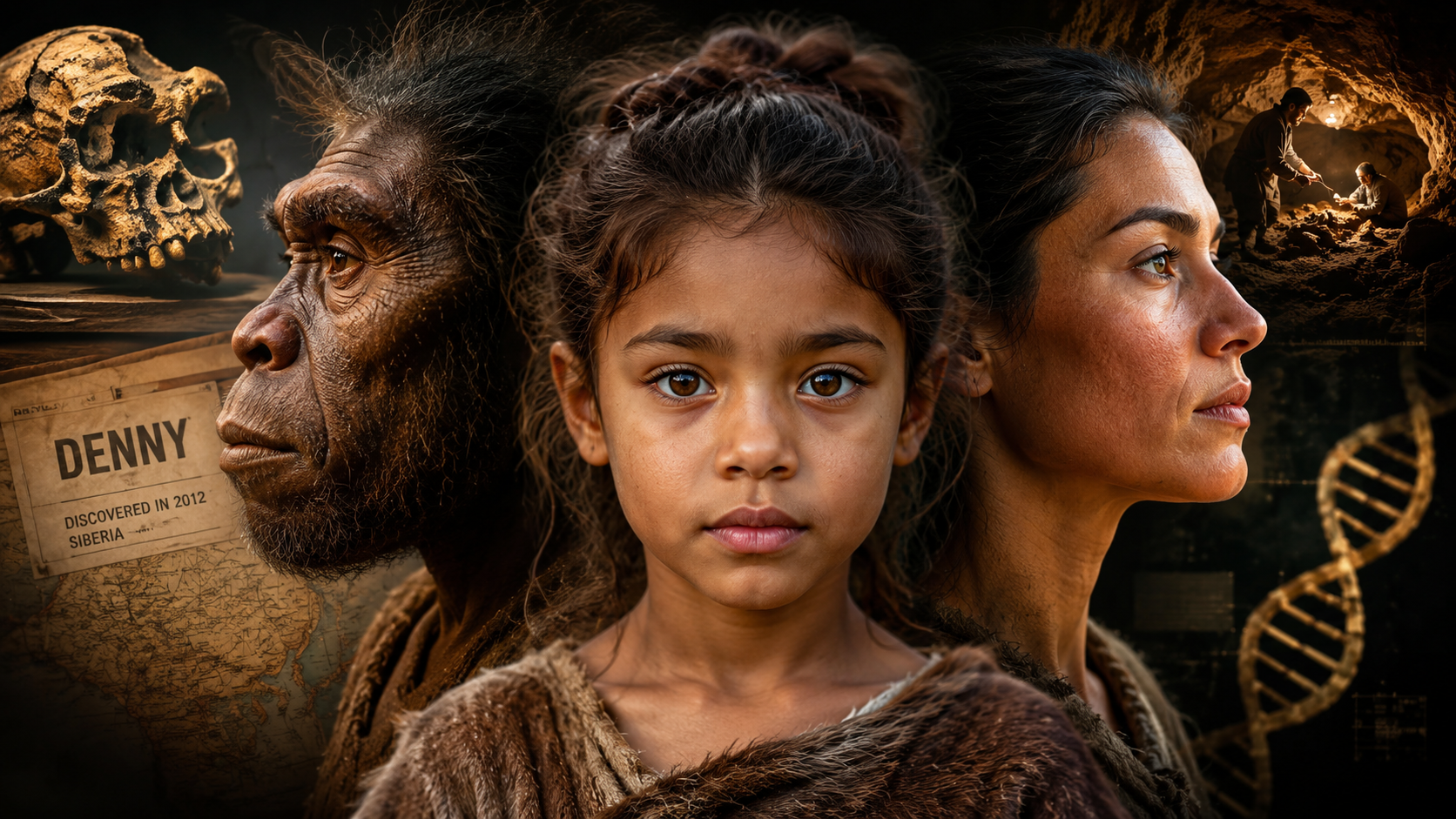
Meet Denny, an ancient teenage girl who lived tens of thousands of years ago and had parents from two different human species. Her remains provided direct evidence that ancient humans not only encountered one another but also had children together. This remarkable finding has given researchers new insights into our distant relatives and the interconnected story of human evolution.
Here are 15 fascinating facts about Denny and why her discovery is considered one of the most important breakthroughs in the study of ancient humans.
1. Denny Lived Around 90,000 Years Ago
Scientists estimate that Denny lived approximately 90,000 years ago during a period when several human species inhabited different regions of the world.
At that time, Earth looked very different from today. Changing climates, vast grasslands, and harsh environments shaped the lives of ancient human populations, who adapted in various ways to survive.
2. Her Remains Consisted of a Tiny Bone Fragment
One of the most remarkable aspects of this discovery is how little evidence scientists initially had to work with.
Denny’s remains were identified from a small bone fragment measuring only a few centimeters in length. Despite its size, advances in genetic technology allowed researchers to uncover an extraordinary amount of information about her life and ancestry.
The tiny fragment became one of the most scientifically valuable fossils ever discovered.
3. She Was Found in Siberia
Denny’s remains were discovered in the famous Denisova Cave in southern Siberia.
This cave has become one of the world’s most important archaeological sites because it has preserved evidence of multiple ancient human populations that lived there over thousands of years.
4. Her Mother Was a Neanderthal
Genetic analysis revealed that Denny’s mother belonged to the Neanderthal population.
Neanderthals
Neanderthals lived across parts of Europe and western Asia and were highly skilled hunters who made tools, controlled fire, and adapted successfully to challenging environments.
The finding added another layer to scientists’ understanding of Neanderthals, showing that they occasionally formed families with other human groups.
5. Her Father Was a Denisovan
Denny’s father belonged to another ancient human group known as the Denisovans.
Denisovans
Denisovans remain somewhat mysterious because scientists have found relatively few physical remains from them. Much of what researchers know about this population comes from DNA analysis.
Denny’s discovery offered one of the clearest glimpses into Denisovan life and relationships.
6. She Was a First-Generation Hybrid
Perhaps the most astonishing fact about Denny is that she was a direct, first-generation child of parents from two distinct human groups.
Scientists had previously suspected that interbreeding occurred among ancient human populations. However, finding an individual whose mother and father belonged to different human species provided direct evidence that these encounters produced offspring.
The discovery was both rare and scientifically groundbreaking.
7. Her Discovery Changed Scientific Assumptions
For many years, researchers assumed that ancient human groups remained largely separate.
Denny’s remains challenged that view. Her existence demonstrated that interactions between different human populations may have been more common than previously believed.
Rather than isolated branches of humanity, ancient human groups appear to have had a much more interconnected history.
8. Her Father Also Had Mixed Ancestry
The surprises did not stop with Denny’s parents.
Genetic studies indicated that her Denisovan father himself had inherited traces of Neanderthal ancestry from earlier generations. This suggests that interbreeding between these groups had happened before Denny was born.
In other words, her family tree was already genetically diverse.
9. Scientists Nicknamed Her “Denny”
Researchers gave the young girl the nickname “Denny” as a simpler way to refer to the individual represented by the bone fragment.
The nickname has since become widely recognized and has helped make a highly technical scientific discovery accessible to people around the world.
10. She Was Probably a Teenager
Studies of the bone fragment suggest that Denny was likely around 13 years old when she died.
Although only a tiny portion of her remains has been found, modern analytical techniques can reveal remarkable details about age and development from even limited fossil evidence.
11. Her Story Reveals Human Evolution Was More Like a Web Than a Straight Line
Many people imagine human evolution as a simple progression from one species to another.
Denny’s existence paints a different picture. Ancient human populations sometimes met, migrated, and exchanged genes, creating a far more complicated pattern of relationships.
Scientists increasingly describe human evolution as a branching and interconnected network rather than a straight line.
12. Her Discovery Highlights the Power of Ancient DNA Research
Without advances in DNA technology, Denny’s significance might never have been recognized.
Her bone fragment contained genetic information that allowed researchers to reconstruct aspects of her ancestry with astonishing precision. The discovery demonstrates how modern science can extract remarkable insights from even the smallest pieces of evidence.
Ancient DNA research has revolutionized our understanding of the distant past.
13. Some Modern Humans Still Carry Denisovan Genes
Although Denisovans disappeared long ago, traces of their genetic legacy remain.
Today, some populations in Asia and Oceania carry inherited Denisovan DNA. These genetic contributions influence certain biological traits and provide evidence that ancient interbreeding events left lasting effects on later human populations.
Denny’s story is therefore connected, in a small way, to people living today.
14. Her Discovery Raised New Questions
Every major scientific discovery generates fresh mysteries.
Researchers continue investigating where Denisovans lived, how frequently they interacted with Neanderthals and early modern humans, and what cultural practices they may have shared.
Denny’s remains answered one important question while opening many others.
15. Denny Reminds Us How Closely Connected Ancient Humans Were
Perhaps the most fascinating aspect of Denny’s story is what it reveals about humanity itself.
The boundaries between ancient human groups were not as rigid as once believed. Different populations met, interacted, and occasionally formed families. Their histories became intertwined in ways scientists are only beginning to understand.
Why Denny’s Story Matters
Denny’s tiny bone fragment transformed the scientific understanding of human evolution. She provided the first direct evidence of a child born to a Neanderthal mother and a Denisovan father, demonstrating that ancient human groups were far more interconnected than researchers once imagined.
Her discovery reminds us that human history is filled with unexpected connections and hidden stories waiting to be uncovered. From a single fragment of bone emerged one of the most remarkable insights into our ancient past—a teenage girl whose mixed ancestry helped rewrite the story of humanity and revealed that our evolutionary journey was far more diverse and fascinating than anyone had previously realized.







