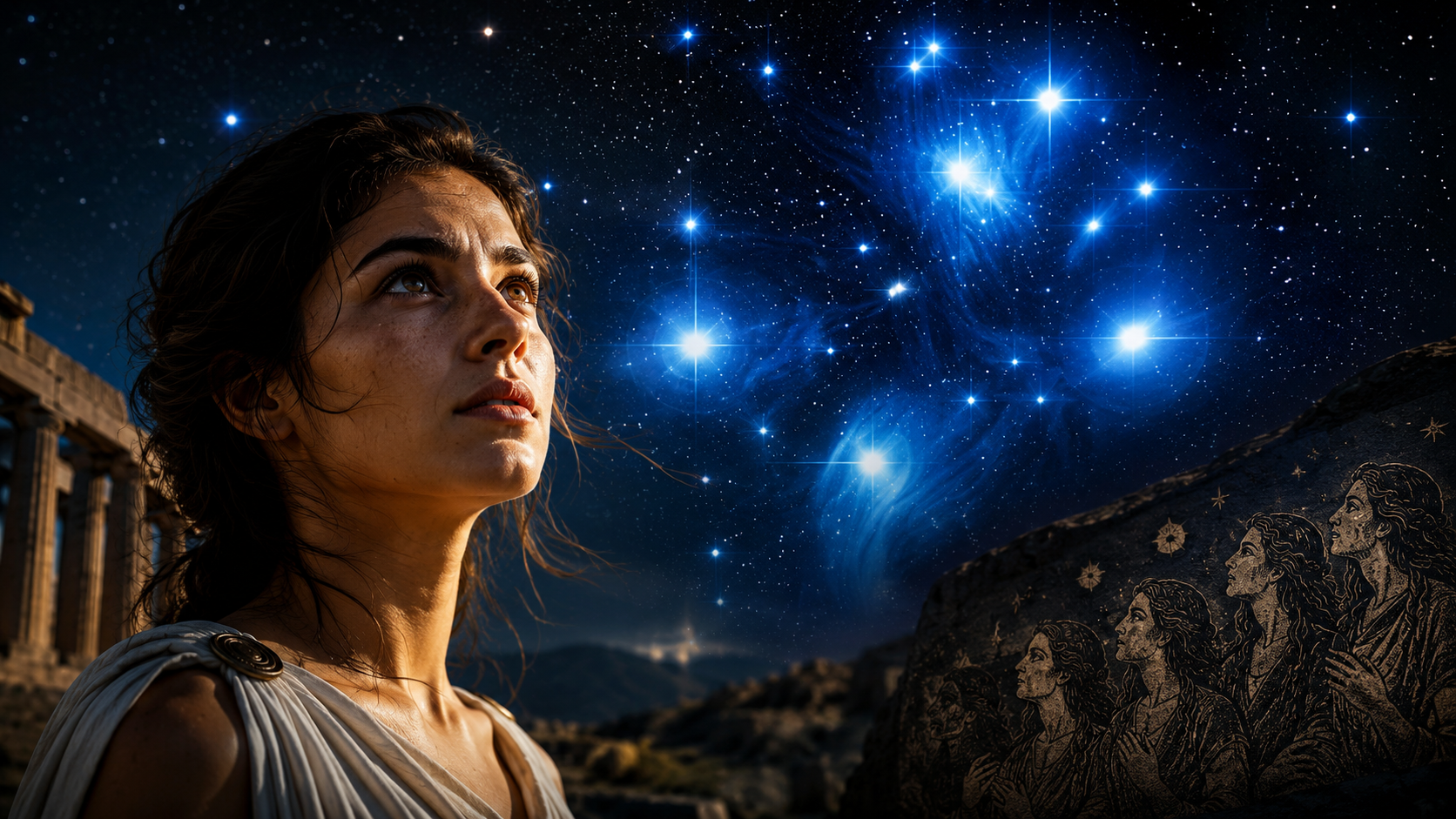
For thousands of years, people around the world have looked up at a small, shimmering group of stars and wondered about its secrets. Known as the Pleiades, this famous star cluster has inspired myths, guided travelers, and captivated astronomers from ancient civilizations to the modern age.
Although it appears as a tiny patch of stars in the night sky, the Pleiades is far more remarkable than it seems. It is a vast collection of hot, young stars traveling together through space, carrying clues about stellar evolution and humanity’s long relationship with the cosmos.
Here are fifteen fascinating facts about the ancient star cluster known as the Pleiades.
1. The Pleiades Is One of the Most Recognizable Star Clusters in the Sky
Pleiades is among the easiest star clusters to spot with the naked eye. On a dark night, it appears as a small group of bright stars packed closely together.
Its distinctive shape has made it a familiar sight for skywatchers throughout history, and even people with little knowledge of astronomy can often recognize it once it has been pointed out.
2. It Is Also Known as the Seven Sisters
The Pleiades is commonly called the Seven Sisters. According to ancient Greek mythology, the stars represented seven sisters who were transformed into celestial objects and placed in the sky.
Interestingly, many people can see only six stars without optical aid. Nevertheless, the traditional name has endured for thousands of years and remains one of astronomy’s most famous nicknames.
3. The Cluster Is Located in the Constellation Taurus
Taurus is home to the Pleiades.
The cluster appears near the shoulder of the celestial bull and is visible from much of the world during certain months of the year. Its position makes it one of the highlights of winter skies in the Northern Hemisphere.
4. The Pleiades Is Relatively Close to Earth
In cosmic terms, the Pleiades is practically in our galactic neighborhood.
The cluster lies about 440 light-years away from Earth. Although this distance is enormous by human standards, it is relatively nearby compared with many of the deep-sky objects observed by astronomers.
The light reaching our eyes tonight actually left the cluster centuries ago.
5. It Contains Far More Than Seven Stars
The seven brightest stars receive most of the attention, but the cluster itself is much larger.
Astronomers have identified more than a thousand stars associated with the Pleiades. Many of these stars are too faint to be seen without telescopes.
What appears to be a small grouping of lights in the sky is actually a vast stellar family moving together through the Milky Way.
6. The Stars Are Surprisingly Young
Despite its ancient place in human history, the cluster itself is relatively young by astronomical standards.
Scientists estimate that the Pleiades formed around 100 million years ago. By comparison, Earth is about 4.5 billion years old.
This means the cluster formed long after many of the processes that shaped our planet had already taken place.
7. It Is an Open Star Cluster
The Pleiades belongs to a category known as an open cluster.
Open clusters are groups of stars that formed from the same giant cloud of gas and dust. Because they were born together, they share similar ages and chemical compositions.
Studying these stellar families helps astronomers better understand how stars form and evolve.
8. Most of Its Brightest Stars Are Extremely Hot
The brightest members of the Pleiades are hot blue stars.
These stars are significantly hotter than our Sun and emit large amounts of energy. Their blue-white color indicates extremely high surface temperatures.
Although they shine brilliantly now, such massive stars typically live shorter lives than smaller stars like the Sun.
9. The Cluster Is Surrounded by a Beautiful Blue Glow
Photographs of the Pleiades often reveal a delicate blue haze surrounding its brightest stars.
For many years, astronomers debated whether this material was left over from the cluster’s formation. Today, scientists believe the stars are currently passing through an interstellar dust cloud.
The dust scatters blue light especially well, producing the breathtaking appearance seen in long-exposure images.
10. The Pleiades Has Been Known Since Prehistoric Times
Humanity’s relationship with the Pleiades stretches far into the past.
Archaeological evidence suggests people were observing this cluster long before written history began. Ancient communities likely used its appearance in the sky to mark seasons and important events.
Few astronomical objects have maintained such a long and continuous connection with human civilization.
11. Many Cultures Created Their Own Stories About It
The Pleiades appears in myths and traditions from around the globe.
Ancient Greeks, Indigenous peoples of the Americas, communities in Africa, Asian civilizations, and cultures throughout the Pacific all developed stories connected to this star cluster.
The remarkable similarity of some of these traditions demonstrates the universal human fascination with the night sky.
12. It Has Served as a Seasonal Calendar
Long before modern calendars existed, people relied on the sky to track time.
The rising and setting of the Pleiades often signaled important seasonal changes, including planting periods, harvest times, and ceremonial events.
Its dependable appearance made it one of humanity’s earliest celestial timekeepers.
13. The Cluster Will Not Stay Together Forever
Although its stars travel through space as a group today, the Pleiades will not remain intact indefinitely.
Over vast spans of time, gravitational interactions will gradually pull the stars apart. Eventually, the cluster will disperse, and its members will become separated across the Milky Way.
This process reminds us that even seemingly permanent features of the universe are constantly changing.
14. The Pleiades Is an Important Laboratory for Astronomers
Because its stars formed around the same time and lie at approximately the same distance from Earth, the cluster provides scientists with an excellent opportunity to study stellar evolution.
By examining the properties of its stars, researchers can test theories about how stars develop, age, and eventually die.
The Pleiades continues to play an important role in expanding our understanding of the cosmos.
15. You Can Easily Observe It Yourself
Perhaps the most fascinating fact of all is that you do not need advanced equipment to appreciate the Pleiades.
On a clear, dark night, the cluster can often be seen with the naked eye as a tiny sparkling patch above the horizon. Binoculars reveal even more stars and transform the cluster into one of the sky’s most beautiful sights.
When you look at the Pleiades, you are not merely seeing a handful of distant stars. You are witnessing a stellar family that has inspired stories, guided civilizations, and illuminated the skies of countless generations.
Final Thoughts
The Pleiades may occupy only a small portion of the night sky, but its significance is immense. It is simultaneously a scientific treasure, a cultural icon, and a reminder of humanity’s enduring fascination with the universe.
For thousands of years, people have gazed at these stars and wondered about their meaning. Today, modern astronomy allows us to understand them more deeply than ever before, yet the cluster has lost none of its mystery or beauty.
The next time you spot the tiny sparkling group known as the Seven Sisters, remember that you are looking at one of the most celebrated and enduring wonders in the heavens.







