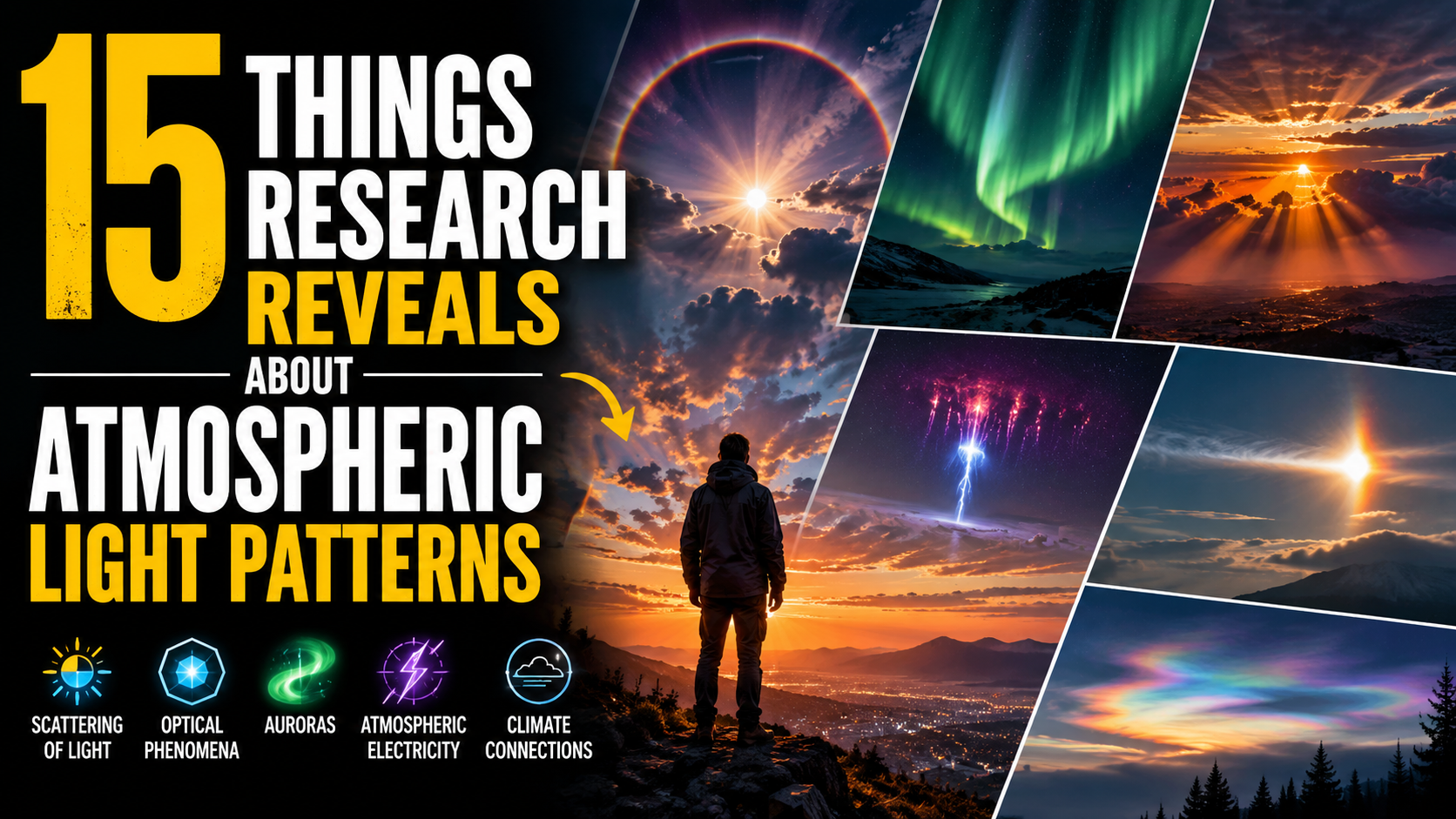
The sky above us is constantly changing, filled with patterns of light that range from familiar sunsets to rare and mysterious glowing phenomena. While many of these effects are well understood, others continue to puzzle scientists and spark curiosity around the world.
Atmospheric light patterns are shaped by a combination of physics, weather systems, solar activity, and human perception. Advances in satellite imaging, atmospheric science, and optical research have helped experts explain many of these phenomena, but new discoveries continue to emerge.
Here are 15 key insights research reveals about atmospheric light patterns and how they shape what we see in the sky.
1. Light in the Atmosphere Is Constantly Being Scattered
One of the most basic explanations for sky color and brightness is light scattering.
When sunlight enters Earth’s atmosphere, it interacts with molecules, dust, and water droplets. This causes light to scatter in different directions, producing the blue sky during the day and vibrant colors at sunrise and sunset.
Without scattering, the sky would appear completely dark even in daylight.
2. Rayleigh Scattering Creates the Blue Sky
A specific process called Rayleigh scattering explains why shorter wavelengths of light (blue and violet) are scattered more than longer wavelengths.
Because our eyes are more sensitive to blue light, the sky appears blue most of the time.
This same process also contributes to red and orange sunsets when the sun is low on the horizon.
3. Atmospheric Conditions Can Dramatically Change Light Behavior
Humidity, temperature, pollution, and dust levels all influence how light behaves in the atmosphere.
For example, high humidity can create hazy skies, while dust particles can intensify sunsets by scattering more red light.
Volcanic eruptions and wildfires can even alter sky color globally for short periods of time.
4. Rare Optical Phenomena Are Caused by Ice Crystals
Many unusual sky effects, such as halos and sun dogs, are caused by ice crystals in the upper atmosphere.
These crystals act like natural prisms, bending and reflecting sunlight into circular or glowing shapes.
These effects are especially common in cold regions or high-altitude clouds.
5. Auroras Are Driven by Solar Particles
One of the most famous atmospheric light displays is the aurora borealis and aurora australis.
These glowing lights occur when charged particles from the Sun interact with Earth’s magnetic field and collide with gases in the atmosphere.
The result is a shimmering curtain of green, red, purple, and blue light near the polar regions.
6. Lightning Creates Its Own Optical Effects
Lightning does more than illuminate the sky for a moment.
It can also create secondary optical phenomena such as sprites, jets, and elves—high-altitude electrical discharges that occur above thunderstorms.
These events were only confirmed relatively recently thanks to high-speed cameras and satellite observations.
7. Human Perception Plays a Major Role in Sky Mysteries
Not all unusual sky lights are purely physical phenomena.
Research shows that human perception, distance estimation, and environmental context can influence how people interpret what they see.
A distant airplane, star, or reflection can sometimes appear unusual depending on viewing conditions.
8. Temperature Inversions Can Bend Light
Under certain atmospheric conditions, warm air can sit above cooler air, creating a temperature inversion.
This can bend light in unusual ways, leading to mirages where objects appear distorted, elevated, or even inverted.
These effects are common in deserts and over large bodies of water.
9. Noctilucent Clouds Glow at the Edge of Space
One of the rarest atmospheric light patterns comes from noctilucent clouds.
These high-altitude clouds form near the edge of space and reflect sunlight long after sunset, creating a glowing blue appearance in the night sky.
Scientists believe they are becoming more common due to changes in atmospheric conditions.
10. Air Pollution Alters Sky Brightness and Color
Pollution particles in the air can significantly change how light is scattered.
In urban areas, this often leads to duller skies, reduced visibility, and altered sunset colors.
However, certain pollutants can intensify red and orange tones during sunrise and sunset.
11. The Sun’s Position Affects Every Sky Color We See
The angle of the Sun is one of the most important factors in atmospheric lighting.
When the Sun is high, light passes through less atmosphere, producing a bright blue sky.
At sunrise and sunset, sunlight travels through more of the atmosphere, scattering shorter wavelengths and leaving warmer colors.
12. Clouds Act as Natural Light Modifiers
Clouds play a major role in shaping how we perceive light in the sky.
They reflect, absorb, and diffuse sunlight depending on their thickness and composition.
Thin clouds can produce soft halos around the Sun, while thick storm clouds can darken the sky dramatically.
13. Atmospheric Electricity Produces Transient Luminous Events
Above thunderstorms, scientists have discovered rare electrical phenomena known as transient luminous events (TLEs).
These include red sprites, blue jets, and faint glowing halos in the upper atmosphere.
They last only milliseconds but reveal complex interactions between Earth’s atmosphere and space.
14. Satellites Help Scientists Track Global Light Patterns
Modern satellites allow researchers to observe atmospheric light patterns on a global scale.
They can track cloud movement, pollution spread, auroras, and storm systems in real time.
This has improved weather forecasting and deepened understanding of atmospheric physics.
15. Many Sky Phenomena Are Still Not Fully Understood
Despite scientific progress, not all atmospheric light patterns are completely explained.
Some rare sightings, unusual flashes, and transient lights remain difficult to categorize due to limited data.
Researchers continue to study these events using advanced imaging, sensors, and global observation networks.
The sky still holds mysteries waiting to be solved.
Why Atmospheric Light Patterns Matter
Atmospheric light is not just a visual phenomenon—it is deeply connected to Earth’s climate system, weather behavior, and even human perception.
Understanding how light behaves in the sky helps scientists:
- Improve weather predictions
- Study climate change
- Monitor environmental conditions
- Explore space-weather interactions
- Understand optical physics
Every glow, reflection, and color shift in the sky carries scientific meaning.
Final Thoughts
Atmospheric light patterns are a fascinating intersection of science, nature, and perception. From everyday sunsets to rare auroras and mysterious optical events, the sky above us is constantly telling a story shaped by physics and environmental conditions.
While science has explained many of these patterns, new discoveries continue to emerge as technology improves. Each observation adds another piece to the puzzle of how light behaves in Earth’s atmosphere.
In the end, the sky remains both familiar and mysterious—a daily reminder that science is still uncovering the hidden beauty of the world above us.