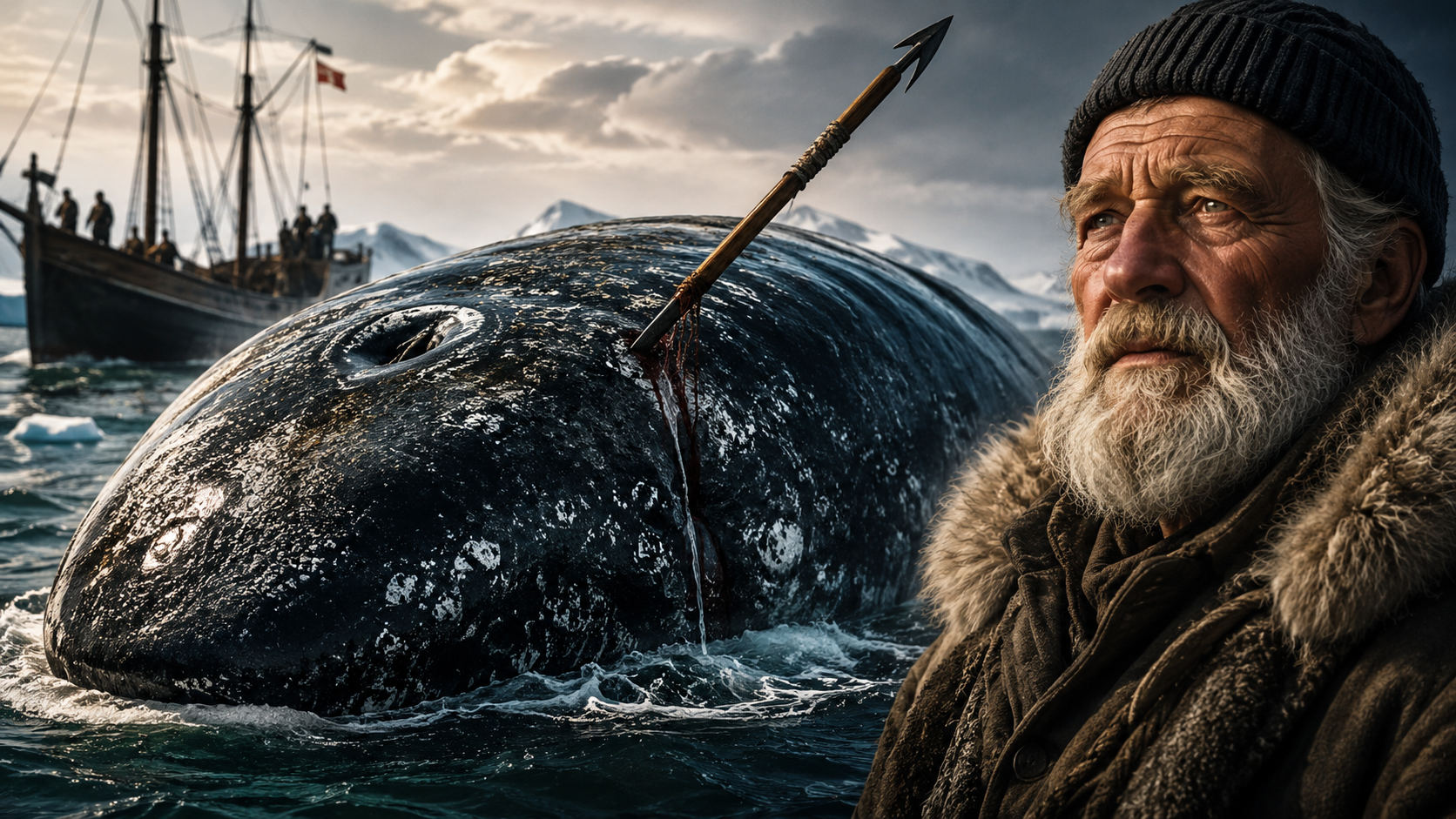
The bowhead whale is one of the most extraordinary creatures in the ocean, known for its massive size, thick blubber, and astonishing lifespan. Among the many stories linked to this species, one of the most remarkable is the discovery of a bowhead whale that survived for more than a century after being struck with a harpoon.
This incredible case has fascinated scientists and the public alike, not only because of the whale’s survival but also because of what it reveals about longevity, marine biology, and the resilience of ocean life.
Bowhead whales are already known to live longer than almost any other mammal, with some individuals believed to exceed 200 years of age. But the idea that one could survive a harpoon embedded in its body for over 100 years elevates its story into something almost mythical.
Here are seven astonishing facts about the bowhead whale that survived over a century with a harpoon.
1. Bowhead Whales Are Among the Longest-Lived Mammals on Earth
One of the most fascinating aspects of bowhead whales is their extraordinary lifespan.
Scientific studies suggest that some individuals may live for well over 150 years, with a few potentially reaching or exceeding 200 years.
This makes them one of the longest-living mammals ever recorded, surpassing humans by a significant margin.
Their longevity has made them a key subject of scientific research into aging and cellular repair.
2. The Harpoon Discovery Provided Evidence of Extreme Longevity
The famous case of a bowhead whale found with an old harpoon lodged in its body became a landmark moment in marine science.
The harpoon was identified as a type used in the 19th century, suggesting the whale had survived for over a century after the initial strike.
This discovery provided one of the most compelling pieces of evidence supporting the species’ extreme lifespan.
It also demonstrated how physical artifacts can help scientists estimate biological age in marine animals.
3. Their Thick Blubber Plays a Role in Survival
Bowhead whales are equipped with an exceptionally thick layer of blubber, sometimes reaching up to half a meter or more in depth.
This insulating layer protects them from the freezing Arctic waters they inhabit.
In the case of injuries, such as a harpoon wound, this blubber may also help reduce damage and increase the chances of survival.
Their physical structure is a key factor in their resilience.
4. They Inhabit Some of the Harshest Environments on Earth
Bowhead whales primarily live in Arctic and sub-Arctic waters, where temperatures can be extremely low and ice coverage is common.
Despite these harsh conditions, they have adapted remarkably well to life in frozen seas.
Their ability to survive injuries in such environments makes their long-term survival even more impressive.
Few large mammals are as well adapted to extreme cold.
5. Slow Aging May Be Linked to Unique Genetic Traits
Scientists studying bowhead whales have found evidence that their DNA may contain unique traits associated with slow aging and strong cellular repair mechanisms.
These genetic adaptations may help them resist age-related diseases and recover from injuries more effectively than other mammals.
This is one reason they are often studied in aging research.
Understanding their biology could provide insights into longevity in other species, including humans.
6. Historical Whaling Practices Left Lasting Physical Evidence
The discovery of old harpoons in bowhead whales also highlights the history of commercial whaling.
During the 19th century, bowhead whales were heavily hunted for their blubber and oil.
Some whales that survived these encounters continued living for decades or even centuries afterward, carrying remnants of human activity in their bodies.
These findings serve as living records of historical human-ocean interactions.
7. Their Survival Demonstrates Extraordinary Healing Capacity
One of the most astonishing aspects of the harpoon story is the whale’s ability to survive such a severe injury.
Over time, the whale’s body likely adapted to the embedded object, with surrounding tissue healing and stabilizing the area.
This suggests a remarkable capacity for long-term survival even under extreme physical stress.
It also highlights how different marine mammals are compared to humans in their healing processes.
Why This Story Fascinates Scientists and the Public
The bowhead whale harpoon story continues to capture attention because it combines survival, history, and biology in a single narrative.
It challenges assumptions about how long animals can live and how well they can recover from traumatic injuries.
It also connects modern science with historical events, creating a rare bridge between past and present.
For many, it serves as a reminder of how little we still understand about life in the deep ocean.
The Importance of Studying Bowhead Whales
Beyond their fascinating stories, bowhead whales are important for scientific research.
Their longevity and resilience make them valuable subjects for studying aging, disease resistance, and adaptation.
As climate change continues to affect Arctic ecosystems, understanding these whales has become even more critical.
They are not only living records of history but also indicators of environmental change.
Final Thoughts
The bowhead whale that survived over a century with a harpoon is more than just an unusual wildlife story—it is a window into the extraordinary resilience of nature.
From their incredible lifespan to their ability to endure extreme conditions and survive serious injuries, bowhead whales challenge what we think we know about life and survival in the ocean.
Their story continues to inspire scientists and wildlife enthusiasts alike, reminding us that the natural world still holds mysteries far beyond our imagination.







