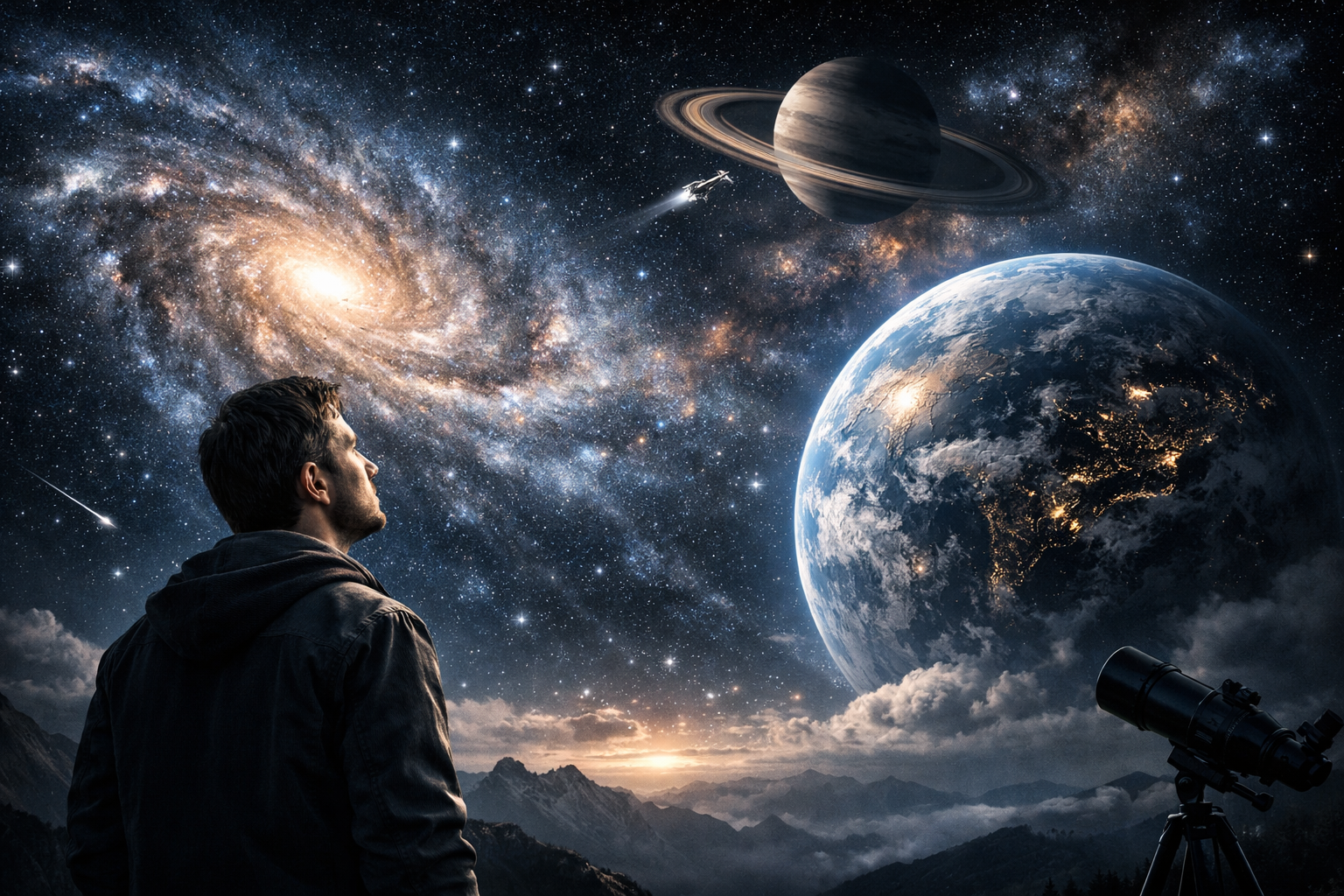
For thousands of years, human beings have looked toward the night sky with wonder. Long before telescopes, satellites, or space missions existed, our ancestors studied the stars, tracked the movements of planets, and created stories to explain the mysterious lights above them. Today, despite living in a world filled with technology and distractions, that fascination remains as strong as ever.
Millions of people watch rocket launches live, follow discoveries from distant galaxies, and stay awake late to witness eclipses, meteor showers, and planetary alignments. Even individuals with little scientific background often feel a deep sense of curiosity when confronted with images of nebulae, black holes, or the vastness of the universe.
But our attraction to space says more about us than it does about the stars.
In many ways, humanity’s enduring interest in the cosmos serves as a mirror, revealing important truths about how we think, feel, learn, and connect with the world. The fact that we are captivated by places we may never visit and phenomena we can barely comprehend offers valuable insight into human psychology and behavior.
Here are seven fascinating lessons about human nature that become clear when we examine our collective love of space.
1. Humans Are Naturally Curious
Perhaps the most obvious lesson revealed by our interest in space is that curiosity is deeply embedded in human nature.
From childhood onward, people ask questions about the unknown. Why do stars shine? What lies beyond our solar system? Are we alone in the universe?
These questions persist because the human mind is wired to seek explanations.
Curiosity has played a crucial role throughout history. It drove early explorers across oceans, inspired scientific discoveries, and continues to fuel innovation today. Space represents one of the largest unanswered questions humanity has ever faced, making it a perfect target for our natural desire to learn.
The fact that people remain fascinated by distant planets and galaxies demonstrates that curiosity extends far beyond practical needs. We don’t explore space because we must—we explore it because we want to understand.
What This Reveals
Humans are not satisfied with simply existing. We are driven to investigate, discover, and make sense of the unknown.
2. We Constantly Search for Meaning
Looking at the night sky often inspires deeper questions.
People don’t just wonder how stars work. They wonder what our place in the universe might be. Questions about existence, purpose, and significance frequently emerge when we contemplate the vastness of space.
This tendency reflects a broader aspect of human nature: our desire to create meaning.
Throughout history, cultures around the world have connected celestial objects to myths, religions, philosophies, and stories. Even today, space exploration often sparks conversations about humanity’s future and our role in the cosmos.
The stars become more than physical objects. They become symbols that help us explore larger questions about ourselves.
What This Reveals
Humans naturally seek significance and meaning, even in subjects that appear purely scientific.
3. We Are Drawn to Mystery
Many of the universe’s greatest attractions are things we don’t fully understand.
Black holes, dark matter, dark energy, and the origins of the universe remain among science’s biggest mysteries. Rather than discouraging interest, these unanswered questions often increase it.
Psychologists have long recognized that uncertainty can be highly engaging. When information is incomplete, the brain becomes motivated to fill the gap.
Space offers an endless supply of mysteries.
Every new discovery often generates even more questions, creating a cycle that continually captures human attention.
What This Reveals
People are not only attracted to answers. We are also fascinated by mysteries and unresolved questions.
4. We Need Perspective
One reason images of Earth from space resonate so strongly is that they change how we view ourselves.
Photographs showing our planet suspended in darkness often inspire feelings of humility and connection. National borders disappear. Political divisions become invisible. The entire human population appears to share a single fragile world.
This reaction highlights an important psychological need: perspective.
Modern life can make everyday problems feel overwhelming. Space reminds us that our lives exist within a much larger context.
Astronomy doesn’t diminish human experiences—it places them within a broader framework.
What This Reveals
Humans benefit from experiences that help us step back and view life from a wider perspective.
5. We Thrive on Exploration
Exploration is one of the defining characteristics of our species.
Throughout history, people have crossed deserts, sailed oceans, climbed mountains, and ventured into unknown territories. Space exploration represents the latest chapter in that story.
What’s remarkable is that many people feel inspired by exploration even when they are not personally involved.
A rover landing on Mars or a spacecraft reaching a distant planet can generate excitement around the world because it satisfies a deeply rooted desire to push boundaries.
The destination matters, but so does the journey.
What This Reveals
Humans possess a powerful drive to explore, discover, and expand beyond familiar limits.
6. Awe Is Essential to the Human Experience
Few things inspire awe as reliably as the universe.
Standing beneath a sky filled with stars or viewing a photograph of a distant galaxy often evokes emotions that are difficult to describe. People frequently report feelings of wonder, amazement, and even reverence.
Psychological research suggests that experiences of awe can influence behavior in positive ways. They may encourage curiosity, increase appreciation for life, and promote a greater sense of connection with others.
Space provides these experiences on a scale unlike almost anything else.
The universe is so vast and complex that it challenges our assumptions and stretches our imagination.
What This Reveals
Humans need moments of wonder. Awe helps us feel connected to something larger than ourselves.
7. We Are Storytelling Creatures
Even in the age of modern science, stories remain central to how people understand the universe.
Ancient civilizations told myths about constellations. Today, people share narratives about astronauts, scientific discoveries, and the search for life beyond Earth.
Facts are important, but stories make those facts meaningful.
The history of space exploration is filled with compelling narratives:
- The first Moon landing
- Deep-space missions
- The search for habitable planets
- The development of powerful telescopes
- Future visions of human exploration
These stories inspire generations because humans naturally connect with narratives.
What This Reveals
People understand and remember the world most effectively when information is woven into stories.
Why Space Continues to Captivate Humanity
Space occupies a unique position in human culture because it combines several elements that naturally attract our attention.
It offers:
- Beauty
- Mystery
- Discovery
- Challenge
- Perspective
- Adventure
- Possibility
Very few subjects bring all these qualities together so effectively.
Whether someone is interested in science, philosophy, history, or art, space provides something meaningful to explore.
This broad appeal helps explain why fascination with the cosmos spans cultures, generations, and educational backgrounds.
The Connection Between Space and Human Psychology
Researchers have increasingly explored how encounters with vast environments influence the mind.
Looking at star-filled skies or contemplating cosmic scales can produce what psychologists sometimes call the “small self” effect.
This doesn’t mean people feel insignificant in a negative sense. Instead, they often feel connected to something larger than their individual concerns.
These experiences can encourage:
- Humility
- Gratitude
- Curiosity
- Creativity
- Cooperation
In other words, our response to space reveals important aspects of emotional and cognitive functioning.
The universe affects not only what we know but also how we think.
What Space Exploration Says About Humanity’s Future
Our fascination with space also reveals optimism.
Exploration requires belief in the possibility of discovery. It assumes that the future contains opportunities worth pursuing.
When people support scientific missions, search for exoplanets, or imagine future journeys beyond Earth, they are expressing confidence in humanity’s ability to learn and grow.
This forward-looking mindset has been present throughout history.
Despite challenges and setbacks, humans continue reaching toward the unknown.
That persistence is one of our defining characteristics.
Lessons We Can Apply to Everyday Life
The truths revealed by our love of space are not limited to astronomy.
They can influence daily life in practical ways.
Stay Curious
Curiosity fuels learning and personal growth.
Embrace Mystery
Not every question requires an immediate answer.
Seek Perspective
Stepping back often helps clarify what truly matters.
Continue Exploring
Growth occurs when we venture beyond familiar routines.
Make Time for Awe
Experiences that inspire wonder can improve well-being and creativity.
These lessons reflect the same qualities that drive humanity’s interest in the cosmos.
Why Children Often Love Space
Children are frequently drawn to astronomy because many of its themes align with natural developmental tendencies.
Young minds are especially interested in:
- Exploration
- Big questions
- Adventure
- Imagination
- Discovery
Space combines all of these elements.
The enthusiasm many children feel when learning about planets, stars, and galaxies highlights just how deeply curiosity is rooted in human nature.
In many cases, that fascination continues into adulthood.
The Night Sky as a Shared Human Experience
One of the most remarkable aspects of astronomy is its universality.
People from different cultures, countries, and backgrounds all look at the same Moon, observe the same planets, and wonder about the same stars.
Throughout history, the night sky has served as a common point of connection among humanity.
That shared experience reminds us that curiosity about the universe is not limited to any one group. It is a characteristic that unites people across time and geography.
Final Thoughts
Our fascination with space is about much more than planets, stars, and galaxies. It reveals some of the most important qualities of human nature: curiosity, imagination, a desire for meaning, a love of exploration, and an appreciation for wonder. The fact that people remain captivated by places they may never visit and mysteries they may never fully solve speaks to something fundamental about who we are.
The universe challenges us to think bigger, ask deeper questions, and view life from a broader perspective. In doing so, it becomes more than a scientific subject—it becomes a reflection of the human spirit itself. And perhaps that is why our love of space has endured for thousands of years and shows no signs of fading anytime soon.







