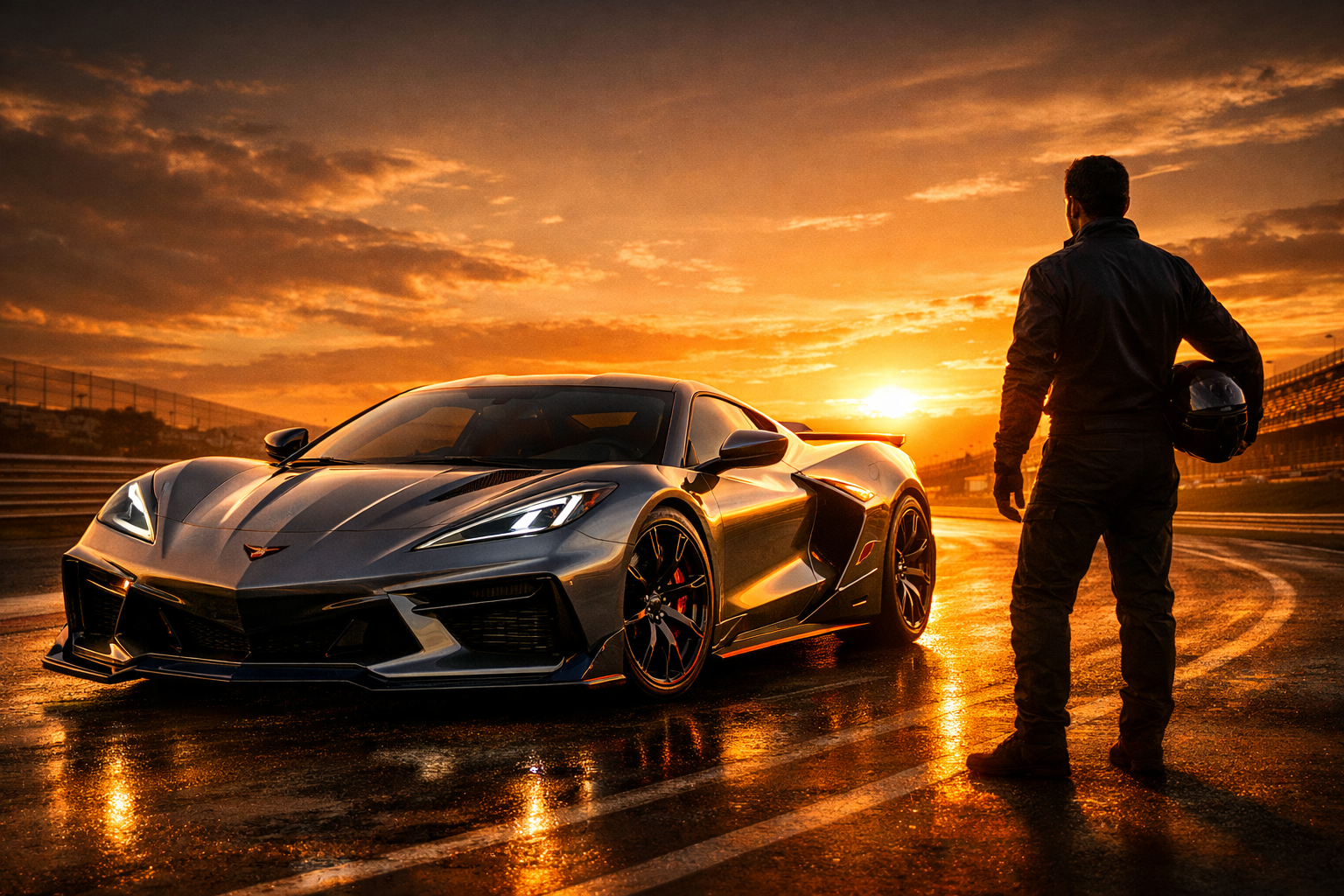
For decades, the Chevrolet Corvette has represented the pinnacle of American performance. From the classic front-engine models of the past to today’s mid-engine supercar-inspired machines, the Corvette has continuously evolved while maintaining its reputation as a performance bargain.
But the arrival of the 2026 Corvette Zora may represent the biggest leap in the car’s history.
Named after legendary Corvette engineer Zora Arkus-Duntov, the man often credited as the “Father of the Corvette,” this highly anticipated model isn’t simply another high-performance trim level. Instead, it’s the culmination of everything Chevrolet has learned from the C8 generation, combining race-bred engineering, hybrid technology, and hypercar-level performance into one package.
While automotive enthusiasts have followed rumors surrounding the Zora for years, many drivers still don’t fully understand what makes this Corvette so special. Beyond the headline-grabbing horsepower figures, there are several surprising facts that separate the Zora from every Corvette that came before it.
Here are seven things most drivers don’t realize about Chevrolet’s groundbreaking 2026 Corvette Zora.
1. It’s More Than Just the Fastest Corvette Ever Built
Most people assume the Zora is simply a more powerful version of the Corvette ZR1. While raw power is certainly part of the story, the Zora represents something much bigger.
Chevrolet’s engineers didn’t set out to create merely another high-performance sports car. Their goal was to build a vehicle capable of competing with the world’s most respected hypercars.
That means the Zora focuses on the complete driving experience rather than horsepower alone. Acceleration, cornering ability, braking performance, aerodynamic efficiency, and advanced electronics all work together as a unified system.
In many ways, the Zora serves as Chevrolet’s ultimate showcase of engineering capability. It blends technology from multiple Corvette variants and pushes the platform to levels that were once considered impossible for an American production car.
The result is a vehicle designed to challenge exotic machines that often cost several times as much.
2. The Hybrid System Isn’t About Fuel Economy
When many drivers hear the word “hybrid,” they immediately think about fuel savings and environmental benefits.
That’s not the primary purpose of the Zora’s hybrid technology.
Unlike traditional hybrids that focus on efficiency, the Corvette Zora uses electrification as a performance tool. The electric motor adds instant torque, improves traction, and helps deliver power more effectively during acceleration.
Electric motors generate maximum torque almost instantly. By combining this immediate response with the explosive power of a twin-turbocharged V8 engine, Chevrolet has created a system capable of producing breathtaking acceleration.
The hybrid setup also helps improve vehicle balance and all-wheel-drive capability. Instead of reducing excitement, the electrified drivetrain enhances it.
This approach reflects a growing trend in the performance-car world. Some of the fastest vehicles on the planet now use hybrid technology not to save fuel, but to achieve performance levels that gasoline engines alone cannot reach.
3. Its Name Honors a Corvette Legend
Many casual drivers have never heard of Zora Arkus-Duntov, yet his influence on Corvette history cannot be overstated.
After joining General Motors in the 1950s, Arkus-Duntov became one of the strongest advocates for turning the Corvette into a true sports car. At a time when the Corvette was struggling to find its identity, he pushed for higher performance, racing involvement, and engineering innovation.
His efforts transformed the Corvette from a stylish cruiser into a legitimate performance machine.
Naming the flagship Corvette after him is more than a tribute—it’s a statement. Chevrolet is acknowledging that this model represents the realization of a vision that Arkus-Duntov championed decades ago.
For longtime Corvette fans, the Zora badge carries significant emotional weight. It symbolizes the pursuit of performance without compromise.
4. The Power Numbers Are Almost Difficult to Comprehend
Modern performance cars have reached levels that would have seemed absurd just a generation ago.
The Corvette Zora sits at the very top of that performance ladder.
By combining a twin-turbocharged V8 with an electric motor, the vehicle is expected to produce around 1,250 horsepower. That’s significantly more power than many race cars and enough to place the Zora in hypercar territory.
To put that figure into perspective, some of the most celebrated sports cars of the 1990s produced less than 400 horsepower. Even early supercars rarely exceeded 500 horsepower.
The Zora more than doubles those numbers.
What’s even more remarkable is how usable that power is expected to be. Advanced traction systems, all-wheel drive, and sophisticated electronics help transform immense horsepower into real-world performance.
This isn’t just power for bragging rights—it’s power engineered to be controlled.
5. It Could Change How People View American Performance Cars
For decades, European manufacturers dominated conversations about elite performance vehicles.
Brands from Italy, Germany, and the United Kingdom traditionally occupied the highest levels of the automotive world. American sports cars were often viewed as powerful but less refined alternatives.
The Corvette Zora challenges that perception.
Modern Corvettes have already earned praise from international automotive journalists, track-day enthusiasts, and professional drivers. The Zora takes that progress even further.
Its combination of hybrid technology, advanced aerodynamics, lightweight materials, and track-focused engineering demonstrates how far American performance cars have evolved.
For many enthusiasts, the Zora isn’t simply another Corvette. It’s evidence that American automakers can compete directly with the world’s most sophisticated sports-car manufacturers.
That shift in perception may become one of the Zora’s most lasting contributions to automotive history.
6. The Technology Goes Far Beyond the Engine
When discussing performance cars, people often focus exclusively on horsepower. Yet much of the Zora’s magic comes from technology hidden beneath the surface.
Modern supercars rely heavily on software, sensors, and electronic systems to achieve their capabilities. The Corvette Zora is no exception.
The vehicle is expected to feature advanced traction management, adaptive suspension systems, sophisticated launch-control programming, and continuously adjusted power delivery.
These systems work together thousands of times per second, helping drivers extract maximum performance while maintaining stability and confidence.
The aerodynamics are equally important. Every vent, splitter, diffuser, and air channel serves a specific purpose. Rather than existing purely for appearance, these components help generate downforce, improve cooling, and reduce drag.
As a result, the Zora isn’t simply fast in a straight line. It’s designed to perform at an exceptionally high level on road courses and racetracks as well.
This holistic approach reflects the evolution of performance-car engineering, where intelligence is often just as important as horsepower.
7. It May Be the Ultimate Expression of the C8 Generation
Every Corvette generation has a defining model.
For the C4 generation, it was the ZR-1. For the C6, many enthusiasts point to the ZR1. The C7 reached new heights with its own supercharged flagship.
The C8 generation changed everything by moving the engine behind the driver. That radical shift laid the foundation for increasingly ambitious variants, including the Stingray, Z06, E-Ray, and ZR1.
The Zora represents the culmination of that journey.
It combines lessons learned from each model into a single package. The naturally aspirated excitement of the Z06, the hybrid innovation of the E-Ray, and the brutal power of the ZR1 all influence the final formula.
Because of this, many enthusiasts view the Zora as the ultimate C8 Corvette—the version that fully realizes the platform’s potential.
If future Corvette generations move toward greater electrification or entirely new architectures, the Zora could become a landmark vehicle that marks the peak of a remarkable era in Corvette history.
Why the Corvette Zora Matters
Performance numbers alone don’t explain why the Corvette Zora has generated so much excitement.
What truly matters is what the car represents.
It showcases the evolution of American automotive engineering. It demonstrates how hybrid technology can enhance driving excitement rather than diminish it. It proves that performance innovation can come from unexpected places.
Most importantly, it shows that the Corvette remains willing to reinvent itself.
For more than 70 years, the Corvette has survived because Chevrolet has continually pushed boundaries instead of relying solely on tradition. The Zora continues that philosophy by embracing cutting-edge technology while preserving the spirit that made the Corvette famous in the first place.
Final Thoughts
The 2026 Chevrolet Corvette Zora is far more than a powerful sports car. It’s the culmination of decades of engineering progress, racing influence, and performance innovation.
Many drivers will focus on the eye-catching horsepower figures, but the real story lies in the vehicle’s broader significance. Its hybrid drivetrain, advanced technology, all-wheel-drive capability, and hypercar-level ambitions make it one of the most important Corvettes ever created.
Whether you’re a lifelong Corvette enthusiast or simply someone who appreciates groundbreaking automotive engineering, the Zora stands as a reminder that the future of performance cars remains incredibly exciting.
And if expectations prove accurate, it may go down as the most ambitious Corvette Chevrolet has ever built.







