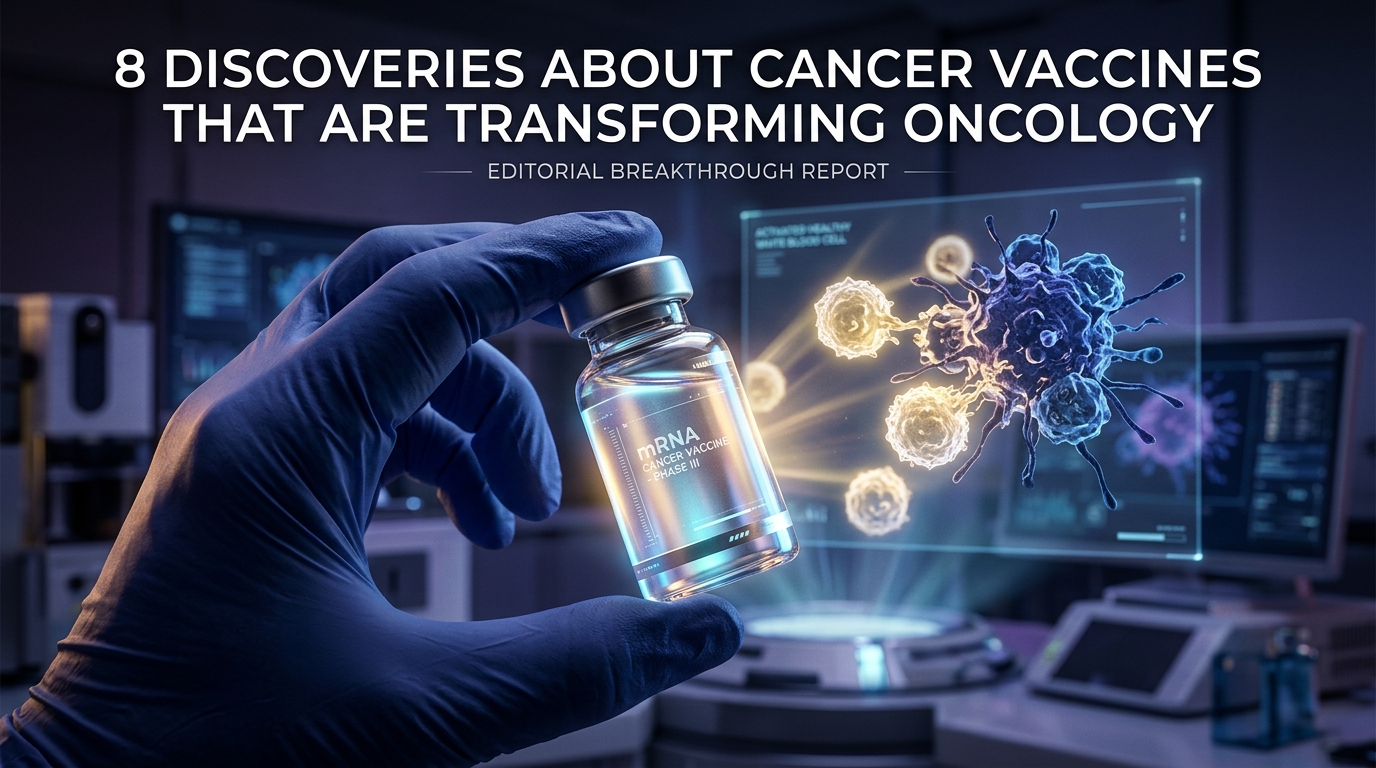
Cancer treatment is undergoing one of the most significant transformations in modern medical history. While traditional approaches such as surgery, chemotherapy, and radiation remain essential, researchers are increasingly turning to immunotherapy—strategies that harness the body’s own immune system to fight cancer.
Among the most promising developments in this field are cancer vaccines. Unlike vaccines that prevent infectious diseases, cancer vaccines are designed to help the immune system recognize and attack cancer cells. Over the past decade, scientific breakthroughs in genetics, molecular biology, and mRNA technology have dramatically expanded what these vaccines can do.
Although many cancer vaccines are still experimental, early research is reshaping expectations about how cancer may be treated in the future. Here are 8 key discoveries that are transforming oncology.
1. Cancer vaccines are designed to treat, not prevent disease
One of the most important discoveries in oncology is that most cancer vaccines are therapeutic rather than preventive.
Instead of stopping cancer before it starts, these vaccines are designed to train the immune system to recognize existing tumor cells and attack them more effectively.
This represents a major shift in strategy, turning the immune system into a targeted cancer-fighting tool rather than a general defense mechanism.
2. Tumor-specific mutations create unique immune targets
Researchers have discovered that cancer cells often carry mutations that are not found in normal cells. These mutations can produce abnormal proteins called neoantigens.
Neoantigens act like biological “flags” that the immune system can potentially recognize.
Cancer vaccines can be designed to target these unique markers, allowing for highly specific immune responses that focus on tumor cells while sparing healthy tissue.
3. mRNA technology is accelerating vaccine development
One of the most significant breakthroughs in cancer vaccine research is the use of mRNA platforms.
Originally popularized by COVID-19 vaccines, mRNA technology allows scientists to quickly design vaccines that instruct the body to produce tumor-specific antigens.
This approach dramatically shortens development time and makes it easier to customize vaccines for individual patients or tumor types.
Researchers believe mRNA-based cancer vaccines could become a cornerstone of personalized oncology.
4. Personalized vaccines are becoming a reality
Advances in genomic sequencing have made it possible to analyze an individual patient’s tumor in detail.
Based on this genetic profile, researchers can design custom vaccines tailored to the specific mutations present in that person’s cancer.
These personalized vaccines represent a shift toward precision medicine, where treatment is uniquely matched to each patient’s disease rather than using a one-size-fits-all approach.
5. Cancer vaccines often work best with other therapies
Another major discovery is that cancer vaccines are rarely most effective on their own.
Instead, they may work better when combined with other treatments such as:
- Immune checkpoint inhibitors
- Chemotherapy
- Radiation therapy
- Targeted drug therapies
These combinations can help weaken tumors, expose hidden cancer cells, or enhance immune system activation, making vaccines more effective overall.
6. The immune system can develop long-term memory against cancer
One of the most promising aspects of cancer vaccines is the potential for immune memory.
If successful, vaccines may train T cells to remember cancer-specific markers long after treatment ends.
This could allow the immune system to respond more quickly if cancer returns, reducing the risk of recurrence in some patients.
Researchers are still studying how strong and durable this immune memory can be in different types of cancer.
7. Early clinical trials show encouraging immune responses
Although still in early stages, clinical trials of cancer vaccines have produced encouraging results.
In some studies, patients have shown measurable T-cell activation against tumor antigens after vaccination.
In certain cases, disease progression has slowed or stabilized, suggesting that immune responses triggered by vaccines may have real biological effects.
However, scientists caution that larger trials are needed to confirm long-term effectiveness.
8. Cancer vaccines are reshaping the future of oncology
Perhaps the most important discovery is the broader shift cancer vaccines represent in medical thinking.
Instead of relying solely on treatments that directly kill cancer cells, researchers are increasingly focusing on strategies that empower the immune system to do the work.
This shift toward immunological control of cancer is influencing nearly every area of oncology research.
Future cancer care may involve highly personalized vaccine-based strategies combined with other immune-boosting therapies to create long-term disease control.
Why cancer vaccines matter
Cancer remains one of the leading causes of death worldwide, and many forms are still difficult to treat effectively once they spread.
Cancer vaccines offer a fundamentally different approach: instead of broadly attacking dividing cells, they aim to precisely target the molecular signatures of cancer itself.
This precision could potentially reduce side effects while improving effectiveness in selected patients.
Current limitations and challenges
Despite rapid progress, several challenges remain before cancer vaccines become widely available:
- Tumors can evolve and evade immune detection
- Not all cancers produce strong neoantigens
- Individual immune responses vary widely
- Large-scale clinical validation is still ongoing
- Manufacturing personalized vaccines can be complex
Researchers are actively working to overcome these obstacles through improved vaccine design and combination therapies.
The bottom line
Cancer vaccines are transforming oncology by shifting the focus from generalized cancer destruction to highly targeted immune system activation. With advances in mRNA technology, genetic sequencing, and immunotherapy, scientists are now closer than ever to developing personalized vaccines that can recognize and attack cancer with precision.
While most approaches are still in clinical development, early discoveries suggest that cancer vaccines could become a key pillar of future cancer treatment—offering more tailored, immune-driven strategies that may improve outcomes and reshape how the disease is managed.







