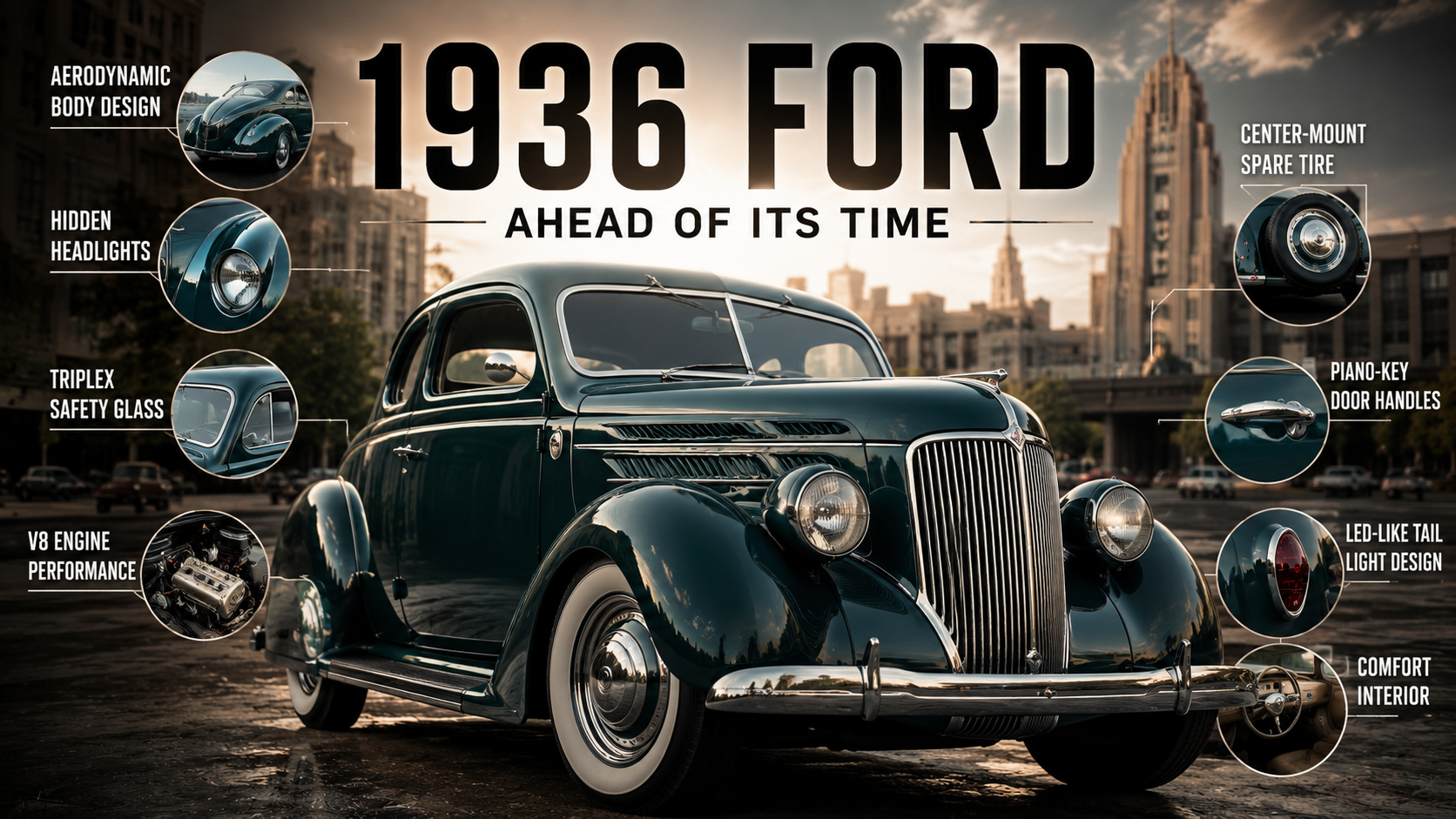
The automobile industry of the 1930s was evolving rapidly. Manufacturers were moving beyond the basic transportation models of the early automotive era and beginning to focus on comfort, style, safety, and performance. Amid this transformation, the 1936 Ford emerged as one of the most influential vehicles of its generation.
At first glance, the 1936 Ford may appear like a classic pre-war automobile with its rounded fenders, chrome accents, and vintage charm. However, a closer look reveals a vehicle that introduced several forward-thinking design elements that helped shape the future of car manufacturing.
Produced during a challenging economic period, the 1936 Ford managed to combine affordability with innovation. It appealed to everyday drivers while offering features and styling cues that felt remarkably modern for its time. Many automotive historians consider it one of the most important models in Ford’s early history.
Nearly nine decades later, collectors and enthusiasts continue to admire the car not only for its beauty but also for the engineering decisions that placed it ahead of many competitors.
Here are nine design features that made the 1936 Ford a groundbreaking automobile long before modern technology transformed the industry.
1. A More Streamlined and Aerodynamic Body
By the mid-1930s, automakers had begun experimenting with designs inspired by aerodynamics. While modern wind-tunnel testing was still in its infancy, engineers recognized that smoother shapes could improve performance and efficiency.
The 1936 Ford embraced this concept with a body that appeared significantly more streamlined than many earlier models.
Its flowing fenders, curved surfaces, and integrated styling gave the car a more modern appearance compared to the boxy vehicles of the 1920s. The design reduced visual clutter and created a cohesive look that hinted at the future direction of automotive styling.
Although aerodynamics would become much more sophisticated in later decades, the 1936 Ford helped introduce consumers to the idea that a car could be both functional and stylish.
2. The Distinctive V8 Powerplant
One of Ford’s greatest achievements during this era was making V8 power accessible to ordinary drivers.
At a time when eight-cylinder engines were often associated with luxury automobiles, Ford offered its famous flathead V8 at a price many middle-class families could afford.
This was a major innovation because it delivered stronger performance, smoother acceleration, and greater driving enjoyment than many competing vehicles.
The availability of affordable V8 power helped establish Ford as a leader in automotive engineering and gave the 1936 model a significant advantage in the marketplace.
For many drivers, owning a V8-powered car represented an experience previously reserved for wealthier buyers.
3. Improved Structural Strength
Safety standards in the 1930s were vastly different from today’s requirements, but Ford was already taking steps to improve vehicle durability and passenger protection.
The 1936 Ford featured a stronger body structure than many earlier models. Engineers worked to increase rigidity and improve overall construction quality, creating a vehicle that felt more solid on the road.
This stronger framework enhanced driving confidence and contributed to the car’s reputation for reliability.
While modern safety systems such as airbags and crumple zones were still decades away, structural integrity was an important step forward in automotive design.
The emphasis on durability reflected Ford’s understanding that customers wanted vehicles capable of handling daily use over many years.
4. A More Comfortable Interior Experience
Early automobiles often prioritized mechanical function over passenger comfort.
By 1936, consumer expectations had changed. Drivers wanted vehicles that were not only reliable but also pleasant to spend time in.
Ford responded by improving interior design and passenger accommodations.
The cabin offered more comfortable seating, better materials, and a layout that felt more refined than previous generations. Controls were positioned for easier access, and attention was given to creating a more enjoyable driving experience.
These enhancements reflected a broader industry trend toward treating automobiles as lifestyle products rather than simple transportation machines.
The focus on comfort would eventually become one of the defining characteristics of modern vehicle design.
5. Integrated Styling That Looked Decades Ahead
One reason the 1936 Ford remains popular among collectors is its timeless appearance.
Unlike some earlier vehicles that seemed assembled from separate visual components, the 1936 model featured a more unified design language.
The grille, hood, fenders, and body lines flowed together naturally, creating a balanced and sophisticated look.
This integration gave the car a sense of elegance and cohesion that was uncommon for many vehicles of the period.
In many ways, the design anticipated the smoother, more coordinated styling philosophies that would dominate postwar automotive development.
Even today, the car’s proportions continue to attract admiration at classic car shows around the world.
6. Better Ride Quality Through Suspension Improvements
Driving conditions during the 1930s were often challenging.
Many roads remained unpaved or poorly maintained, making ride quality an important consideration for consumers.
Ford engineers worked to improve suspension performance, helping the vehicle handle rough surfaces more comfortably.
The result was a smoother ride compared to many earlier automobiles. Passengers experienced less vibration and improved stability during travel.
Although modern suspension technology has advanced dramatically, the improvements found in the 1936 Ford represented meaningful progress for everyday drivers.
The company’s focus on ride comfort demonstrated an understanding that customer satisfaction extended beyond engine performance alone.
7. Enhanced Cooling and Engine Reliability
Automotive reliability was a major concern during the early decades of motoring.
Long-distance travel could place significant strain on engines, particularly during hot weather or under heavy loads.
Ford engineers paid close attention to cooling efficiency and overall engine dependability in the 1936 model.
The flathead V8 benefited from ongoing refinements that improved performance and reduced common maintenance issues.
These upgrades helped build consumer confidence and reinforced Ford’s reputation for producing practical vehicles capable of handling real-world conditions.
Reliability remains one of the most important factors in vehicle ownership today, and the 1936 Ford helped establish the principle that engineering excellence should extend beyond raw horsepower.
8. Affordable Innovation for Everyday Drivers
Perhaps one of the most remarkable aspects of the 1936 Ford was its accessibility.
Many advanced automotive features of the era were typically found in luxury vehicles with premium price tags.
Ford took a different approach by making innovation available to a broader audience.
The company successfully balanced affordability with engineering progress, allowing average consumers to enjoy features that might otherwise have remained exclusive to wealthier buyers.
This philosophy reflected Henry Ford’s long-standing vision of democratizing transportation.
The ability to deliver advanced design at a reasonable price helped strengthen Ford’s position as one of America’s most influential automakers.
It also established a model that many manufacturers continue to follow today.
9. A Platform That Inspired Future Customization
Although customization culture would flourish decades later, the 1936 Ford unintentionally became one of the most beloved platforms for future enthusiasts.
Its strong construction, attractive proportions, and powerful V8 engine made it a favorite among hot rod builders and custom car creators.
As automotive culture evolved after World War II, many enthusiasts chose the 1936 Ford as the foundation for creative modifications and performance upgrades.
This lasting popularity speaks volumes about the quality of the original design.
Cars that remain relevant across generations often possess a unique combination of beauty, practicality, and engineering excellence.
The 1936 Ford achieved all three.
Why the 1936 Ford Still Matters Today
The automotive world has changed dramatically since the 1930s.
Modern vehicles feature advanced electronics, sophisticated safety systems, autonomous driving technology, and electric powertrains. Yet many of the principles that guide today’s automotive design can be traced back to vehicles like the 1936 Ford.
The car represented a shift toward integrated styling, improved comfort, greater reliability, and accessible innovation. These ideas continue to influence vehicle development nearly a century later.
Collectors value the 1936 Ford because it captures an important moment in automotive history—a period when manufacturers were beginning to think beyond basic transportation and focus on the complete driving experience.
It serves as a reminder that innovation is not always about cutting-edge technology. Sometimes innovation means recognizing what consumers need before they realize it themselves.
The Lasting Legacy of a Classic
Few automobiles from the pre-war era have maintained the enduring popularity of the 1936 Ford.
Its combination of attractive styling, practical engineering, and affordable performance helped it stand out in a competitive marketplace. More importantly, many of its design choices anticipated trends that would shape the automotive industry for decades.
The vehicle demonstrated that innovation could be both accessible and appealing. It showed that ordinary drivers appreciated thoughtful engineering, improved comfort, and modern aesthetics.
Those lessons remain relevant today.
As automotive technology continues to evolve, the 1936 Ford stands as a testament to the power of forward-thinking design.
Final Thoughts
The 1936 Ford was far more than just another automobile from the Great Depression era. It was a vehicle that successfully blended style, engineering, performance, and practicality in ways that felt remarkably modern for its time.
From its streamlined body and affordable V8 engine to its stronger construction and improved passenger comfort, the car introduced ideas that would influence generations of vehicles that followed.
Nearly ninety years later, enthusiasts continue to celebrate the 1936 Ford because it represents a pivotal moment in automotive history. It proved that innovation didn’t have to be reserved for luxury buyers and that great design could stand the test of time.
For classic car lovers, historians, and automotive enthusiasts alike, the 1936 Ford remains a shining example of a vehicle that was truly ahead of its time.







