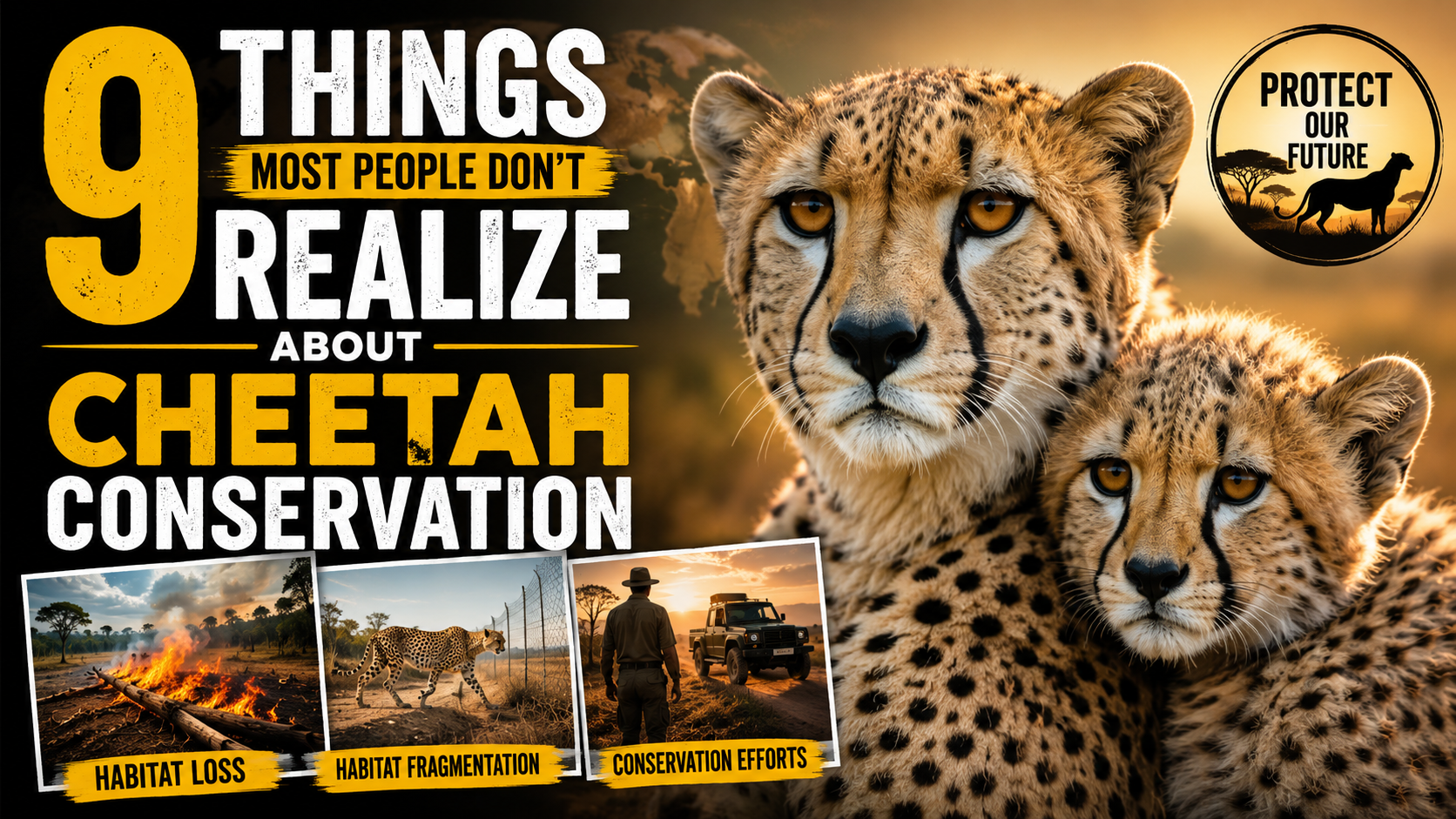
When people think of cheetahs, one image usually comes to mind: the fastest land animal on Earth racing across an open savanna. Their incredible speed, distinctive spotted coats, and graceful movements have made them one of the most recognizable animals in the world.
Yet behind this iconic image lies a troubling reality. Cheetahs face a growing number of challenges that threaten their long-term survival. While many people are aware that cheetahs are considered vulnerable in the wild, fewer understand the complex conservation efforts required to protect them.
Saving cheetahs isn’t simply about preventing poaching or creating nature reserves. It involves protecting habitats, supporting local communities, maintaining genetic diversity, reducing human-wildlife conflict, and addressing environmental changes that affect entire ecosystems.
Here are nine important things most people don’t realize about cheetah conservation and why these remarkable animals need continued protection.
1. Habitat Loss Is One of the Biggest Threats
Many people assume poaching is the primary danger facing cheetahs. While illegal wildlife trade remains a concern, habitat loss is often an even greater challenge.
As human populations grow, natural landscapes are increasingly converted into:
- Farms
- Roads
- Housing developments
- Industrial sites
- Grazing land
These changes reduce the amount of space available for wildlife.
Cheetahs require large territories to hunt, find mates, and raise cubs successfully. When habitats shrink, populations become isolated and survival becomes more difficult.
Conservation efforts frequently focus on protecting and restoring these critical landscapes.
2. Fragmented Habitats Create Hidden Problems
Even when habitat remains, fragmentation can create serious obstacles.
A fragmented habitat occurs when large natural areas become divided into smaller sections by roads, fences, farms, or urban development.
This separation limits animal movement and can prevent cheetahs from reaching:
- Hunting grounds
- Water sources
- Breeding partners
- Safe migration routes
Over time, isolated populations become more vulnerable to disease, environmental changes, and genetic challenges.
Wildlife corridors are increasingly used to reconnect fragmented habitats and improve movement between populations.
3. Cheetahs Need More Space Than Most People Realize
Unlike some large predators that can adapt to relatively small territories, cheetahs often roam across enormous areas.
A single cheetah’s range may cover hundreds of square miles depending on food availability and environmental conditions.
This creates unique conservation challenges.
Protecting one small reserve may not provide enough space for a healthy population to thrive. As a result, conservation programs often involve cooperation between multiple regions, landowners, and governments.
Protecting wide-ranging species requires large-scale planning that extends beyond individual parks.
4. Human-Wildlife Conflict Is a Major Concern
As natural habitats shrink, encounters between people and cheetahs become more common.
Farmers and livestock owners sometimes view predators as threats to their animals.
Although cheetahs generally avoid humans and are less dangerous to livestock than some other predators, conflicts still occur.
Conservation organizations often work directly with local communities to develop solutions such as:
- Predator-proof enclosures
- Livestock guardian animals
- Improved monitoring systems
- Community education programs
Successful conservation frequently depends on helping both wildlife and people coexist.
5. Genetic Diversity Is Surprisingly Important
One of the lesser-known challenges facing cheetahs involves genetics.
Scientists have discovered that modern cheetahs possess relatively low genetic diversity compared to many other species.
Low genetic variation can make populations more vulnerable to:
- Disease outbreaks
- Environmental changes
- Reproductive difficulties
- Reduced adaptability
Maintaining healthy population sizes and ensuring movement between groups helps preserve genetic diversity over time.
This is one reason wildlife corridors and connected habitats are so important.
6. Conservation Is About Entire Ecosystems
Protecting cheetahs requires much more than focusing on cheetahs alone.
As top predators, they depend on healthy ecosystems that include:
- Prey species
- Vegetation
- Water resources
- Natural migration routes
If these supporting elements disappear, cheetah populations struggle regardless of direct protection efforts.
Conservationists often take an ecosystem-based approach that benefits numerous species simultaneously.
By protecting landscapes for cheetahs, many other animals and plants also gain protection.
7. Local Communities Play a Critical Role
One of the biggest shifts in modern conservation involves recognizing the importance of local participation.
Decades ago, conservation efforts sometimes focused solely on creating protected areas.
Today, researchers understand that long-term success often depends on community involvement.
People living near wildlife habitats frequently become conservation partners through:
- Ecotourism programs
- Education initiatives
- Sustainable land-use practices
- Wildlife monitoring projects
When local communities benefit from conservation, support for protecting wildlife often increases significantly.
This collaborative approach has become a cornerstone of many successful conservation programs.
8. Climate Change May Increase Future Challenges
Climate change introduces additional uncertainty for wildlife populations around the world.
Changing temperatures, shifting rainfall patterns, droughts, and altered ecosystems may affect:
- Prey availability
- Water resources
- Habitat quality
- Migration patterns
Although scientists continue studying the full impact of climate change on cheetahs, many experts believe environmental shifts could create new conservation challenges in the coming decades.
This makes long-term planning increasingly important.
Protecting resilient ecosystems today may help species adapt more effectively to future changes.
9. Every Conservation Success Matters
Conservation stories often focus on problems, but there are also reasons for optimism.
Around the world, researchers, wildlife organizations, governments, and local communities have achieved meaningful progress through:
- Habitat restoration
- Population monitoring
- Community partnerships
- Anti-poaching initiatives
- Wildlife corridor projects
Many conservation successes occur gradually rather than overnight.
Protecting a species requires patience, scientific research, and sustained effort over many years.
Each successful project contributes to a stronger future for wildlife populations.
Why Cheetahs Matter Beyond Their Speed
Cheetahs are often celebrated for their incredible athletic abilities.
Capable of reaching speeds exceeding 60 miles per hour under the right conditions, they represent one of nature’s most extraordinary evolutionary achievements.
However, their importance extends far beyond speed.
As predators, cheetahs help maintain ecological balance by influencing prey populations and supporting healthy ecosystem dynamics.
Their presence often serves as an indicator of broader environmental health.
When cheetahs thrive, many other species tend to benefit as well.
The Role of International Cheetah Day
Awareness campaigns such as International Cheetah Day play an important role in conservation.
These events help educate the public about:
- Threats facing cheetahs
- Ongoing research efforts
- Habitat protection needs
- Conservation successes
- Opportunities for involvement
Public awareness can influence policy decisions, funding priorities, and support for conservation initiatives.
The more people understand wildlife challenges, the greater the potential for collective action.
How Scientists Study Cheetahs
Modern conservation relies heavily on scientific research.
Researchers use a variety of tools to monitor cheetah populations, including:
- GPS tracking collars
- Camera traps
- Genetic analysis
- Population surveys
- Satellite imagery
These technologies provide valuable insights into movement patterns, habitat use, population health, and conservation needs.
Data collected through research helps guide evidence-based decisions and improve conservation strategies.
Conservation Is About the Future
Protecting wildlife is not simply about preserving animals for today’s generation.
It is also about ensuring future generations have the opportunity to experience healthy ecosystems and biodiversity.
Cheetahs have existed for thousands of years, adapting to changing environments and surviving countless challenges.
The decisions made today will help determine whether future generations continue to share the planet with these remarkable animals.
Common Misconceptions About Cheetah Conservation
Many people assume conservation means keeping animals inside fenced reserves.
In reality, modern conservation is far more complex.
It involves balancing ecological needs, human livelihoods, economic realities, scientific research, and long-term sustainability.
Another common misconception is that conservation efforts only benefit wildlife.
In many cases, healthy ecosystems also support clean water, tourism opportunities, climate resilience, and local economies.
Protecting wildlife often produces benefits that extend well beyond a single species.
Looking Ahead
The future of cheetah conservation will likely depend on continued collaboration across multiple sectors.
Scientists, governments, conservation organizations, local communities, and private landowners all play important roles.
Future priorities may include:
- Expanding habitat connectivity
- Improving wildlife monitoring
- Strengthening community partnerships
- Addressing climate-related challenges
- Enhancing international cooperation
While significant obstacles remain, ongoing research and conservation efforts continue to provide valuable opportunities for progress.
Final Thoughts
Cheetahs are among the world’s most extraordinary animals, but protecting them involves far more than many people realize. Habitat loss, fragmentation, genetic challenges, climate change, and human-wildlife conflict all contribute to the complex conservation picture.
At the same time, successful conservation efforts demonstrate that positive change is possible. Through science, education, habitat protection, and community engagement, researchers and conservationists continue working to secure a future for these iconic cats.
Understanding the realities behind cheetah conservation helps reveal a broader truth about wildlife protection: saving a species is rarely about one solution. It requires long-term commitment, cooperation, and a deep appreciation for the interconnected systems that support life on Earth. By learning more about these challenges, we become better equipped to support the efforts that help ensure cheetahs remain part of the natural world for generations to come.







