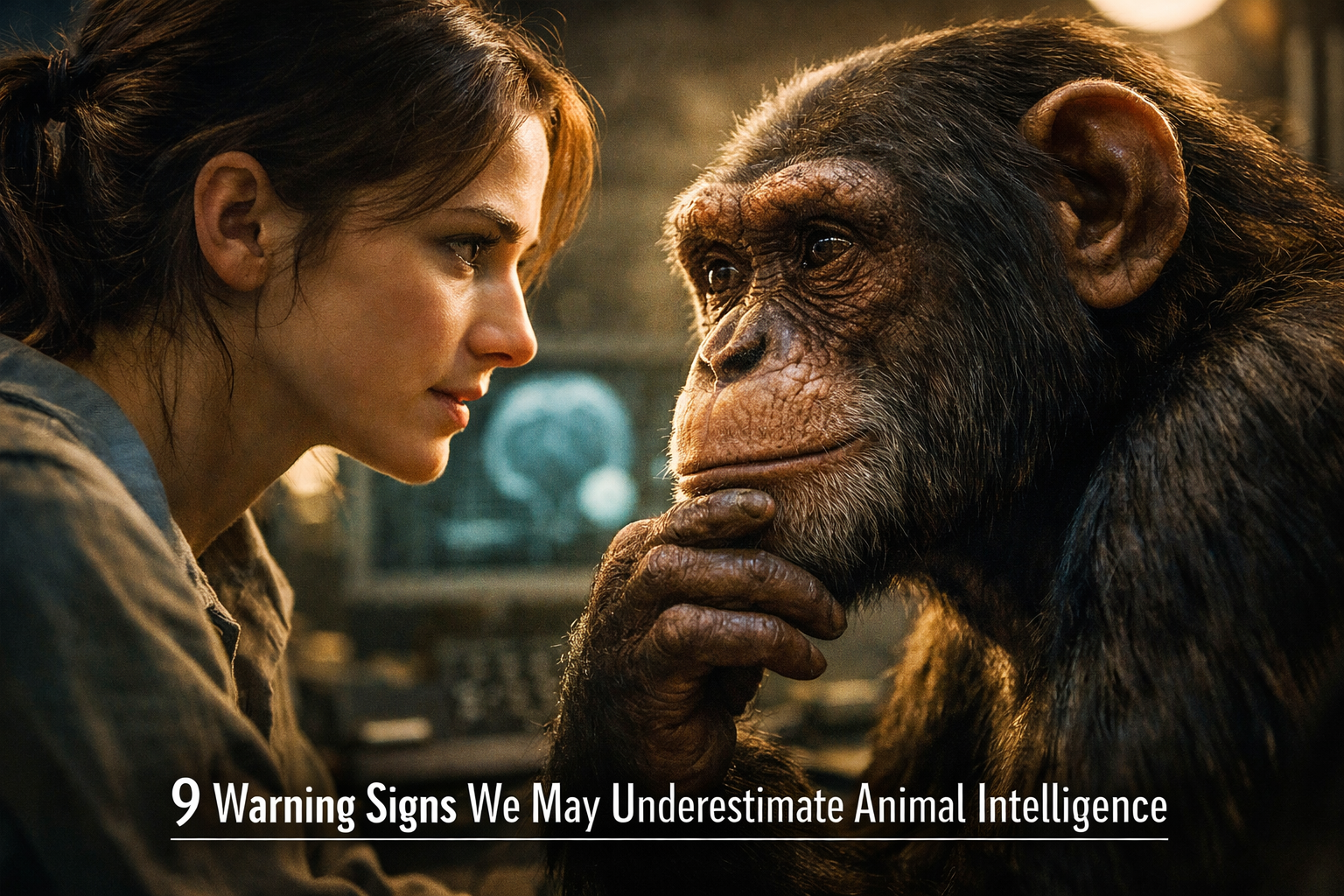
For centuries, humans have viewed themselves as the most intelligent creatures on Earth. While there’s no doubt that people possess unique cognitive abilities, modern research continues to reveal something surprising: many animals are far smarter than we once believed.
Scientists studying animal behavior have uncovered remarkable examples of problem-solving, communication, memory, emotional awareness, and even creativity across a wide range of species. In many cases, animals display abilities that challenge long-held assumptions about intelligence itself.
The problem may not be that animals lack intelligence. Instead, it could be that humans have been measuring intelligence through a very narrow lens—one designed around our own abilities and experiences.
As research advances, evidence continues to emerge suggesting that we may be seriously underestimating the mental capabilities of the creatures that share our planet.
Here are nine warning signs that animal intelligence may be far more sophisticated than most people realize.
1. Animals Solve Complex Problems Without Human Help
One of the clearest indicators of intelligence is the ability to solve problems.
Across the animal kingdom, researchers have observed countless examples of species overcoming challenges in creative and unexpected ways. Animals frequently encounter obstacles related to food, shelter, safety, and social interactions, and many have developed impressive strategies to deal with them.
Some birds can retrieve hard-to-reach food by manipulating objects. Certain mammals learn to navigate complex environments and adapt when circumstances change. Even creatures with relatively small brains often demonstrate surprising problem-solving abilities.
What’s particularly fascinating is that these solutions are not always instinctive. In many cases, animals appear to learn through observation, experimentation, and experience.
This ability to adapt to new situations suggests a level of cognitive flexibility that deserves greater recognition.
2. Many Species Use Tools
For a long time, tool use was considered one of the defining characteristics of human intelligence.
Today, that belief has largely been overturned.
Researchers have documented tool use in a wide variety of species, including birds, primates, marine mammals, and even some insects. Animals have been observed using sticks, stones, leaves, and other objects to access food, protect themselves, or modify their environment.
What makes tool use particularly significant is the planning involved. Selecting the right object for a specific task requires understanding cause and effect.
In some cases, animals even modify tools to improve their effectiveness, a behavior once thought to be uniquely human.
These discoveries continue to reshape our understanding of intelligence in the natural world.
3. Animals Demonstrate Remarkable Memory
Memory plays a critical role in survival, and many animals possess extraordinary recall abilities.
Migratory species often remember routes spanning thousands of miles. Some animals can locate food sources months after hiding them. Others recognize individuals they have not encountered in years.
Researchers have found that memory in animals extends beyond simple survival tasks. Many species appear capable of remembering social relationships, previous experiences, and environmental changes.
Such sophisticated memory systems suggest that animal cognition involves much more than basic instinct.
The ability to store, retrieve, and apply information over long periods is a hallmark of advanced intelligence.
4. Communication Is More Complex Than We Once Thought
When most people think of language, they think of human speech. However, communication exists in countless forms throughout nature.
Animals communicate through sounds, body language, facial expressions, scent signals, vibrations, and visual displays. What researchers are discovering is that these systems can be surprisingly sophisticated.
Certain species use distinct signals to convey different messages. Others alter their communication depending on context, audience, or environmental conditions.
Some animals even appear capable of learning and adapting communication patterns over time.
While animal communication may not resemble human language, complexity should not be mistaken for simplicity. The ability to transmit detailed information is often a strong indicator of cognitive sophistication.
5. Animals Show Evidence of Emotional Awareness
For many years, scientists hesitated to attribute emotions to animals.
Today, growing evidence suggests that numerous species experience emotional states that resemble those observed in humans.
Animals have been documented displaying behaviors associated with affection, grief, joy, fear, frustration, and social bonding. Some species comfort distressed companions, while others appear to mourn the loss of group members.
Emotional awareness requires an understanding of both one’s own experiences and the experiences of others.
Although researchers continue to debate the extent of animal emotions, the evidence increasingly suggests that many species possess rich emotional lives.
Ignoring these behaviors may cause us to underestimate the depth of animal intelligence.
6. Social Animals Navigate Surprisingly Complex Relationships
Living within a social group presents numerous challenges.
Animals must recognize individuals, establish relationships, resolve conflicts, cooperate with others, and respond to shifting group dynamics. Successfully navigating these interactions often requires significant cognitive abilities.
Many species maintain long-term social bonds and display behaviors that suggest an understanding of hierarchy, cooperation, and reciprocity.
In some animal communities, individuals remember past interactions and adjust future behavior accordingly.
Managing these relationships requires more than instinct alone. It demands social intelligence—a form of cognition that plays a crucial role in survival and reproduction.
The complexity of these social systems suggests that many animals are capable of far more sophisticated thinking than previously assumed.
7. Some Animals Display Self-Awareness
Self-awareness is often considered one of the highest forms of intelligence.
Researchers have developed various methods to explore whether animals possess some understanding of themselves as individuals. One commonly discussed test involves observing whether an animal can recognize its own reflection.
While not all species pass such tests, some have demonstrated behaviors that suggest a degree of self-recognition.
More importantly, scientists now recognize that self-awareness may exist on a spectrum rather than as an all-or-nothing trait.
Animals may possess different forms of self-understanding that do not necessarily mirror human cognition.
The possibility that self-awareness appears in multiple species challenges traditional ideas about what separates humans from the rest of the animal kingdom.
8. Animals Can Learn From Observation
Learning through observation is another strong sign of intelligence.
Rather than relying solely on instinct, many animals acquire new behaviors by watching others. Young individuals often learn essential survival skills from parents or experienced members of their group.
Researchers have documented animals copying techniques related to hunting, food gathering, navigation, and social interaction.
In some cases, behaviors spread through populations in ways that resemble cultural traditions.
This ability to learn from observation allows knowledge to persist across generations, increasing a group’s ability to adapt to changing conditions.
Such social learning demonstrates a level of cognitive sophistication that goes far beyond simple trial-and-error behavior.
9. Intelligence Takes Many Different Forms
Perhaps the biggest warning sign that we underestimate animal intelligence is our tendency to compare every species to humans.
Human intelligence is highly specialized. We excel at language, abstract reasoning, and technological innovation. However, other species have evolved cognitive abilities tailored to their unique environments.
An animal that cannot perform human tasks may still possess extraordinary intelligence in areas relevant to its survival.
For example, some species have exceptional spatial memory, sensory perception, navigation skills, or social awareness. Others can process environmental information in ways that humans simply cannot.
When intelligence is measured only by human standards, many remarkable abilities go unnoticed.
Recognizing multiple forms of intelligence provides a more accurate understanding of animal cognition.
Why Human Assumptions Can Be Misleading
One reason animal intelligence has historically been underestimated is that humans naturally view the world through a human-centered perspective.
We often assume that intelligence should look like language, mathematics, technology, or written communication because those are the abilities we value most.
However, evolution does not produce a single type of intelligence. Different species develop cognitive skills that help them survive within their specific environments.
A bird navigating vast distances, a predator coordinating a hunt, or a social animal managing complex relationships may demonstrate intelligence every bit as impressive as human achievements—just in a different form.
The challenge lies in recognizing these abilities without imposing human expectations.
What Modern Research Is Revealing
Advances in animal behavior research, neuroscience, and cognitive science are transforming our understanding of non-human intelligence.
Scientists now use sophisticated tools to study memory, decision-making, communication, and learning across a wide variety of species.
The results consistently point toward one conclusion: intelligence is far more widespread and diverse than previously believed.
Rather than existing as a simple hierarchy with humans at the top, intelligence appears to take many forms throughout the natural world.
Each new discovery adds another piece to the puzzle, revealing just how complex animal minds can be.
Final Thoughts
The more we learn about animals, the more difficult it becomes to dismiss them as simple creatures driven solely by instinct. From problem-solving and tool use to emotional awareness and social learning, evidence continues to show that many species possess remarkable cognitive abilities.
These discoveries do not diminish human intelligence. Instead, they expand our understanding of intelligence itself.
The greatest mistake may be assuming that intelligence must resemble our own in order to be meaningful. Animals have evolved unique ways of thinking, learning, and interacting with the world—many of which scientists are only beginning to understand.
As research continues to uncover new insights, one thing becomes increasingly clear: the natural world is filled with minds far more capable than we once imagined. By recognizing and appreciating these abilities, we gain a deeper respect not only for animals but also for the extraordinary diversity of life on Earth.







