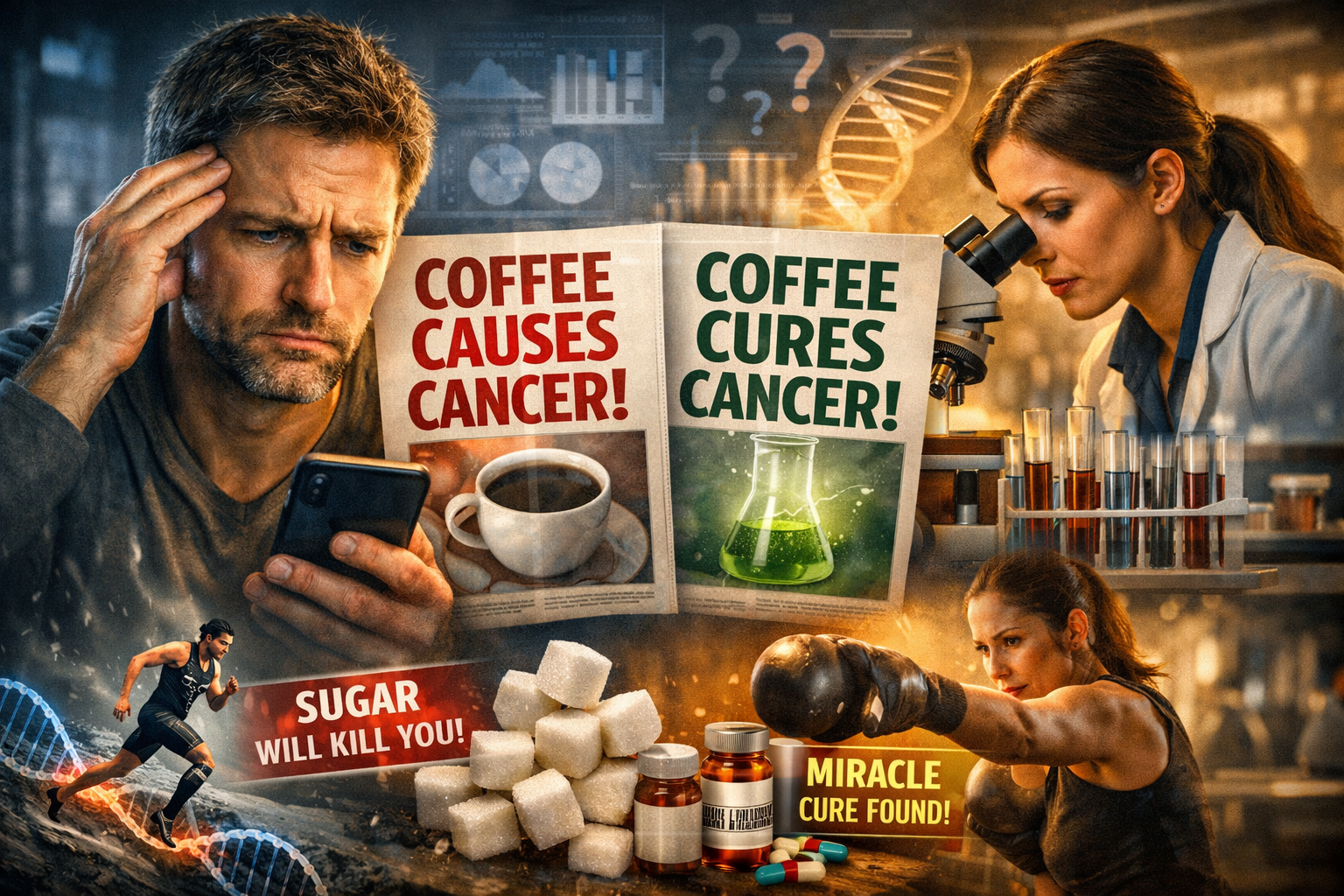
Every week, eye-catching health headlines flood news websites, social media feeds, and online discussions. One day, a study claims a common food may improve health. The next day, another article appears to suggest the exact opposite. For many readers, keeping up with medical research can feel confusing, frustrating, and sometimes overwhelming.
The challenge is that scientific studies are often complex, while headlines are designed to be short, attention-grabbing, and easy to understand. In the process, important details can get lost. A single sentence may oversimplify months or even years of research, leading readers to conclusions the original study never intended.
This doesn’t mean medical journalism is inherently misleading. In fact, many health reporters work hard to communicate complicated information accurately. However, understanding how research works can help readers separate meaningful discoveries from exaggerated interpretations.
If you’ve ever felt confused by health news, you’re not alone. Here are ten warning signs that may indicate you’re misunderstanding a medical research headline—and how to become a more informed reader.
1. Assuming a Single Study Provides a Final Answer
One of the most common mistakes people make is treating one study as definitive proof.
Science rarely works that way.
Most medical knowledge develops gradually through multiple studies conducted over many years. Researchers compare findings, test results in different populations, and look for consistent patterns before reaching strong conclusions.
A single study may offer valuable information, but it usually represents just one piece of a much larger puzzle.
When you see a headline announcing a “breakthrough” or “game-changing discovery,” remember that scientific understanding evolves over time. Confirmation from additional research is often necessary before findings become widely accepted.
2. Confusing Correlation With Causation
This is perhaps the most important concept in medical research.
Correlation means two things appear to occur together. Causation means one thing directly causes the other.
For example, researchers might discover that people who exercise regularly tend to have better health outcomes. However, other factors could also contribute, such as diet, income, healthcare access, or lifestyle habits.
Observational studies often identify associations but cannot always prove cause and effect.
When a headline suggests one factor directly causes a health outcome, it’s worth investigating whether the study actually demonstrated causation or simply found a correlation.
3. Ignoring the Size of the Study
The number of participants involved in a study matters.
A study involving 50 participants may produce interesting preliminary findings, but its conclusions are generally less reliable than research involving thousands of participants.
Larger studies often provide more robust data because they reduce the influence of chance and better represent broader populations.
When evaluating health headlines, ask yourself:
- How many people participated?
- Was the sample large enough?
- Did researchers include diverse populations?
These factors can significantly affect how much confidence should be placed in the findings.
4. Overlooking the Type of Study
Not all studies provide the same level of evidence.
Some common study types include:
Observational Studies
Researchers observe participants without intervening. These studies can identify patterns but often cannot prove cause and effect.
Randomized Controlled Trials
Participants are assigned to different groups to test interventions. These studies generally provide stronger evidence.
Laboratory Studies
Experiments performed on cells or tissues in controlled settings.
Animal Studies
Research conducted on animals before human testing begins.
A headline may sound exciting, but if the findings come from animal research or laboratory experiments, the results may not translate directly to humans.
Understanding study design helps place findings in the proper context.
5. Believing Headlines Without Reading Beyond Them
Many people never read the article itself.
They see a headline, form an opinion, and move on.
Unfortunately, headlines are often simplified summaries that may omit important limitations, caveats, or context.
The article frequently contains critical information such as:
- Study size
- Research methods
- Potential weaknesses
- Expert opinions
- Alternative explanations
Reading beyond the headline can dramatically improve your understanding of what researchers actually discovered.
6. Assuming “Natural” Means Safe or Effective
Health headlines often attract attention by highlighting natural remedies, supplements, or plant-based compounds.
While some natural substances offer genuine health benefits, “natural” does not automatically mean safe, effective, or scientifically proven.
Many natural compounds have side effects, interact with medications, or lack sufficient evidence to support specific health claims.
Researchers evaluate natural treatments using the same scientific standards applied to pharmaceutical drugs.
Whenever a headline emphasizes a natural solution, it’s important to examine the quality of the supporting evidence.
7. Ignoring Study Limitations
Every scientific study has limitations.
Researchers routinely discuss these limitations in their published papers, but they may receive little attention in media coverage.
Common limitations include:
- Small sample sizes
- Short study durations
- Participant selection biases
- Measurement challenges
- Limited generalizability
Understanding limitations does not invalidate research. Instead, it helps readers interpret findings realistically.
A responsible interpretation considers both the strengths and weaknesses of a study.
8. Assuming Results Apply to Everyone
Human beings are incredibly diverse.
Factors such as age, genetics, sex, health status, lifestyle, ethnicity, and environmental influences can affect how individuals respond to treatments or health interventions.
A study conducted in one population may not produce identical results in another.
For example, findings involving healthy young adults may not apply equally to older adults or people with chronic medical conditions.
When reading health news, consider whether the study population resembles the broader population being discussed.
9. Mistaking Early Research for Proven Treatment
Early-stage research often generates excitement—and sometimes unrealistic expectations.
Many promising discoveries begin in laboratories, animal models, or small clinical trials. However, only a fraction eventually become widely used medical treatments.
Drug development, medical device approval, and treatment validation require extensive testing to ensure safety and effectiveness.
A headline describing a potential cure or breakthrough should be viewed as an early step rather than a guaranteed solution.
Scientific progress is often slower and more complicated than headlines suggest.
10. Letting Emotion Override Critical Thinking
Health-related stories often involve fear, hope, curiosity, or personal experiences.
These emotions are completely natural, but they can sometimes influence how people interpret information.
For example:
- A person seeking a cure may place too much trust in preliminary findings.
- Someone worried about a disease may overestimate risks.
- Personal beliefs may shape how evidence is evaluated.
Critical thinking requires balancing emotional reactions with objective analysis.
The strongest conclusions come from carefully examining evidence rather than relying solely on feelings or assumptions.
Why Medical Headlines Can Be Misleading
Health journalism faces a difficult challenge.
Researchers communicate findings using technical language and detailed statistical analysis. Journalists must translate that information into accessible stories for the general public.
In the process, complexity is often reduced.
Additionally, news organizations compete for attention in crowded digital environments. Headlines must capture interest quickly, which can sometimes encourage oversimplification.
Most misleading impressions result not from intentional deception but from the natural tension between scientific accuracy and public communication.
Understanding this challenge can help readers approach medical news more thoughtfully.
How to Read Health News More Effectively
Fortunately, becoming a better consumer of medical information is easier than many people think.
Consider asking these questions whenever you encounter a health headline:
- What type of study was conducted?
- How many participants were involved?
- Was the research performed in humans?
- Are there important limitations?
- Have other studies found similar results?
- Does the article cite qualified experts?
- Is the claim supported by evidence or speculation?
These simple questions can significantly improve your ability to evaluate health information.
The Importance of Scientific Literacy
Scientific literacy isn’t about becoming a medical expert.
It’s about understanding enough to interpret information responsibly.
In today’s world, people encounter health claims daily through social media, websites, podcasts, videos, and news reports. Developing basic research literacy helps individuals make better decisions and avoid common misunderstandings.
It also encourages healthier discussions about science and medicine.
Rather than reacting to every new headline, informed readers learn to view research as part of an ongoing process of discovery.
Final Thoughts
Medical research plays a vital role in improving human health, but understanding scientific findings requires more than reading a headline. Studies are complex, evidence accumulates gradually, and meaningful conclusions often emerge only after years of investigation.
The ten warning signs discussed here—from confusing correlation with causation to overestimating early-stage research—highlight some of the most common ways people misunderstand health news.
By approaching medical headlines with curiosity, skepticism, and a willingness to explore the details, readers can become more informed consumers of scientific information.
The next time a headline promises a miracle cure, shocking discovery, or revolutionary breakthrough, take a moment to look beyond the surface. The real story is often more nuanced—and far more interesting—than the headline alone suggests.
In a world overflowing with information, the ability to critically evaluate medical research may be one of the most valuable health skills anyone can develop.







