Every day, headlines announce new scientific discoveries. One study says coffee may be beneficial. Another suggests screen time affects mental health. A third claims a particular diet could improve longevity. With so much information circulating online, it can be difficult to know which research findings deserve attention and which should be viewed with caution.
The challenge isn’t that science is unreliable. In fact, science remains one of the most powerful tools for understanding the world. The real challenge is that scientific findings are often simplified, misunderstood, or presented without important context.
Researchers, journalists, healthcare professionals, and educators all emphasize the importance of learning how to evaluate research claims critically. Doing so helps people make better decisions about their health, finances, education, and daily lives.
Fortunately, you don’t need a scientific degree to become a more informed reader. Experts recommend focusing on a few key principles that can help separate strong evidence from weak conclusions.
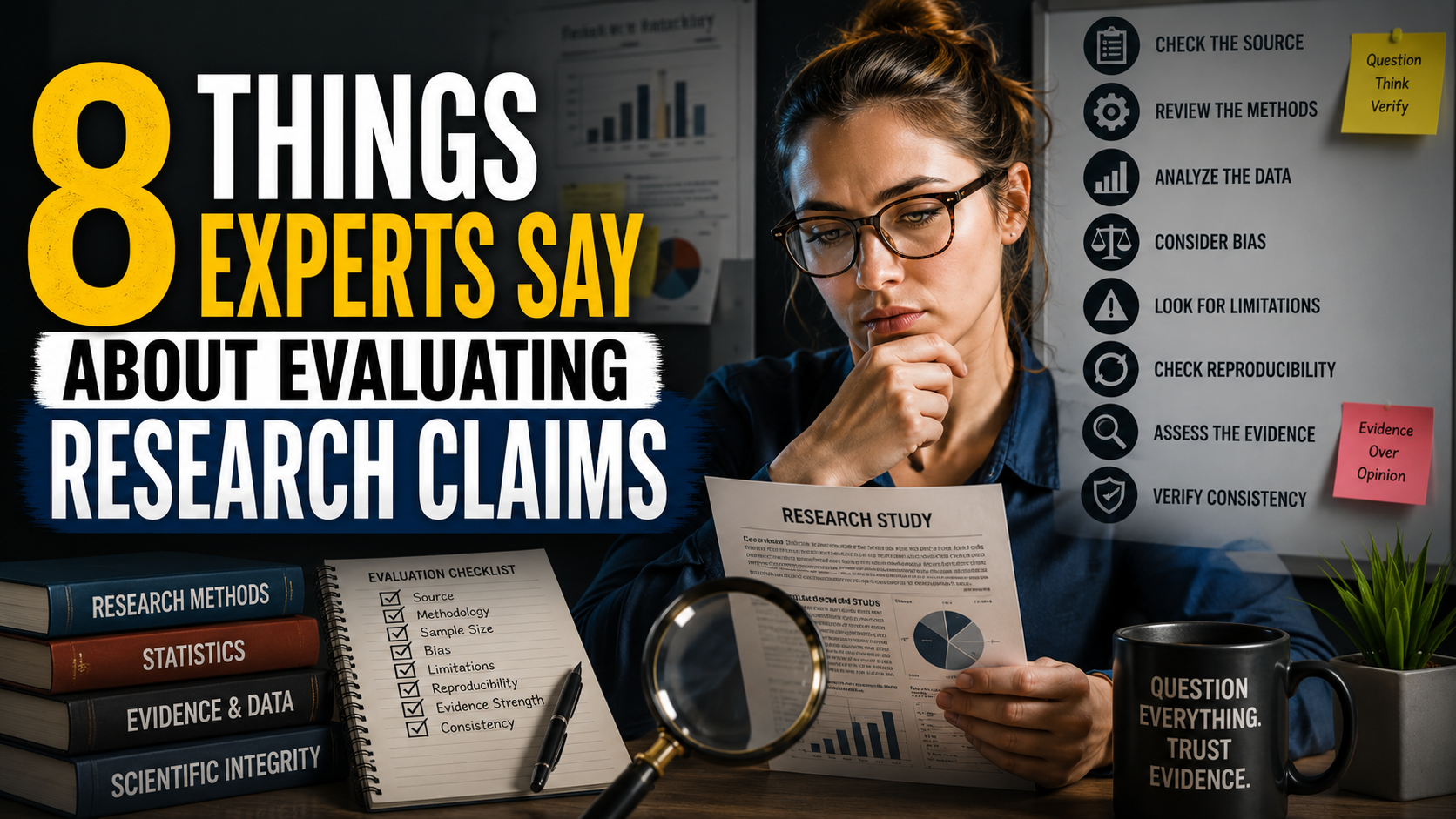
Here are eight important things experts say everyone should know when evaluating research claims.
1. Look Beyond the Headline
Headlines are designed to attract attention.
In news articles and social media posts, research findings are often condensed into a few words that may not fully capture the complexity of the study. While headlines can provide a useful summary, they rarely tell the whole story.
For example, a headline might state that a particular habit “boosts health” or “reduces risk,” but it may not explain how much risk was reduced, who was studied, or whether other factors could have influenced the results.
Experts encourage readers to go beyond the headline whenever possible.
Reading the full article—or better yet, reviewing the original study summary—often reveals important details that change how the findings should be interpreted.
A good rule of thumb is simple: the more dramatic the headline sounds, the more important it is to investigate further.
2. Consider the Source
Not all sources are equally reliable.
Before accepting a research claim, it’s worth asking where the information originated.
Was the study published in a respected scientific journal? Was it conducted by researchers affiliated with recognized institutions? Is the information being reported by a credible news organization or simply shared through social media?
Reliable sources generally provide transparency about methodology, funding, limitations, and potential conflicts of interest.
Experts often recommend checking whether multiple trustworthy organizations are reporting similar conclusions rather than relying on a single source.
The credibility of the source doesn’t automatically guarantee accuracy, but it can provide useful clues about the quality of the information.
3. Pay Attention to Sample Size
One of the first questions researchers ask when evaluating a study is: How many people participated?
Sample size matters because larger groups often provide more reliable data.
A study involving 25 participants may produce interesting observations, but its conclusions may not be as dependable as research involving thousands of individuals.
Smaller studies can be valuable, especially in early-stage research, but they often need to be replicated before broad conclusions can be drawn.
Experts caution against treating small studies as definitive proof of anything. Instead, they should be viewed as pieces of a larger scientific puzzle.
4. Remember That Correlation Does Not Mean Causation
This is one of the most important concepts in research evaluation.
A study may find that two things occur together, but that doesn’t necessarily mean one caused the other.
For example, researchers might observe that people who exercise regularly tend to report better mental health. While exercise may contribute to improved well-being, other factors such as income, education, social support, or lifestyle habits could also play a role.
When studies identify associations, it’s important to avoid assuming direct cause-and-effect relationships unless the research design supports that conclusion.
Experts often remind readers that many sensational headlines arise from confusion between correlation and causation.
Understanding the difference can dramatically improve your ability to interpret scientific findings accurately.
5. Look for Replication and Consistency
Science rarely advances through a single study.
One of the strongest indicators of reliability is replication—the process of repeating research and obtaining similar results.
When multiple independent studies arrive at comparable conclusions, confidence in the findings generally increases.
Experts often place greater weight on consistent patterns across numerous studies than on any individual piece of research.
This is why scientific consensus develops gradually over time.
If a new study appears to contradict years of existing evidence, researchers typically investigate further before revising established conclusions.
Scientific knowledge becomes stronger when findings can be reproduced repeatedly under different conditions.
6. Understand the Study’s Limitations
Every study has limitations.
Researchers themselves usually acknowledge these limitations in the discussion section of scientific papers.
Common limitations may include:
- Small sample sizes
- Short study durations
- Self-reported data
- Limited participant diversity
- Difficulty controlling external variables
Limitations do not automatically invalidate a study.
Instead, they provide context for understanding how broadly the findings can be applied.
Experts recommend paying close attention to what researchers say their study cannot prove. These details often reveal as much as the results themselves.
Good science is rarely presented as absolute certainty. It typically includes discussions about uncertainty, unanswered questions, and areas requiring further investigation.
7. Be Careful With Extraordinary Claims
People naturally pay attention to surprising discoveries.
Claims that promise miracle cures, revolutionary breakthroughs, or dramatic outcomes often generate significant public interest.
However, experts advise applying extra scrutiny when claims sound too good—or too alarming—to be true.
Throughout scientific history, many early findings that attracted widespread attention later failed to hold up under further investigation.
Extraordinary claims generally require strong evidence.
Before accepting dramatic conclusions, consider whether the findings have been independently verified, replicated, and evaluated by experts in the field.
Healthy skepticism is not the same as cynicism. It simply means asking thoughtful questions before reaching conclusions.
8. Focus on the Overall Body of Evidence
Perhaps the most important lesson experts emphasize is that no single study should be viewed in isolation.
Scientific understanding develops through the accumulation of evidence over time.
A single study may contribute valuable information, but broader conclusions are usually based on many studies conducted across different populations, settings, and methodologies.
When evaluating a research claim, ask:
- Does this finding align with existing evidence?
- Have other studies reached similar conclusions?
- What do expert reviews and scientific organizations say?
Systematic reviews and meta-analyses are particularly valuable because they evaluate multiple studies together rather than relying on one set of findings.
Experts often consider these broader reviews among the strongest forms of scientific evidence available.
Why Research Claims Are Often Misunderstood
Even well-designed studies can be misunderstood once they reach the public.
Several factors contribute to confusion:
Simplified Reporting
Complex findings are often condensed into short headlines or brief social media posts.
Confirmation Bias
People tend to notice information that supports existing beliefs while overlooking conflicting evidence.
Scientific Uncertainty
Research evolves over time, and new evidence may refine previous conclusions.
Misinterpretation of Statistics
Numbers and probabilities can sometimes be difficult to understand without proper context.
Recognizing these challenges helps readers become more thoughtful consumers of information.
Questions to Ask When Reading a Research Story
Whenever you encounter a scientific claim, consider asking:
- Who conducted the study?
- How large was the sample?
- Was the study peer-reviewed?
- Does the article explain limitations?
- Have the findings been replicated?
- Are experts in the field commenting on the results?
- Does the conclusion match the evidence presented?
These questions can help you evaluate information more effectively and avoid being influenced by misleading interpretations.
The Importance of Scientific Literacy
In today’s information-rich world, scientific literacy is more important than ever.
People regularly make decisions involving health, nutrition, education, technology, finance, and public policy. Many of these decisions are influenced by research findings.
The ability to critically evaluate evidence helps individuals navigate complex topics with greater confidence and accuracy.
Scientific literacy doesn’t require memorizing technical terms or becoming an expert in statistics. It simply involves developing habits of curiosity, critical thinking, and evidence-based reasoning.
Final Thoughts
Scientific research plays a vital role in expanding knowledge and improving our understanding of the world. However, not every headline, study, or claim deserves equal confidence.
Experts emphasize the importance of looking beyond headlines, evaluating sources carefully, understanding study design, considering limitations, and focusing on the broader body of evidence.
The goal isn’t to become skeptical of science. Quite the opposite. It’s to become a more informed reader who understands how science works and how knowledge develops over time.
By learning to evaluate research claims thoughtfully, you can make better decisions, avoid misinformation, and gain a deeper appreciation for the process of scientific discovery itself.