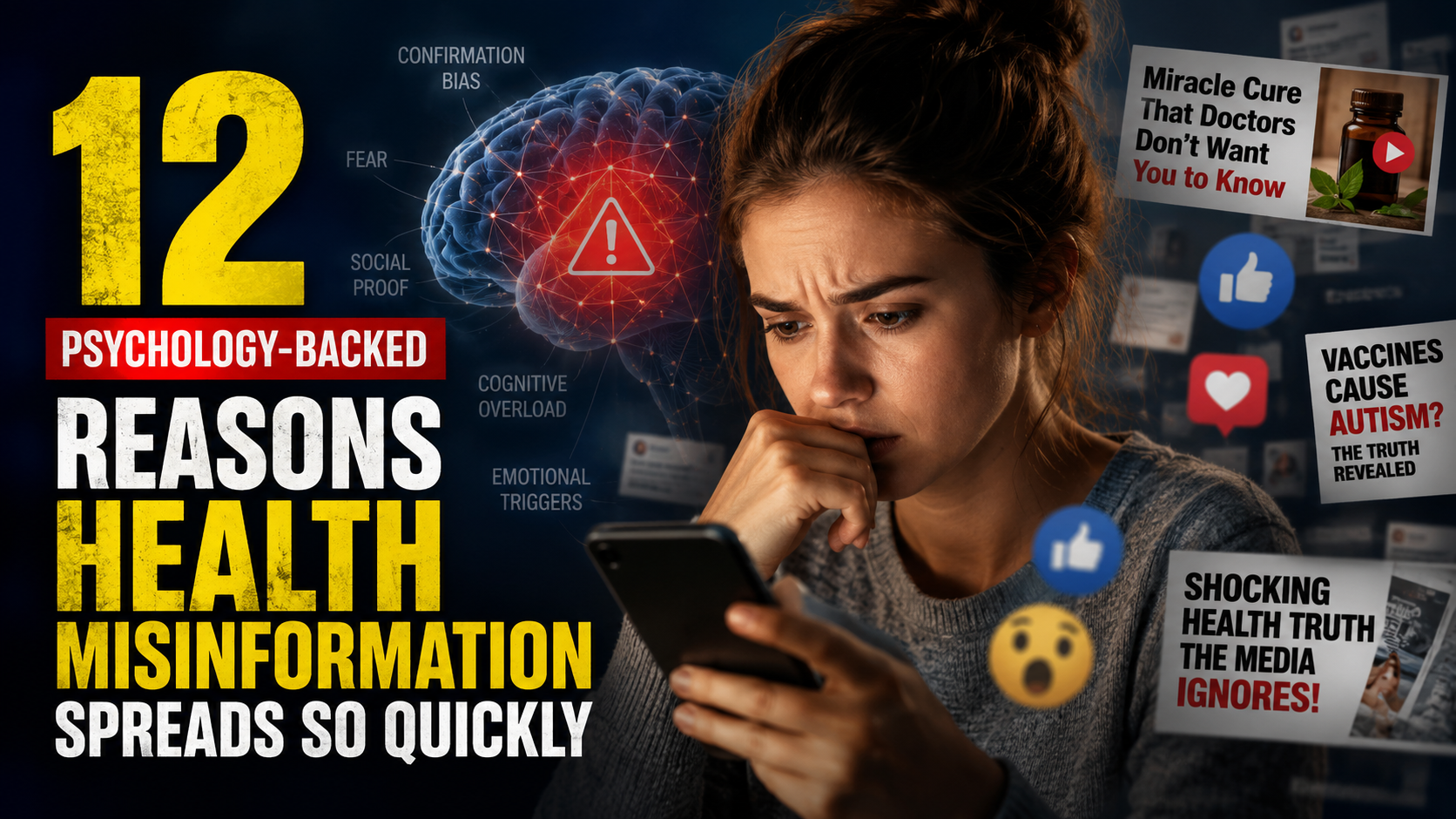
In today’s digital world, information travels faster than ever before. A health claim posted online can reach millions of people within hours, regardless of whether it is accurate or completely false. From miracle cures and diet myths to vaccine rumors and misleading medical advice, health misinformation has become one of the biggest challenges facing modern society.
The question is: why do so many people believe and share health misinformation, even when reliable scientific evidence is available?
The answer lies largely in human psychology. Our brains are designed to process information quickly, rely on mental shortcuts, and respond strongly to emotions. While these traits helped humans survive for thousands of years, they can also make us vulnerable to misinformation in the digital age.
Here are 12 psychology-backed reasons why health misinformation spreads so quickly—and why even intelligent people can fall for it.
1. Emotional Stories Feel More Convincing Than Facts
Humans are naturally drawn to stories. A personal account about someone who claims they were cured by an unconventional treatment often feels more compelling than statistics from a scientific study.
When a story triggers emotions such as fear, hope, anger, or inspiration, people tend to remember it better and share it more frequently. Unfortunately, emotional impact does not guarantee accuracy.
Scientific evidence may be more reliable, but a dramatic personal story often captures attention much faster.
2. Confirmation Bias Makes People Seek Supporting Evidence
One of the strongest psychological tendencies is confirmation bias—the habit of favoring information that supports existing beliefs while ignoring information that challenges them.
For example, someone who already distrusts pharmaceutical companies may be more likely to believe negative claims about vaccines, even when those claims lack evidence.
People often search for information that confirms what they already think rather than evaluating all available evidence objectively.
3. Fear Drives Faster Sharing
Fear is one of the most powerful human emotions. When people encounter information suggesting an immediate threat to their health or the health of their loved ones, they often react before verifying the facts.
Messages containing warnings such as “Doctors don’t want you to know this” or “This hidden danger could affect your family” create urgency and encourage rapid sharing.
Fear bypasses careful analysis and pushes people toward quick action.
4. The Brain Loves Simple Explanations
Health and medical science can be complex. Understanding diseases, treatments, and biological processes often requires specialized knowledge.
Misinformation frequently succeeds because it offers simple answers to complicated questions.
A claim like “One ingredient causes all disease” is much easier to understand than a detailed explanation involving genetics, lifestyle factors, environmental influences, and biological mechanisms.
People naturally gravitate toward explanations that are easy to process.
5. Repetition Creates a False Sense of Truth
Psychologists call this the “illusory truth effect.” The more often people hear a statement, the more likely they are to believe it.
Even false information can start to feel true when it appears repeatedly across social media feeds, videos, blogs, and conversations.
Familiarity creates comfort, and the brain often mistakes familiarity for accuracy.
This is one reason misinformation campaigns can be so effective over time.
6. Social Proof Influences Belief
People often look to others when deciding what to believe.
If a health claim has thousands of likes, shares, comments, or endorsements, many assume it must be credible.
This psychological phenomenon, known as social proof, helps people make decisions quickly. However, popularity is not the same as accuracy.
A misleading claim shared by millions can still be completely false.
7. Authority Figures Can Increase Trust Instantly
People tend to trust information presented by individuals who appear knowledgeable or influential.
A person wearing a lab coat, using medical terminology, or claiming expert credentials can gain credibility even if their information is inaccurate.
Similarly, celebrities and influencers can significantly impact public opinion on health topics.
When authority is perceived rather than verified, misinformation can spread rapidly.
8. Cognitive Overload Reduces Critical Thinking
Modern consumers face an overwhelming amount of information every day.
Between social media updates, news articles, videos, advertisements, and notifications, the brain often experiences information overload.
When people feel mentally exhausted, they rely more heavily on shortcuts and quick judgments rather than careful analysis.
As a result, misleading health claims can slip through without being properly evaluated.
9. Conspiracy Thinking Offers Psychological Comfort
Many health myths are connected to conspiracy theories.
While conspiracy theories may seem irrational from the outside, they often satisfy important psychological needs. They provide simple explanations for complex events and create a sense of certainty during uncertain times.
Believing that a hidden group controls events can sometimes feel easier than accepting that health crises involve complicated and unpredictable factors.
This desire for certainty can make conspiracy-related misinformation particularly appealing.
10. People Trust Friends and Family More Than Experts
Research consistently shows that personal relationships strongly influence beliefs.
If a close friend or family member shares a health claim, people are often more likely to trust it than information from a government agency or scientific institution.
The emotional trust built through relationships can outweigh objective evidence.
Unfortunately, this means misinformation can spread rapidly through social networks, even among people with good intentions.
11. Hope Can Be Just as Powerful as Fear
While fear often drives misinformation, hope can be equally influential.
People facing serious illnesses or difficult health challenges may become especially attracted to claims offering quick solutions, miracle cures, or guaranteed results.
The promise of an easy answer can be emotionally comforting.
Scammers and misinformation creators often exploit this desire for hope by promoting unproven treatments or exaggerated health claims.
12. Algorithms Reward Engagement, Not Accuracy
Although this reason involves technology, it interacts strongly with human psychology.
Social media platforms are designed to maximize engagement. Content that generates strong emotional reactions often receives more visibility.
Posts that provoke outrage, surprise, fear, or excitement tend to attract more clicks, comments, and shares.
Because misinformation frequently triggers strong emotions, algorithms may unintentionally amplify it, exposing larger audiences to questionable claims.
As a result, misleading health content can spread much faster than nuanced scientific explanations.
How to Protect Yourself From Health Misinformation
Understanding these psychological factors is the first step toward becoming a more informed consumer of health information.
Here are a few practical habits that can help:
- Pause before sharing health-related content.
- Verify claims using trusted medical sources.
- Check whether the information comes from qualified experts.
- Look for scientific evidence rather than isolated anecdotes.
- Be cautious of claims that seem overly dramatic or too good to be true.
- Read beyond headlines before forming conclusions.
- Compare information across multiple reliable sources.
Critical thinking is one of the most effective tools for navigating today’s information landscape.
Final Thoughts
Health misinformation spreads quickly because it takes advantage of natural human psychology. Emotional stories, confirmation bias, fear, social influence, and the desire for certainty all shape how people process information.
The reality is that believing misinformation is not necessarily a sign of low intelligence. These psychological tendencies affect nearly everyone. Understanding how they work can help individuals make better decisions, evaluate claims more carefully, and avoid becoming part of the misinformation cycle.
As information continues to move at unprecedented speed, developing strong critical-thinking skills may be one of the most valuable health habits a person can build. In a world overflowing with content, the ability to separate evidence from emotion is more important than ever.







