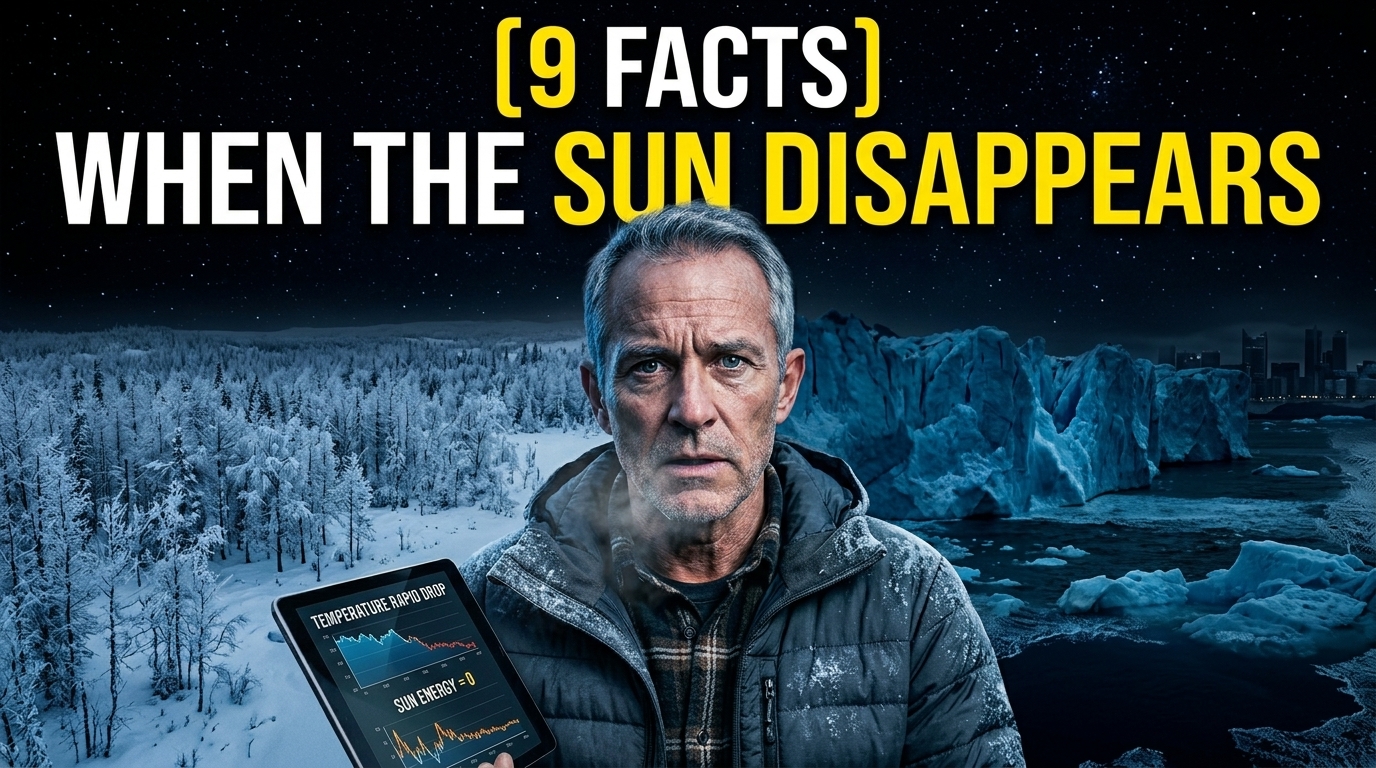
The Sun is so deeply woven into our daily lives that most of us rarely stop to think about its importance. Every sunrise brings light, warmth, and the energy needed to sustain life on Earth. Plants depend on it for growth, weather patterns are driven by it, and our planet remains in a stable orbit because of its gravitational pull.
But what if the unimaginable happened? What if the Sun suddenly vanished?
While this scenario is purely hypothetical and astronomically impossible under current scientific understanding, it offers a fascinating way to explore how dependent Earth is on its nearest star. Scientists have studied the physical consequences of such an event, and the results are both intriguing and terrifying.
Here are nine science-backed facts about what would happen if the Sun suddenly disappeared.
1. We Wouldn’t Notice Immediately
One of the most surprising facts is that the disappearance of the Sun would not be instantly noticeable on Earth.
Light travels at a finite speed—about 186,000 miles (300,000 kilometers) per second. Since the Sun is approximately 93 million miles (150 million kilometers) away from Earth, sunlight takes about 8 minutes and 20 seconds to reach us.
That means if the Sun vanished at this very moment, people on Earth would continue seeing it shining in the sky for another 8 minutes and 20 seconds. Daylight would continue as usual, and no one would realize anything was wrong.
Only after that brief delay would the sky suddenly go dark.
2. Earth Would Be Thrown Into Deep Space
The Sun doesn’t just provide light and heat—it also supplies the gravitational force that keeps Earth in orbit.
Just as sunlight takes time to travel across space, changes in gravity also move at the speed of light. This means Earth would continue orbiting normally for approximately 8 minutes and 20 seconds after the Sun disappeared.
Once that time passed, the gravitational pull holding Earth in its orbital path would vanish. Instead of circling where the Sun once was, Earth would move in a straight line through space at its current orbital velocity.
In simple terms, our planet would become a wandering world drifting through the darkness of interstellar space.
3. The Sky Would Turn Completely Dark
Without sunlight, daytime would instantly become night.
The bright blue color of the sky exists because sunlight scatters through Earth’s atmosphere. Remove the Sun, and that scattering effect disappears.
The result would be a sky far darker than anything normally experienced on Earth. Stars would become visible everywhere, even during what used to be daytime hours.
For a short time, some reflected light from planets and distant celestial objects might still be visible. However, the overall appearance of the sky would be dramatically darker than anything humanity has ever known.
4. Temperatures Would Begin Falling Rapidly
Earth’s warmth comes primarily from the Sun. Once that energy source disappeared, global temperatures would begin dropping almost immediately.
The cooling process wouldn’t be instant because the atmosphere and oceans store significant amounts of heat. However, temperatures would steadily decline as the planet radiated energy into space without receiving any replacement heat.
Within a few days, average temperatures could fall below freezing across much of the world. After a week, conditions would become increasingly hostile for both humans and wildlife.
Scientists estimate that within a year, the average surface temperature could plunge to around -100 degrees Fahrenheit (-73 degrees Celsius) or even lower in many regions.
5. Photosynthesis Would Stop Almost Immediately
Plants rely on sunlight to produce energy through photosynthesis. Without solar radiation, this process would cease almost instantly.
Initially, many plants would survive by using stored energy reserves. However, as days turned into weeks, most vegetation would begin to die.
This would trigger a chain reaction throughout ecosystems.
Herbivores would lose their primary food sources. Carnivores would eventually lose prey populations. Agricultural systems would collapse, making food production nearly impossible on a global scale.
The disappearance of sunlight would therefore threaten the foundation of Earth’s food web.
6. Oceans Would Eventually Freeze
The world’s oceans possess tremendous thermal inertia, meaning they lose heat more slowly than land surfaces.
Because of this, oceans would remain liquid longer than many people expect. Surface waters would gradually cool, and ice would begin forming on top.
Interestingly, the freezing process would happen from the surface downward. Ice acts as an insulator, slowing additional heat loss from deeper water layers.
Even after years without sunlight, parts of the deep ocean might remain liquid because of geothermal heat rising from Earth’s interior.
Nevertheless, the vast majority of the ocean surface would eventually become covered by thick layers of ice.
7. Most Life on Earth Would Struggle to Survive
Life on Earth evolved under constant sunlight, making the disappearance of the Sun a catastrophic event for nearly all living organisms.
Large animals, including humans, would face enormous challenges due to falling temperatures, food shortages, and environmental collapse.
Many species would disappear as ecosystems broke down. Forests, grasslands, and agricultural regions would become frozen landscapes incapable of supporting life as they once did.
However, not every organism would vanish.
Certain microbes already thrive in extreme environments such as deep-sea hydrothermal vents, where energy comes from Earth’s internal heat rather than sunlight. These organisms could potentially survive long after surface ecosystems collapsed.
8. Human Survival Would Depend on Technology
Humanity would not disappear overnight, but survival would become extraordinarily difficult.
Communities with access to advanced technology could potentially endure for extended periods by creating artificial environments. Underground shelters, geothermal energy systems, and controlled food production facilities might support limited populations.
Nuclear power and geothermal energy could provide heat and electricity when solar energy was no longer available.
Scientists have suggested that deep underground facilities or habitats near geothermal hotspots would offer the best chances for long-term survival.
Even so, maintaining civilization without sunlight would require unprecedented coordination, resources, and technological innovation.
9. Earth Would Eventually Become a Frozen World
Over time, Earth would transform into a planet almost unrecognizable compared to the one we know today.
Surface temperatures would continue declining. Oceans would freeze. The atmosphere would become increasingly cold and hostile. Most ecosystems would vanish, leaving only isolated pockets of life sustained by geothermal or artificial energy sources.
From space, Earth would appear as a dark, frozen sphere drifting through the galaxy.
While geothermal heat from Earth’s interior would continue providing some warmth deep underground, the vibrant, sunlit world that supports billions of organisms today would effectively cease to exist.
Why the Sun Is More Important Than Most People Realize
The Sun often feels like a permanent fixture of the universe, but its role in sustaining life is extraordinary.
Nearly every major process on Earth depends on solar energy in some way. Weather systems, ocean currents, plant growth, and climate patterns are all driven by sunlight. Even fossil fuels represent ancient solar energy stored in organic matter over millions of years.
Without the Sun, the interconnected systems that make Earth habitable would quickly begin to unravel.
Understanding this relationship helps scientists better appreciate not only our planet’s delicate balance but also the conditions necessary for life elsewhere in the universe.
Could the Sun Actually Disappear?
Fortunately, the answer is no.
Stars do not simply vanish without warning. The Sun is currently about 4.6 billion years old and is expected to remain stable for roughly another 5 billion years.
Eventually, it will expand into a red giant before shedding its outer layers and becoming a white dwarf. These changes will occur gradually over immense timescales, giving astronomers plenty of opportunity to observe and understand the process.
So while the sudden disappearance of the Sun makes for a fascinating scientific thought experiment, it is not something humanity needs to worry about.
Final Thoughts
Imagining a universe without the Sun highlights just how dependent life on Earth is on a single star. From providing warmth and light to maintaining our orbit and powering ecosystems, the Sun influences nearly every aspect of existence.
If it were to suddenly disappear, Earth would face immediate darkness, rapidly falling temperatures, collapsing ecosystems, and eventual transformation into a frozen wandering planet. While some forms of life might survive in isolated environments powered by geothermal energy, the vast majority of life as we know it would struggle to endure.
The scenario may be hypothetical, but it serves as a powerful reminder of the remarkable role the Sun plays in making Earth a thriving and habitable world.







