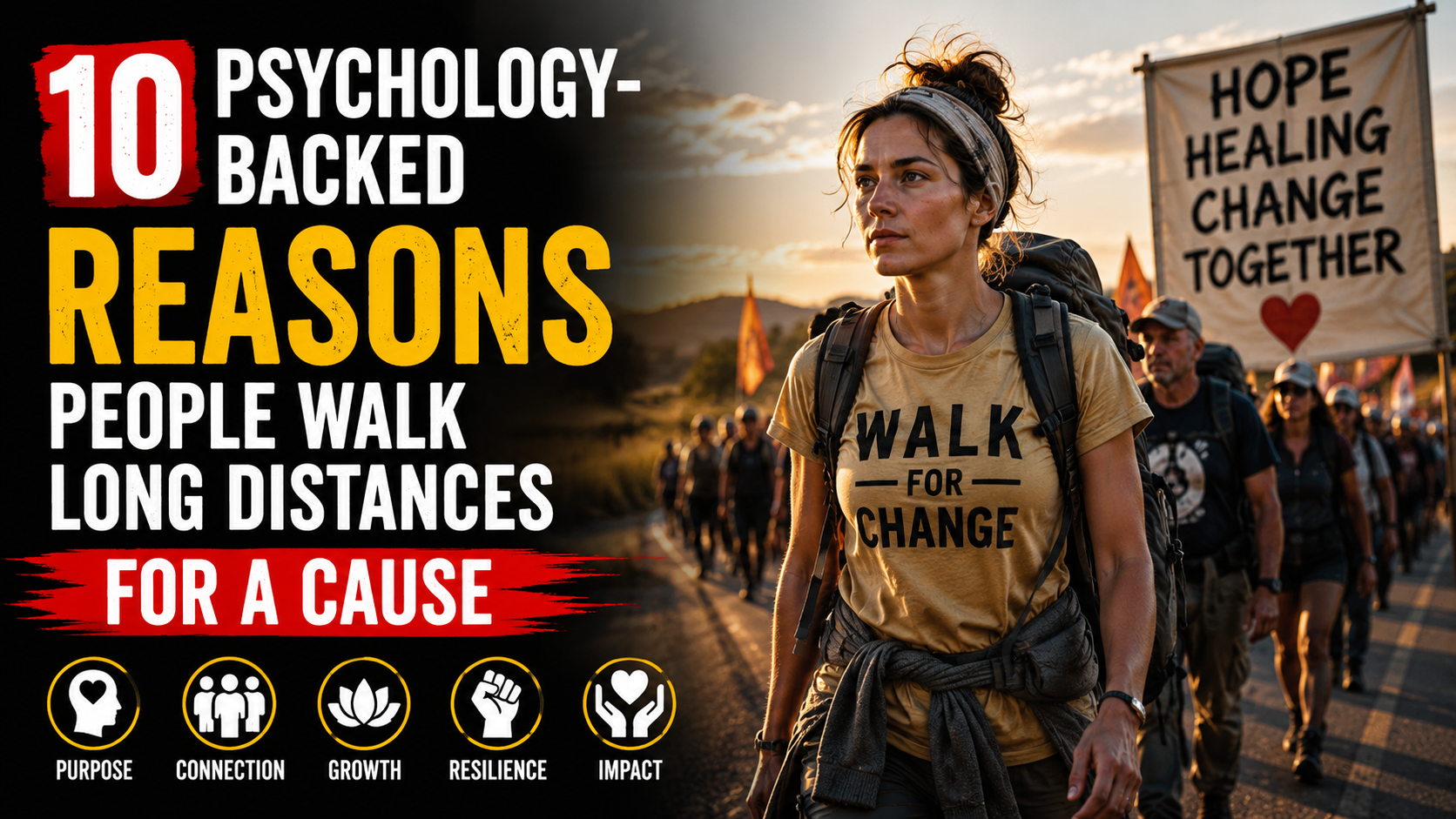
Throughout history, people have walked for reasons far greater than simply getting from one place to another. From religious pilgrimages and civil rights marches to charity events and peace walks, long-distance journeys have often carried deep personal and social meaning.
At first glance, choosing to walk hundreds—or even thousands—of miles may seem difficult to understand. After all, modern transportation can cover the same distance much faster and with far less effort. Yet every year, countless individuals voluntarily take on demanding walks to raise awareness, honor a cause, support a movement, or pursue personal growth.
What motivates someone to endure sore muscles, unpredictable weather, exhaustion, and weeks or months on the road?
The answer goes far beyond physical endurance.
Psychologists have found that people are often driven by powerful emotional and psychological factors when they commit to a meaningful journey. These walks are not simply about reaching a destination. They are often about purpose, connection, identity, and transformation.
Here are 10 psychology-backed reasons people choose to walk long distances for a cause.
1. Purpose Gives People Extraordinary Motivation
One of the strongest drivers of human behavior is purpose.
Research consistently shows that people can tolerate significantly greater challenges when they believe their efforts contribute to something meaningful.
A person walking across a state to raise awareness for mental health, veterans, environmental protection, or peace is often motivated by a mission larger than themselves.
Purpose changes how people interpret discomfort.
Instead of viewing fatigue as a reason to stop, they see it as part of their contribution to the cause.
Psychologists refer to this as “meaning-focused motivation.” When individuals connect their actions to a larger purpose, persistence often increases dramatically.
The walk becomes more than physical movement—it becomes a symbol of commitment.
2. Humans Need to Feel Part of Something Bigger
People are social creatures by nature.
For thousands of years, survival depended on belonging to groups and working together toward common goals.
That need for connection remains deeply rooted today.
Many long-distance walks unite participants around shared values, beliefs, or concerns.
Whether the cause involves peace, social justice, health awareness, or humanitarian efforts, walkers often develop a strong sense of community.
Psychologists call this collective identity.
When individuals feel connected to a group pursuing a meaningful objective, motivation tends to grow stronger and more sustainable.
The journey becomes not just “my walk,” but “our mission.”
3. Walking Creates Space for Reflection
Modern life can be noisy and fast-paced.
Between emails, social media notifications, work responsibilities, and daily obligations, many people rarely experience extended periods of quiet reflection.
Long-distance walking naturally creates that opportunity.
Hours spent moving through different landscapes often encourage introspection.
Many walkers report gaining clarity about personal goals, relationships, values, and life direction during extended journeys.
Studies suggest that repetitive physical activity can support creative thinking and self-reflection by reducing distractions and allowing the mind to process experiences more deeply.
For some people, the psychological benefits of reflection become just as important as the cause itself.
4. Physical Challenges Build Mental Strength
Human beings are often drawn to meaningful challenges.
Although comfort feels good in the short term, overcoming difficulties can create a powerful sense of accomplishment.
Long-distance walks provide a clear and measurable challenge.
Each mile completed serves as evidence of progress.
Psychologists have found that successfully overcoming difficult tasks strengthens self-efficacy—the belief in one’s ability to handle future challenges.
This confidence frequently extends beyond the walk itself.
Participants often finish their journeys believing they are capable of more than they previously imagined.
The experience becomes a reminder that growth often occurs outside familiar comfort zones.
5. Symbolic Actions Carry Emotional Power
Not every meaningful action needs to be practical.
Many long-distance walks are symbolic gestures intended to communicate a message.
The physical effort involved often becomes part of the story.
Walking hundreds of miles demonstrates dedication in a way that words alone cannot.
People instinctively recognize sacrifice and commitment.
When someone devotes weeks or months to a cause, observers often perceive the message as more authentic and sincere.
Psychologists note that symbolic actions tend to resonate emotionally because they make abstract ideas visible and tangible.
A long walk transforms values into action.
6. Helping Others Creates Personal Fulfillment
One of the most consistent findings in psychology is that helping others benefits the helper as well.
Acts of service frequently increase life satisfaction, emotional well-being, and feelings of purpose.
Many individuals participate in long-distance walks to raise funds, increase awareness, or advocate for important issues.
While the cause remains the primary focus, participants often experience personal fulfillment through contributing to something meaningful.
Researchers sometimes refer to this phenomenon as the “helper’s high.”
Acts of generosity and service can activate positive emotional responses that strengthen motivation and increase overall happiness.
In many cases, people discover that helping others enriches their own lives as well.
7. Shared Struggles Create Strong Human Connections
There is something unique about facing challenges alongside others.
Whether it’s climbing a mountain, training for a marathon, or completing a long-distance walk, shared experiences often create lasting bonds.
Psychologists have found that people tend to form stronger relationships when they work together through difficult circumstances.
Long-distance walkers frequently report developing deep friendships with fellow participants.
The challenges they face together create trust, understanding, and mutual respect.
These connections often become one of the most meaningful parts of the entire experience.
Years later, many walkers remember the people they met as vividly as the cause they supported.
8. People Want Their Actions to Reflect Their Values
Most individuals have beliefs they consider important.
However, daily life doesn’t always provide opportunities to express those values in visible ways.
Long-distance walks allow participants to align actions with beliefs.
Someone who values peace may join a peace march.
A person passionate about environmental protection may participate in a conservation walk.
An advocate for health awareness may walk to support research or education efforts.
Psychologists describe this as value congruence—the alignment between personal beliefs and behavior.
When actions reflect deeply held values, people often experience greater satisfaction and authenticity.
The journey becomes an outward expression of what matters most.
9. Difficult Journeys Often Lead to Personal Transformation
Major life experiences frequently change how people see themselves.
Long-distance walking can be one of those transformative experiences.
Extended journeys challenge individuals physically, emotionally, and mentally.
Unexpected obstacles often arise.
Plans change.
Conditions become difficult.
Yet participants continue moving forward.
Psychologists refer to the positive changes that emerge from overcoming adversity as post-challenge growth.
Many walkers finish their journeys with increased confidence, resilience, gratitude, and self-awareness.
The destination matters, but the personal transformation often becomes the lasting reward.
10. Humans Are Naturally Inspired by Hope
Many causes are rooted in hope.
People walk because they believe change is possible.
They believe awareness can grow.
Communities can heal.
Problems can be addressed.
Lives can improve.
Hope is one of the most powerful psychological forces influencing human behavior.
Research suggests that hopeful individuals are more likely to pursue goals, persist through obstacles, and remain motivated during difficult circumstances.
Long-distance walks often symbolize optimism in action.
Each step represents belief in a better future.
That message resonates not only with participants but also with the people who follow and support their journeys.
Why Long-Distance Walks Continue to Inspire People
Even in an age of technology, long-distance walks maintain a special place in society.
Part of their appeal lies in their simplicity.
Walking is something nearly everyone understands.
Unlike highly specialized activities, walking feels accessible and relatable.
People recognize the effort involved.
They understand the commitment required.
This makes the message easier to connect with emotionally.
The physical nature of walking also creates a visible demonstration of dedication.
Observers can see the sacrifice, persistence, and determination involved.
As a result, these journeys often inspire admiration and support.
The Connection Between Movement and Mental Health
Interestingly, walking itself offers numerous psychological benefits.
Research has linked regular walking to reduced stress, improved mood, enhanced cognitive function, and lower levels of anxiety.
Long-distance walkers frequently describe feeling mentally refreshed despite physical fatigue.
The combination of movement, outdoor environments, social interaction, and purposeful activity creates a powerful psychological experience.
Many participants report returning home with greater emotional balance and a stronger sense of perspective.
In this way, the journey often benefits both the cause and the individual undertaking it.
What These Walks Teach Us About Human Nature
Perhaps the most fascinating aspect of long-distance walks is what they reveal about people.
They demonstrate that humans are willing to endure discomfort when they believe in something meaningful.
They show that purpose can be stronger than convenience.
They highlight the importance of connection, service, resilience, and hope.
Most importantly, they remind us that people often seek more than personal success.
Many individuals want to contribute, inspire, and create positive change.
Long-distance walks provide a powerful way to do exactly that.
Final Thoughts
Walking long distances for a cause may appear to be a physical challenge, but psychology suggests it is much more than that.
These journeys are driven by purpose, connection, reflection, service, and hope. They allow individuals to align their actions with their values, strengthen relationships, develop resilience, and contribute to something larger than themselves.
The miles traveled are certainly impressive.
But the deeper story lies in the human motivations behind every step.
Whether someone walks 20 miles or 2,000, the journey often reflects a timeless truth about human nature: people are willing to go remarkably far when they believe their efforts can make a difference.
And perhaps that’s why these stories continue to inspire us.
They remind us that meaningful change rarely happens all at once—it happens one step at a time.







