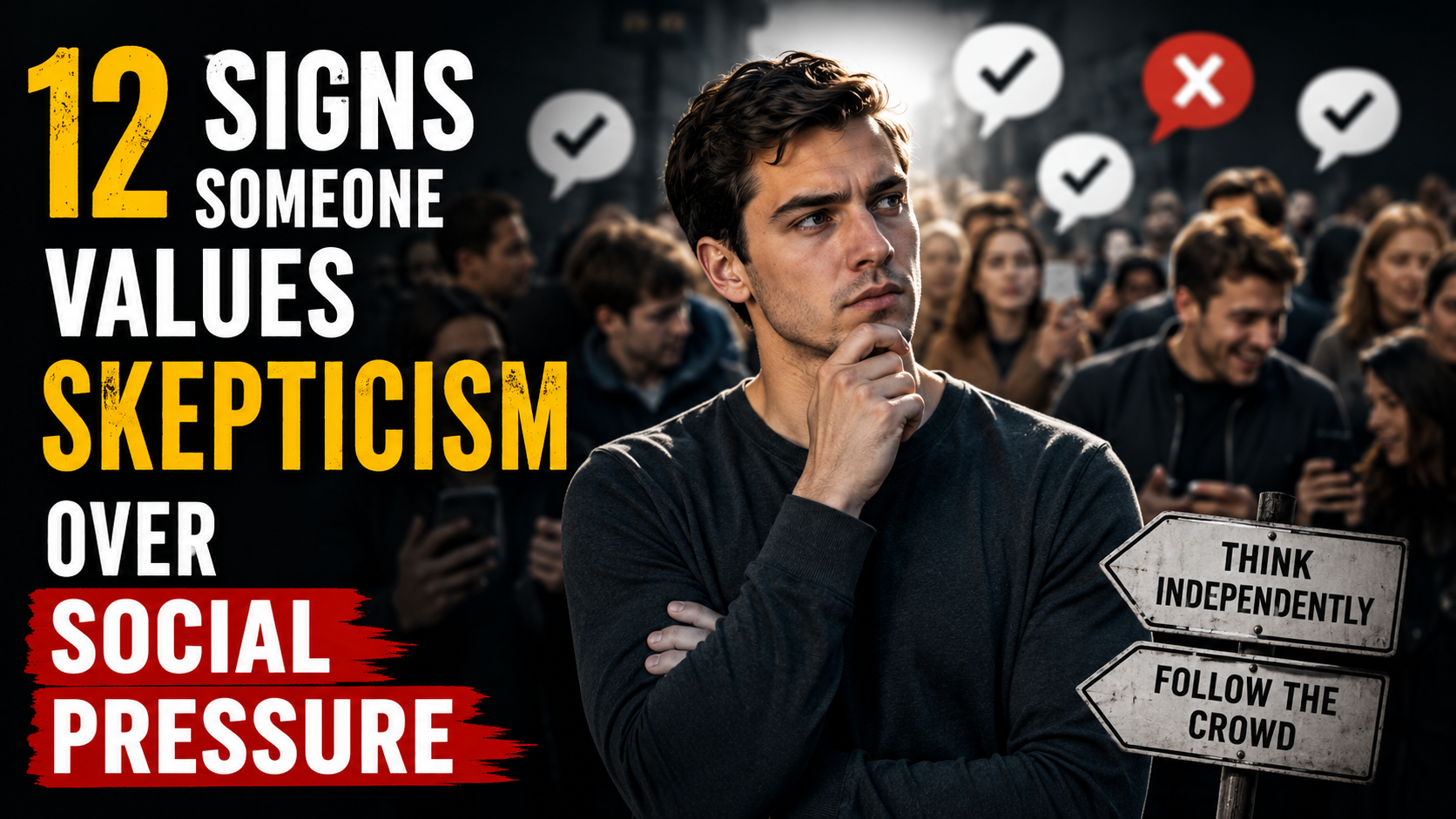
In a world where opinions spread faster than ever, standing apart from the crowd can be surprisingly difficult. Social media trends, workplace cultures, friend groups, and even family traditions often influence what people think, say, and believe. While social connection is a natural part of human life, there is an important difference between learning from others and simply following the crowd.
Some individuals place a high value on skepticism. This doesn’t mean they are cynical, argumentative, or unwilling to trust anyone. Instead, they prefer to evaluate information carefully before accepting it. They ask questions, seek evidence, and remain open to changing their minds when new facts emerge.
Psychologists have long studied the tension between independent thinking and social conformity. Research consistently shows that many people alter their opinions to fit in with a group, even when they privately disagree. Yet there are individuals who resist that pressure and choose critical thinking over popularity.
These people are often better equipped to navigate misinformation, make thoughtful decisions, and maintain intellectual independence.
Here are 12 signs someone values skepticism over social pressure.
1. They Ask Questions Before Accepting Claims
One of the clearest signs of a skeptical thinker is curiosity.
When they hear a bold statement, surprising statistic, or popular opinion, they rarely accept it immediately. Instead, they ask questions.
Where did this information come from?
Is there evidence supporting it?
Who benefits from people believing it?
Rather than viewing questions as confrontational, they see them as a necessary part of understanding reality.
Their goal isn’t to win arguments. It’s to gain clarity.
In many situations, a simple question can reveal whether a claim is supported by facts or built on assumptions.
2. They Feel Comfortable Disagreeing With the Majority
Humans naturally seek belonging. Being accepted by others has historically helped people survive and thrive.
Because of this, disagreeing with a group can feel uncomfortable.
People who value skepticism are willing to tolerate that discomfort.
If evidence leads them toward a different conclusion, they won’t automatically change their opinion simply because most people think otherwise.
This doesn’t mean they’re stubborn.
They’re open to changing their minds—but only when presented with convincing information, not social pressure.
Their confidence comes from reasoning rather than popularity.
3. They Separate Facts From Emotions
Emotions influence every human being.
However, skeptical thinkers recognize that strong feelings don’t automatically make something true.
When evaluating a situation, they try to distinguish between emotional reactions and factual evidence.
For example, a story may feel convincing because it’s dramatic, not because it’s accurate.
A claim may seem believable because it aligns with personal fears or hopes.
People who value skepticism understand this distinction.
They acknowledge emotions while still seeking objective information.
4. They Change Their Minds When New Evidence Appears
Many people assume changing your mind is a sign of weakness.
In reality, it often reflects intellectual maturity.
Skeptical individuals understand that beliefs should evolve when new information becomes available.
If reliable evidence contradicts a previous assumption, they’re willing to reconsider their position.
This flexibility allows them to grow and learn over time.
Their goal isn’t to be right forever.
Their goal is to be as accurate as possible.
5. They Are Comfortable Saying “I Don’t Know”
Modern culture often rewards certainty.
People are expected to have opinions on everything, even subjects they know little about.
Skeptical thinkers take a different approach.
They understand that knowledge has limits.
Rather than pretending to be experts, they’re comfortable admitting uncertainty.
Saying “I don’t know” doesn’t threaten their confidence.
Instead, it opens the door to learning.
Ironically, people who admit what they don’t know are often more trustworthy than those who claim to know everything.
6. They Evaluate Sources Carefully
Not all information deserves equal trust.
People who prioritize skepticism pay attention to where information originates.
They consider factors such as expertise, credibility, evidence, transparency, and potential bias.
This habit becomes especially important in the digital age, where misinformation can spread rapidly.
A skeptical person may read headlines carefully, compare multiple sources, and verify claims before sharing them.
They understand that the quality of information often depends on the quality of the source.
7. They Resist Peer Pressure in Everyday Situations
Skepticism isn’t limited to major social issues or scientific debates.
It also appears in everyday decisions.
Whether choosing products, making financial decisions, joining trends, or participating in group activities, skeptical individuals tend to think independently.
They don’t automatically assume something is worthwhile because everyone else is doing it.
Instead, they evaluate whether it aligns with their goals, values, and understanding.
This independence often protects them from impulsive decisions driven by social influence.
8. They Prefer Evidence Over Popularity
Popularity and accuracy are not the same thing.
History provides countless examples of widely accepted beliefs that later proved incorrect.
People who value skepticism recognize this reality.
When faced with a conflict between evidence and public opinion, they tend to prioritize evidence.
This doesn’t mean they dismiss consensus entirely.
Expert agreement can be valuable.
However, they still want to understand the reasoning and evidence behind the conclusion.
Their trust is earned through substance, not popularity.
9. They Enjoy Learning From Different Perspectives
Contrary to common stereotypes, skepticism often makes people more open-minded.
Because they care about understanding the truth, they are often willing to explore viewpoints different from their own.
They read broadly.
They listen to people with opposing opinions.
They consider alternative explanations.
Exposure to diverse perspectives helps them identify weaknesses in their own thinking and strengthen their understanding.
Rather than fearing disagreement, they often see it as an opportunity to learn.
10. They Recognize Their Own Biases
Everyone has cognitive biases.
These mental shortcuts influence how people interpret information and make decisions.
Skeptical individuals understand that they are not immune.
Instead of assuming they’re perfectly objective, they actively look for blind spots in their thinking.
They ask themselves:
Am I being influenced by personal preferences?
Am I only seeking information that confirms my beliefs?
Could there be another explanation?
This self-awareness improves decision-making and reduces the likelihood of becoming trapped by assumptions.
11. They Value Truth More Than Approval
Perhaps the strongest indicator of skepticism is a willingness to prioritize truth over social acceptance.
This can be challenging.
People naturally enjoy praise, agreement, and validation.
Yet skeptical thinkers understand that popularity is not always a reliable guide.
If evidence points in a certain direction, they are willing to accept uncomfortable conclusions.
Their self-worth depends less on external approval and more on intellectual honesty.
This mindset often requires courage, particularly in environments where conformity is rewarded.
12. They Think Before They Share Information
In today’s fast-moving digital environment, information spreads with a single click.
Many people share articles, videos, and claims without verifying them.
Skeptical individuals take a more cautious approach.
Before reposting content, they often check facts, review sources, and evaluate credibility.
They understand that sharing misinformation—even unintentionally—can have real consequences.
As a result, they tend to contribute to more thoughtful and informed discussions.
Their skepticism acts as a filter against impulsive reactions.
Why Social Pressure Is So Powerful
To appreciate skeptical thinking, it’s helpful to understand why social pressure affects people so strongly.
Psychologists have studied conformity for decades.
Classic experiments demonstrated that many individuals will agree with an incorrect group opinion simply to avoid standing out.
This tendency is deeply rooted in human evolution.
For most of history, belonging to a group improved survival.
As a result, people developed strong psychological motivations to fit in.
While these instincts remain useful in many situations, they can sometimes lead people away from independent thinking.
Recognizing this tendency is the first step toward resisting it.
The Difference Between Skepticism and Cynicism
It’s important not to confuse skepticism with cynicism.
A skeptic asks questions because they want reliable answers.
A cynic assumes the worst regardless of evidence.
Healthy skepticism remains open to persuasion.
It doesn’t reject ideas automatically.
Instead, it evaluates them carefully.
This distinction matters because skepticism supports learning, while cynicism can sometimes prevent it.
The most effective thinkers balance curiosity with critical evaluation.
Benefits of Healthy Skepticism
People who practice healthy skepticism often enjoy several advantages.
They may be less vulnerable to scams, misinformation, and manipulation.
They frequently make more informed decisions because they examine evidence carefully.
They also tend to develop stronger critical-thinking skills over time.
Additionally, skepticism can improve conversations.
Rather than reacting emotionally, skeptical individuals often approach disagreements with curiosity and analysis.
This creates opportunities for deeper understanding and more productive discussions.
How to Develop a More Skeptical Mindset
The good news is that skepticism can be strengthened through practice.
Simple habits can make a significant difference:
- Ask questions before accepting claims.
- Verify information using reliable sources.
- Seek perspectives that challenge your assumptions.
- Learn about common cognitive biases.
- Pause before sharing information online.
- Be willing to revise beliefs when evidence changes.
Over time, these habits help build intellectual independence and improve decision-making.
Final Thoughts
In a world filled with opinions, trends, and constant information, skepticism remains one of the most valuable skills a person can develop.
People who value skepticism over social pressure are not necessarily rebellious or contrarian. Instead, they are committed to understanding reality as accurately as possible. They ask questions, evaluate evidence, remain open to learning, and resist the urge to follow the crowd without reflection.
These habits encourage stronger critical thinking, better decisions, and a deeper appreciation for truth.
Ultimately, skepticism isn’t about doubting everything. It’s about caring enough to look beyond assumptions and discover what is actually true.
And in an age where information is everywhere, that mindset may be more important than ever.







