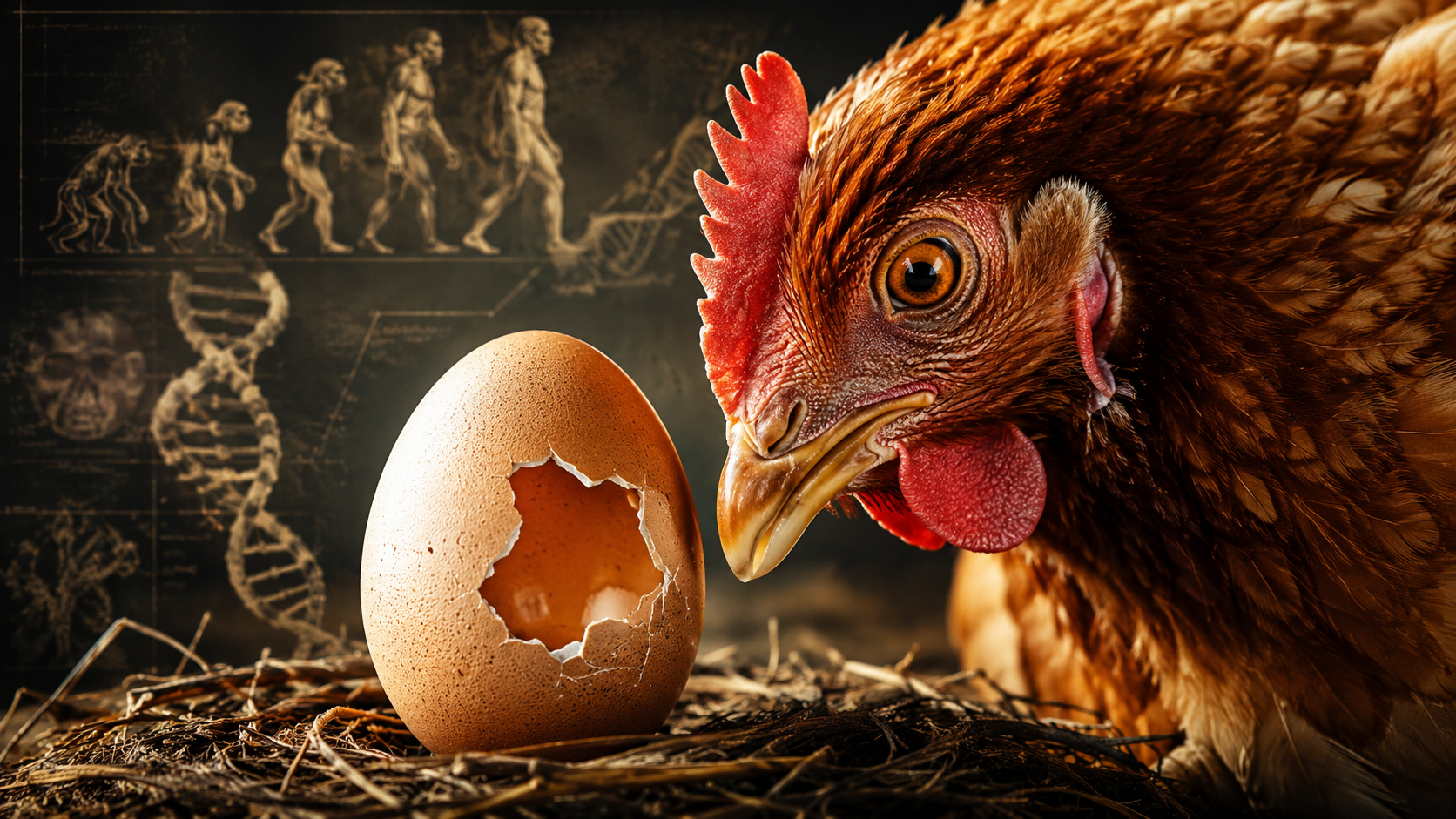
Few questions have sparked as much curiosity as the classic riddle: Which came first, the chicken or the egg?
At first glance, it sounds like a simple brain teaser. After all, every chicken hatches from an egg, and every chicken egg is laid by a chicken. The question seems to create an endless loop with no clear starting point.
However, when viewed through the lens of evolutionary biology, the puzzle becomes far more fascinating. Scientists have spent centuries studying how species evolve, how genetic mutations are passed from one generation to the next, and how entirely new species emerge over time. These discoveries provide surprising insights into the famous question while revealing just how complex the history of life on Earth really is.
The answer isn’t as straightforward as many people expect, and understanding it requires a closer look at evolution itself. Here are 11 fascinating facts about evolution that make the chicken-or-egg puzzle even more intriguing.
1. Eggs Existed Long Before Chickens
One of the most important facts often overlooked in the debate is that eggs are far older than chickens.
Long before birds appeared, ancient fish, amphibians, reptiles, and countless other creatures reproduced using eggs. In fact, egg-laying evolved hundreds of millions of years before the first chicken ever existed.
The earliest amniotic eggs—eggs capable of developing on land—appeared roughly 300 million years ago. Chickens, by comparison, are a very recent addition to Earth’s history.
If we’re talking about eggs in general, the egg clearly came first.
2. Species Do Not Appear Overnight
Many people imagine evolution as a process in which one species suddenly transforms into another. In reality, evolution occurs gradually over many generations.
Small genetic changes accumulate over time. These changes may affect appearance, behavior, size, or other characteristics. Eventually, enough differences emerge that scientists classify the descendants as a new species.
This gradual process makes identifying the exact moment when a non-chicken became a chicken surprisingly difficult.
3. The First Chicken Had Parents That Were Almost Chickens
The modern chicken did not emerge from an entirely different animal.
Instead, it descended from birds that were extremely similar to chickens but not quite identical by scientific definition. These ancestral birds would have looked remarkably familiar to us, with only subtle genetic differences separating them from modern chickens.
At some point, two nearly-chicken parents produced offspring carrying genetic traits that scientists would recognize as belonging to the first true chicken.
4. Genetic Mutations Drive Evolution
Evolution depends on genetic variation.
Whenever organisms reproduce, small changes can occur in their DNA. Most mutations have little effect, while some may provide advantages or disadvantages. Over time, beneficial traits can spread through populations.
The mutation that helped create the first true chicken likely occurred before the chick hatched. That means the defining genetic change existed inside the egg before the chicken itself emerged.
This detail plays a major role in how many scientists answer the chicken-or-egg question.
5. Every Generation Is Slightly Different
No offspring is genetically identical to its parents, except in rare cases such as cloning.
Each generation inherits a unique combination of genetic material. These small differences may seem insignificant, but across thousands or millions of generations, they can lead to dramatic evolutionary changes.
The chicken’s ancestors gradually accumulated countless tiny genetic variations that eventually produced the bird we know today.
6. Evolution Has No Clear Starting Line
One reason the puzzle remains so captivating is that evolution doesn’t operate in neat categories.
Nature does not announce when one species officially becomes another. Instead, populations slowly change over time. Scientists classify species based on observable traits and genetic evidence, but these distinctions are human-created frameworks used to describe a continuous process.
This means the transition from “almost chicken” to “chicken” was likely gradual rather than sudden.
7. Birds Evolved From Dinosaurs
One of the most remarkable discoveries in modern paleontology is that birds are direct descendants of dinosaurs.
Fossil evidence shows that many bird features—including feathers, hollow bones, and specialized skeletal structures—originated in certain dinosaur groups millions of years before modern birds appeared.
In a sense, every chicken carries traces of an ancient dinosaur lineage stretching back more than 150 million years.
This connection makes the chicken-or-egg puzzle part of a much larger evolutionary story.
8. Eggs Are Evolutionary Masterpieces
Eggs played a crucial role in allowing life to expand across Earth’s environments.
The development of protective shells and specialized membranes allowed embryos to survive outside water, opening new opportunities for reptiles, birds, and other animals.
Without this evolutionary innovation, many modern species—including chickens—might never have evolved at all.
The egg was one of nature’s most successful inventions long before chickens entered the picture.
9. Domestic Chickens Have a Surprising History
Modern chickens are descendants of wild birds native to Southeast Asia.
Scientists believe domestic chickens primarily evolved from the red junglefowl, a bird species that still exists today. Over thousands of years, humans selectively bred these birds for traits such as size, egg production, and temperament.
As a result, the chickens found on farms today differ significantly from their ancient ancestors, demonstrating that evolution continues even under human influence.
10. Evolution Never Stops
Many people think evolution is something that happened only in the distant past. In reality, evolution is an ongoing process.
Every living species continues to experience genetic changes over time. Environmental pressures, competition, disease, and reproduction all influence which traits become more common in future generations.
The chicken of today may not be identical to the chicken that exists thousands of years from now.
Evolution is a continuous story rather than a completed event.
11. Science Offers a Fascinating Answer to the Puzzle
When scientists analyze the chicken-or-egg question from an evolutionary perspective, many conclude that the egg came first.
Here’s why: the genetic mutation that produced the first true chicken likely occurred in an embryo developing inside an egg laid by a bird that was almost—but not quite—a chicken.
In that scenario, the egg containing the first true chicken existed before the chicken hatched from it.
This interpretation provides one of the most widely accepted scientific solutions to the famous riddle.
Why the Question Continues to Fascinate People
The chicken-or-egg puzzle endures because it touches on deeper questions about origins, causality, and the history of life.
People naturally seek clear beginnings and simple answers. Evolution, however, often reveals that nature operates through gradual transitions rather than sharp boundaries.
The riddle serves as a reminder that scientific discoveries frequently challenge our assumptions and encourage us to think beyond everyday logic.
What seems like a simple question can open the door to discussions about genetics, paleontology, biodiversity, and the mechanisms that shape life itself.
The Bigger Picture of Evolution
The story behind the chicken and the egg illustrates one of evolution’s most important lessons: life is interconnected.
Every species alive today is linked through a vast chain of ancestry stretching back billions of years. Chickens, dinosaurs, reptiles, fish, and humans all share common evolutionary roots somewhere in the distant past.
Understanding these connections helps scientists reconstruct Earth’s biological history and better understand how life continues to change.
Far from being a trivial riddle, the chicken-or-egg question highlights the extraordinary complexity of evolution and the remarkable journey that produced the diversity of life we see today.
Final Thoughts
The next time someone asks whether the chicken or the egg came first, you’ll know the discussion is about much more than poultry. It’s a question that leads directly into one of science’s most fascinating subjects: evolution.
Eggs existed hundreds of millions of years before chickens, species evolve gradually through genetic changes, and the first true chicken almost certainly hatched from an egg laid by a bird that was nearly a chicken itself.
While the debate may continue as a fun conversation starter, evolutionary biology offers a compelling perspective. The answer appears to favor the egg—but the real value lies in the incredible scientific story hidden behind the question.
Sometimes the simplest riddles reveal the most extraordinary truths about the natural world.







