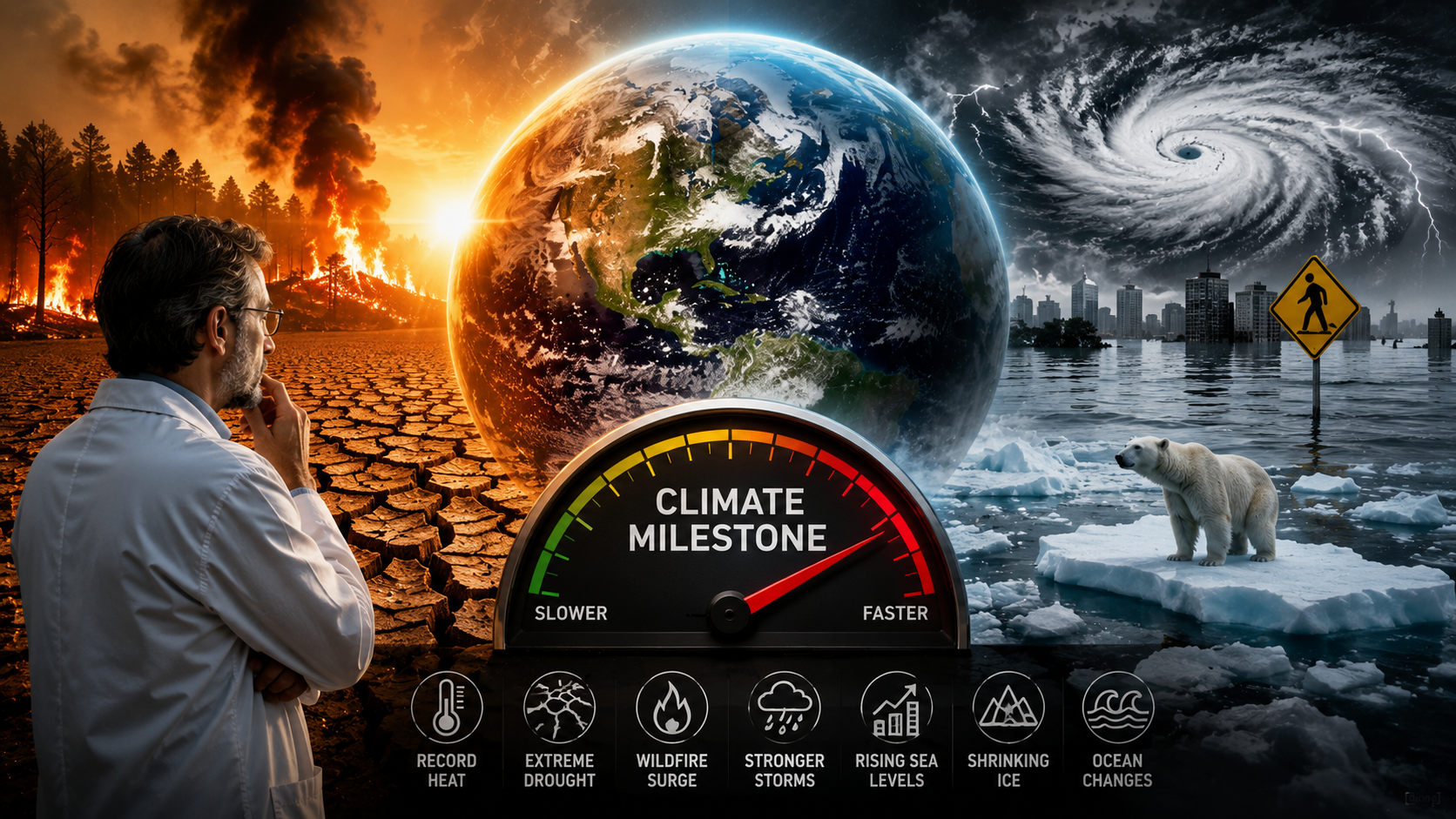
In recent years, climate scientists have increasingly warned that Earth’s environmental systems are changing faster than many earlier projections suggested. While climate change has long been recognized as a gradual process, new data and observed patterns indicate that some critical thresholds—often referred to as climate milestones or tipping points—may be arriving sooner than anticipated.
These milestones are not single dramatic events but rather measurable shifts in long-term environmental systems. They can include rising global temperatures, accelerating ice loss, ocean warming, ecosystem disruption, and changes in atmospheric patterns.
The concern among scientists is not only that these changes are happening, but that they are happening more quickly than expected under earlier models.
Understanding these signals is essential for interpreting where the planet currently stands and what may come next.
Here are seven key signs suggesting that Earth may be reaching significant climate milestones faster than scientists once projected.
1. Record-Breaking Global Temperatures Are Becoming the New Normal
One of the most widely recognized indicators of accelerating climate change is the frequency of global temperature records being broken.
Over the past decade, heat records have not only been set—they have been exceeded repeatedly in short succession.
What was once considered an extreme temperature event is increasingly becoming a regular occurrence.
This shift is important because climate models are built on long-term averages. When those averages are consistently surpassed, it suggests that underlying assumptions may need updating.
Rising temperatures affect nearly every other climate system, including weather patterns, ocean conditions, and ecosystem stability.
The rapid pace of warming is one of the clearest signals that climate milestones may be unfolding faster than expected.
2. Polar Ice Loss Is Accelerating Beyond Earlier Estimates
The polar regions are among the most sensitive indicators of climate change.
Both Arctic and Antarctic ice sheets play a crucial role in regulating global temperatures by reflecting sunlight and maintaining ocean balance.
Recent observations show that ice melt is occurring at a faster rate than earlier scientific projections had suggested.
Glaciers are retreating more quickly, seasonal ice coverage is shrinking, and long-term ice stability is weakening.
This acceleration is significant because ice loss contributes to sea level rise and reduces the planet’s ability to reflect solar radiation, further amplifying warming.
When ice systems change faster than predicted, it signals that feedback loops may be strengthening.
3. Ocean Temperatures Are Rising at Unexpected Rates
The oceans absorb more than 90% of the excess heat generated by greenhouse gas emissions.
As a result, ocean temperature trends are a critical indicator of climate change progression.
In recent years, marine heatwaves have become more frequent and more intense. Large ocean regions have experienced sustained periods of unusually high temperatures.
These changes affect marine ecosystems, weather systems, and global climate patterns.
Warmer oceans can disrupt fish populations, damage coral reefs, and intensify storms.
When ocean warming accelerates beyond expected models, it suggests that Earth’s energy balance is shifting more rapidly than anticipated.
4. Extreme Weather Events Are Increasing in Frequency and Intensity
Another major sign of accelerated climate milestones is the rising frequency of extreme weather events.
These include:
- More intense hurricanes
- Prolonged droughts
- Severe heatwaves
- Heavy rainfall and flooding
While extreme weather has always existed, the pattern of occurrence is changing.
Events that were once considered rare are now happening more regularly, and in some cases with greater intensity.
This shift is consistent with a warming atmosphere, which holds more moisture and energy.
The increasing unpredictability of weather systems is one of the most visible impacts of climate change for people around the world.
5. Ecosystems Are Shifting Faster Than Expected
Natural ecosystems are highly sensitive to temperature and environmental changes.
One of the most concerning trends observed by scientists is the rapid shift in plant and animal behavior, migration, and survival patterns.
Species are moving toward cooler regions, whether that means higher altitudes or latitudes closer to the poles.
Some ecosystems are struggling to adapt quickly enough to changing conditions.
Coral reefs, for example, are experiencing widespread bleaching events due to rising ocean temperatures.
Forest systems are also under stress from heat, drought, and pest outbreaks.
When ecosystems shift faster than expected, it indicates that biological systems are responding urgently to environmental pressure.
6. Sea Level Rise Is Accelerating in Coastal Regions
Sea level rise is one of the most long-term and irreversible consequences of climate change.
It is driven primarily by two factors: melting ice and the thermal expansion of seawater as it warms.
Recent measurements show that sea levels are rising at a faster rate than earlier projections in several regions.
This is particularly concerning for coastal cities, low-lying islands, and vulnerable ecosystems.
Even small increases in sea level can significantly impact flooding frequency, storm surge damage, and freshwater contamination.
The acceleration of this process suggests that polar ice melt and ocean warming may be occurring more rapidly than expected.
7. Climate Feedback Loops May Be Strengthening
Perhaps the most complex and concerning sign of acceleration is the potential strengthening of climate feedback loops.
A feedback loop occurs when a change in the climate system triggers additional changes that further intensify the original effect.
For example:
- Melting ice reduces reflectivity, causing more heat absorption
- Warming oceans release more heat into the atmosphere
- Thawing permafrost releases methane, a powerful greenhouse gas
These processes can reinforce each other, potentially accelerating overall warming.
Scientists closely monitor these feedback mechanisms because they can shift climate systems into faster or less predictable trajectories.
When feedback loops strengthen, they may indicate that certain climate thresholds are being approached sooner than expected.
Why Faster-Than-Expected Change Matters
Climate models are essential tools for predicting future environmental conditions. They are based on historical data, physical laws, and observed trends.
However, when real-world changes begin to outpace predictions, it suggests that some variables may be shifting more quickly or interacting in more complex ways than originally understood.
This does not mean that climate science is uncertain—it means the system itself is dynamic and evolving.
Faster-than-expected changes make planning, adaptation, and mitigation more urgent.
They also highlight the importance of continuous monitoring and updated modeling.
The Human Impact of Climate Acceleration
While climate milestones are often discussed in scientific terms, their effects are increasingly felt in daily life.
Communities around the world are experiencing:
- Higher energy demands due to heat
- Increased flooding in coastal and river regions
- Agricultural stress from changing rainfall patterns
- Health risks linked to air quality and temperature extremes
These impacts are not evenly distributed. Some regions are far more vulnerable than others, particularly areas with limited infrastructure or resources.
As climate systems shift more quickly, adaptation becomes more challenging and more essential.
What Scientists Are Focused on Now
In response to these accelerating changes, climate scientists are focusing on several key priorities:
- Improving predictive climate models
- Monitoring ice sheets and ocean systems in real time
- Studying feedback loop behavior
- Tracking extreme weather trends
- Developing adaptation strategies for vulnerable regions
The goal is not only to understand what is happening, but also to prepare for what may come next.
Final Thoughts
The evidence suggests that Earth’s climate systems are changing in ways that may be faster than earlier scientific expectations.
The seven major signs include:
- Rising global temperatures
- Accelerating ice loss
- Warming oceans
- More extreme weather
- Rapid ecosystem shifts
- Rising sea levels
- Strengthening feedback loops
Together, these indicators point to a planet undergoing rapid transformation.
While the situation is complex, one thing is clear: understanding these changes is essential for planning a more resilient future.
Climate milestones are not distant events—they are unfolding in real time.
And how humanity responds to them will shape the decades ahead.







