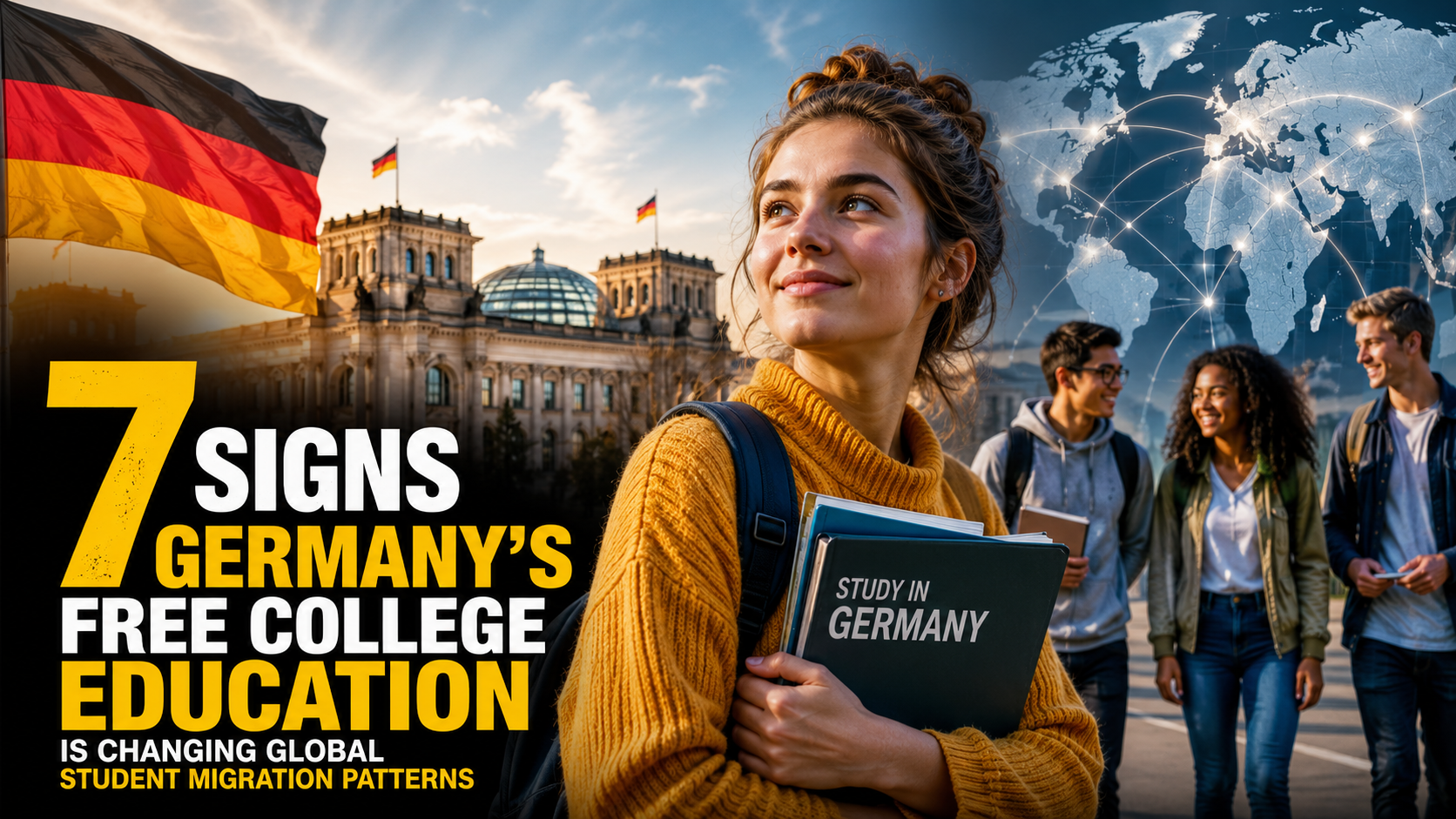
For decades, students seeking higher education abroad typically looked toward countries such as the United States, the United Kingdom, Canada, and Australia. These destinations became synonymous with prestigious universities, cutting-edge research opportunities, and international career prospects. However, a significant shift has been quietly taking place in recent years.
Germany has emerged as one of the most attractive study destinations in the world, thanks largely to its policy of offering low-cost or tuition-free education at many public universities, including for international students. Combined with a strong economy, globally recognized institutions, and growing English-language degree programs, Germany is increasingly influencing where students choose to pursue higher education.
As a result, global student migration patterns are evolving. Here are seven clear signs that Germany’s approach to higher education is reshaping international academic mobility.
1. International Student Enrollment in Germany Continues to Rise
One of the strongest indicators of changing migration trends is the steady growth in the number of international students choosing Germany.
Students from Asia, Africa, the Middle East, Latin America, and even other European nations are increasingly selecting German universities over traditional English-speaking destinations. The appeal is easy to understand: access to high-quality education without the burden of massive tuition costs.
For many families, the financial difference can be dramatic. While a degree in some countries may cost tens of thousands of dollars per year in tuition alone, students in Germany often pay only administrative fees and living expenses.
This affordability has opened doors for talented students who might otherwise be unable to pursue international education.
2. Students Are Prioritizing Value Over Prestige Alone
In previous generations, many students focused primarily on attending universities with globally recognized brand names. Today, cost-benefit analysis plays a much larger role in decision-making.
Rising tuition fees and increasing student debt have led prospective students to reconsider traditional study destinations. Germany’s model presents an appealing alternative: respected academic institutions combined with significantly lower educational costs.
Students are increasingly asking practical questions:
- Will this degree provide career opportunities?
- How much debt will I accumulate?
- What is my return on investment?
For many, Germany provides compelling answers. As a result, migration decisions are becoming more financially strategic rather than purely prestige-driven.
3. More Students Are Choosing Continental Europe
Germany’s popularity has contributed to broader interest in continental Europe as an educational destination.
Previously, many international students viewed Europe mainly through the lens of exchange programs or short-term study opportunities. Today, countries across the continent are attracting full-degree seekers, with Germany often serving as the gateway.
Students who initially research German universities frequently discover the broader advantages of studying within Europe, including:
- Access to multiple countries through convenient travel.
- Exposure to diverse cultures and languages.
- Opportunities for international networking.
- Participation in multinational research initiatives.
Germany’s education model has helped position Europe as a serious competitor to traditional study-abroad destinations.
4. English-Taught Programs Are Expanding Student Accessibility
One factor accelerating Germany’s influence is the rapid growth of English-language degree programs.
Historically, language barriers limited international enrollment. Many students were hesitant to pursue education in countries where fluency in the local language was required.
German universities have increasingly responded by offering bachelor’s, master’s, and doctoral programs taught entirely in English. This change has dramatically expanded accessibility for international applicants.
Students can now earn degrees in fields such as:
- Engineering
- Computer science
- Business administration
- Data science
- International relations
- Environmental studies
Without needing advanced German proficiency before enrollment, students gain access to world-class education while gradually learning the language during their studies.
5. Germany Is Becoming a Long-Term Immigration Destination
Student migration is often connected to broader migration trends.
Many international students choose countries not only for education but also for career opportunities after graduation. Germany’s strong labor market makes it particularly attractive in this regard.
Industries such as engineering, information technology, healthcare, renewable energy, and advanced manufacturing frequently seek highly skilled workers. Graduates who study in Germany often find pathways to internships, employment, and long-term residency.
As a result, educational migration increasingly serves as the first step toward professional migration.
This trend distinguishes Germany from countries where post-graduation work opportunities may be more restrictive or uncertain.
6. Emerging Economies Are Sending More Students to Germany
Another sign of shifting migration patterns is the growing diversity of Germany’s international student population.
Students from rapidly developing nations are increasingly viewing Germany as an attainable and practical destination. Instead of limiting options to a handful of expensive countries, families now consider Germany a realistic pathway to global education.
Several factors contribute to this trend:
- Lower overall educational expenses.
- Strong international reputation.
- Availability of scholarships.
- Research-intensive universities.
- Employment opportunities after graduation.
For students from emerging economies, Germany offers a unique combination of affordability and quality that is difficult to match elsewhere.
Consequently, educational migration routes are becoming more geographically diverse than in previous decades.
7. Other Countries Are Reassessing Their Higher-Education Strategies
Perhaps the clearest sign of Germany’s influence is the growing international conversation about higher education affordability.
As Germany attracts increasing numbers of international students, policymakers and educational leaders around the world are paying attention.
Many countries face concerns about:
- Rising tuition costs.
- Student debt burdens.
- International competitiveness.
- Talent retention.
- Skilled workforce development.
Germany’s success demonstrates that affordable education can coexist with academic excellence and global appeal.
Some governments are exploring scholarship expansion, tuition reforms, and international recruitment strategies in response to changing student preferences.
While few countries may fully replicate Germany’s model, its impact is influencing discussions about the future of global higher education.
Why Germany’s Model Appeals to Modern Students
Today’s students approach education differently than previous generations.
They are more globally connected, more financially conscious, and more focused on long-term outcomes. Social media, online university rankings, and international student communities provide unprecedented access to information.
As a result, students can compare educational systems more effectively than ever before.
Germany stands out because it combines several highly desirable factors:
Academic Quality
German universities maintain strong reputations in science, engineering, technology, medicine, and research.
Financial Accessibility
Lower tuition costs reduce financial barriers and minimize debt accumulation.
Economic Opportunity
Graduates gain access to one of Europe’s largest and most advanced economies.
Cultural Experience
Students benefit from living in a country rich in history, innovation, and international diversity.
Geographic Advantage
Germany’s central location provides convenient access to the rest of Europe.
Together, these advantages create a compelling package for students seeking both educational and professional advancement.
The Broader Impact on Global Mobility
The rise of Germany as a study destination reflects a broader transformation in international mobility.
Rather than concentrating student migration in a few traditional destinations, education is becoming increasingly decentralized. Students are exploring a wider range of countries based on affordability, quality, and career prospects.
This diversification has several implications:
- Universities face increased international competition.
- Students gain more choices than ever before.
- Countries compete to attract global talent.
- Educational systems become more interconnected.
Germany’s role in this transformation demonstrates how policy decisions can significantly influence global movement patterns.
By reducing financial barriers to higher education, the country has attracted students who may otherwise have chosen different destinations—or foregone international study altogether.
Final Thoughts
Germany’s tuition-friendly higher education system is doing more than attracting international students; it is reshaping the way people think about studying abroad.
The rising number of international enrollments, growing interest in continental Europe, expansion of English-language programs, and increasing post-graduation migration opportunities all point to a significant shift in global student behavior.
As students become more focused on affordability, value, and career outcomes, Germany’s model continues to gain attention worldwide. Its success illustrates that high-quality education does not necessarily require high tuition costs and that strategic public investment in universities can create far-reaching international influence.
The seven signs discussed above suggest that Germany is not simply participating in global student migration trends—it is helping redefine them for the next generation of learners.







