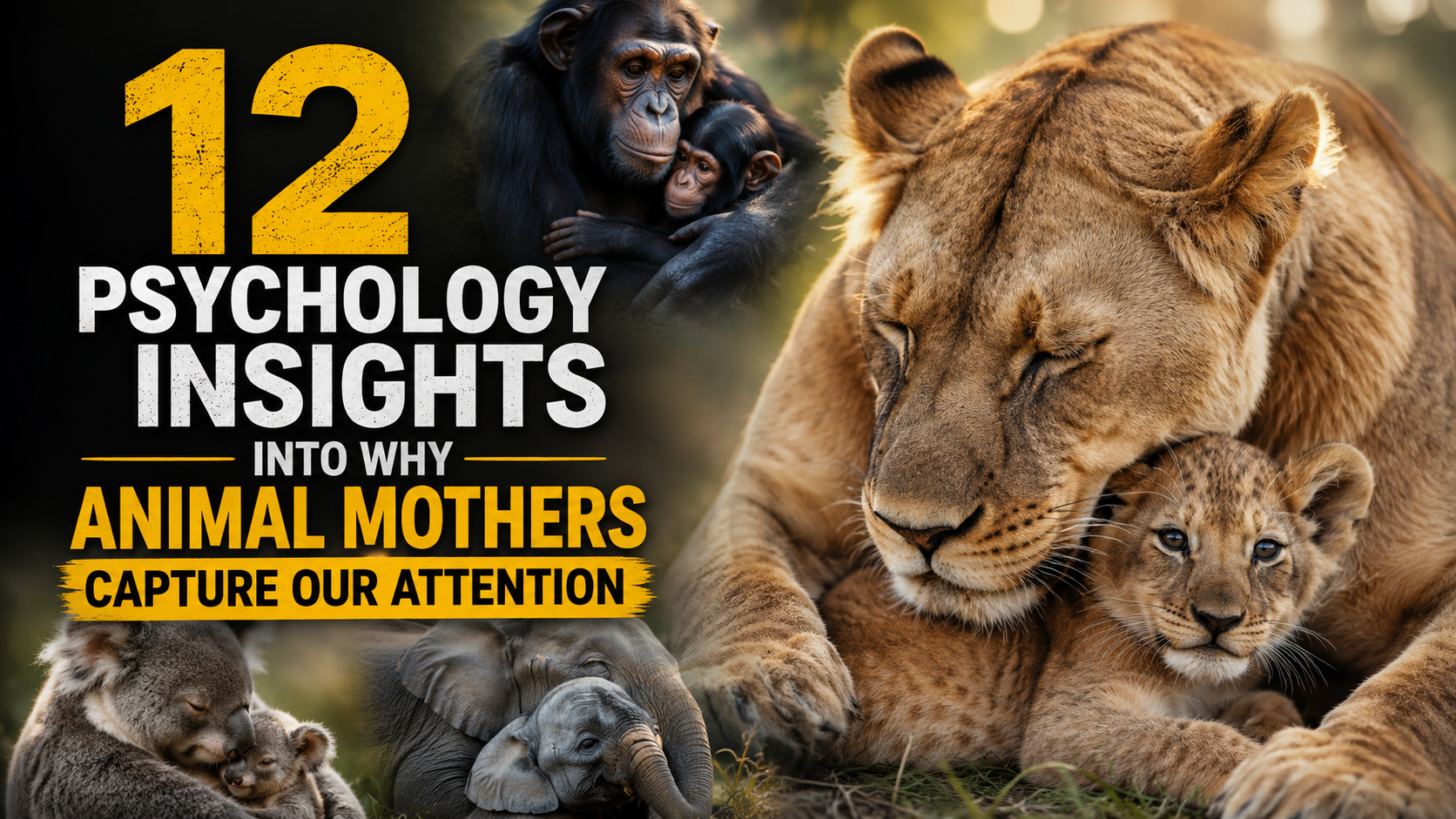
Few images are as universally moving as a mother caring for her young. Whether it’s a bear protecting her cubs, an elephant guiding her calf across the savanna, or a bird tirelessly feeding its chicks, these moments often capture human attention in a powerful way.
Stories involving animal mothers regularly become some of the most shared and discussed content online. People feel emotionally invested in their struggles, celebrate their successes, and often react strongly when they face loss or danger. But why do these stories affect us so deeply?
The answer lies in psychology, evolution, empathy, and the way humans naturally interpret caregiving behaviors. While animals and humans are different in many ways, maternal care creates a bridge that helps us recognize familiar emotions and experiences across species.
Here are 12 fascinating psychological insights that help explain why animal mothers continue to capture our attention and touch our hearts.
1. We Instinctively Recognize Caregiving Behavior
Human beings are wired to notice nurturing behaviors.
From infancy, people learn to recognize actions associated with protection, comfort, feeding, and caregiving. These behaviors are essential for survival, making them deeply embedded in our psychological makeup.
When we observe an animal mother protecting her offspring, we immediately understand what is happening, even if the species is unfamiliar.
A mother bear standing between her cubs and danger or a bird sheltering its chicks during a storm communicates a message that requires no translation.
The instinct to care for vulnerable young is something humans recognize almost instantly, creating an immediate emotional connection.
2. Maternal Love Feels Universal
One reason animal mothers fascinate us is that maternal devotion appears remarkably consistent across nature.
Different species may raise their young in different ways, but the core goal remains the same: ensuring the survival and well-being of the next generation.
This shared purpose creates a sense of familiarity.
People often see reflections of human parenting in animal behavior, whether it’s a mother protecting, teaching, feeding, or comforting her offspring.
The universality of these actions makes animal mothers relatable regardless of culture, language, or background.
3. We Naturally Empathize With Vulnerable Relationships
Psychologists have long observed that people are especially sensitive to situations involving vulnerable individuals.
Young animals represent innocence, dependence, and fragility. As a result, interactions between mothers and offspring often trigger strong emotional responses.
When people see an animal mother caring for her young, they often focus not only on the mother but also on the vulnerable life she is trying to protect.
This dynamic strengthens feelings of empathy and compassion.
The more vulnerable the young appear, the more emotionally invested people become in the mother’s efforts.
4. Animal Mothers Reflect Human Family Values
Many societies place enormous importance on family relationships.
Love, sacrifice, protection, and responsibility are often viewed as core values. When animal mothers display similar behaviors, people naturally connect those actions to their own experiences.
A mother elephant staying close to her calf or a wolf caring for her pups may remind viewers of human parents making sacrifices for their children.
Even though the circumstances differ, the underlying themes feel surprisingly familiar.
This connection helps explain why stories involving animal mothers often resonate so deeply.
5. We Are Drawn to Stories of Sacrifice
Throughout history, stories involving sacrifice have captured human attention.
People admire individuals who put the needs of others before their own. This admiration extends to animals as well.
Many animal mothers face significant challenges while raising their young. They may go without food, travel long distances, defend against predators, or risk injury to keep their offspring safe.
These acts of dedication often appear selfless from a human perspective.
Whether driven by instinct, emotion, or a combination of both, such sacrifices inspire respect and admiration.
6. Maternal Protection Activates Powerful Emotions
Protection is one of the strongest themes in human storytelling.
Movies, books, and real-life news stories frequently highlight parents defending their children from danger. Animal mothers display similar protective behaviors, often with remarkable determination.
A bear defending her cubs, a goose confronting a much larger threat, or a lioness guarding her young immediately captures attention because it taps into a deeply emotional narrative.
The image of a parent standing between danger and a child is one of the most powerful symbols humans recognize.
7. We See Familiar Emotions in Animal Mothers
Humans naturally interpret behavior through an emotional lens.
When we observe an animal mother comforting her offspring, searching for a lost young one, or responding to danger, we often associate those actions with emotions we understand.
Scientists caution against assuming animals experience feelings exactly like humans do. However, research increasingly suggests that many species are capable of forming strong social bonds and displaying complex emotional responses.
Because of this, people often feel a sense of connection when they observe behaviors that resemble affection, concern, or devotion.
8. Animal Mothers Help Us Feel Connected to Nature
Modern life often separates people from the natural world.
Many individuals spend most of their time indoors, surrounded by technology and urban environments. Stories about animal mothers offer a reminder that life follows similar patterns throughout nature.
Birth, growth, protection, learning, and family relationships are not uniquely human experiences.
Observing these patterns in animals helps people feel more connected to the broader living world.
This connection can create feelings of wonder, appreciation, and respect for nature.
9. Their Stories Often Inspire Hope
Not every story involving animals is humorous or dramatic. Many become popular because they inspire optimism.
People enjoy seeing animal mothers overcome challenges, successfully raise offspring, or reunite with their young after difficult situations.
These stories reinforce themes of resilience and perseverance.
In a world often filled with stressful news, stories of determination and care provide emotional relief and encouragement.
They remind readers that nurturing and protection remain powerful forces in nature.
10. We Learn Lessons About Responsibility
Animal mothers often serve as powerful reminders of commitment and responsibility.
Many species invest enormous time and energy into raising their young. Birds make hundreds of trips to feed chicks. Mammals spend months or years teaching survival skills. Some animals remain highly protective long after birth.
Watching these behaviors can inspire reflection on the responsibilities involved in caregiving and family life.
People often admire the dedication displayed by animal mothers because it reflects qualities they value in themselves and others.
11. Stories of Loss Create Strong Emotional Reactions
One of the most powerful reasons animal mothers capture attention is that stories involving loss often trigger deep empathy.
When an animal appears to search for a missing offspring or displays unusual behavior after separation, people frequently respond with sadness and compassion.
This reaction stems from our ability to imagine what loss feels like.
Whether the situation involves humans or animals, themes of grief, attachment, and longing are emotionally significant.
Stories that highlight these experiences tend to remain memorable because they touch on universal human emotions.
12. They Remind Us That Connection Crosses Species Boundaries
Perhaps the most important psychological insight is that animal mothers challenge the idea that humans exist entirely separate from the rest of nature.
The behaviors we admire—care, protection, nurturing, patience, and devotion—can often be observed throughout the animal kingdom.
While each species experiences the world differently, these shared patterns create a sense of continuity between humans and other living creatures.
Animal mothers remind us that caregiving is not uniquely human. It is a powerful force that appears across many forms of life.
That realization often inspires humility, empathy, and a deeper appreciation for the natural world.
Why These Stories Continue to Go Viral
In the digital age, stories involving animal mothers regularly spread across social media, news websites, and video platforms.
The reason is simple: they combine several elements people find emotionally compelling.
They feature vulnerability, protection, sacrifice, hope, and family bonds. They evoke empathy while also providing moments of inspiration and wonder.
Unlike many news stories that divide audiences, these themes are nearly universal.
People from different backgrounds can all relate to the image of a mother caring for her young.
The Science Behind Our Emotional Response
Research suggests that humans are biologically predisposed to respond to caregiving cues.
Features associated with youth and vulnerability often activate nurturing instincts. Similarly, protective behaviors trigger emotional responses linked to empathy and social bonding.
When animal mothers display these behaviors, many of the same psychological mechanisms become active.
This helps explain why a photograph of a mother bear with her cubs or a video of a bird feeding its chicks can generate such strong reactions.
Our brains are naturally drawn to stories about care and connection.
Final Thoughts
Animal mothers capture our attention because they represent some of the most meaningful themes in life: love, protection, sacrifice, and resilience.
Whether it’s a bear guiding her cubs through the wilderness, an elephant caring for a calf, or a bird tirelessly building a nest, these moments remind us that the drive to nurture and protect exists throughout the natural world.
The more we learn about animal behavior, the more we recognize how many emotional and social patterns are shared across species.
Perhaps that is why stories about animal mothers continue to resonate so deeply. They remind us that beneath our differences lies something profoundly familiar—the instinct to care for those who depend on us.
And that is a story people never seem to tire of hearing.







