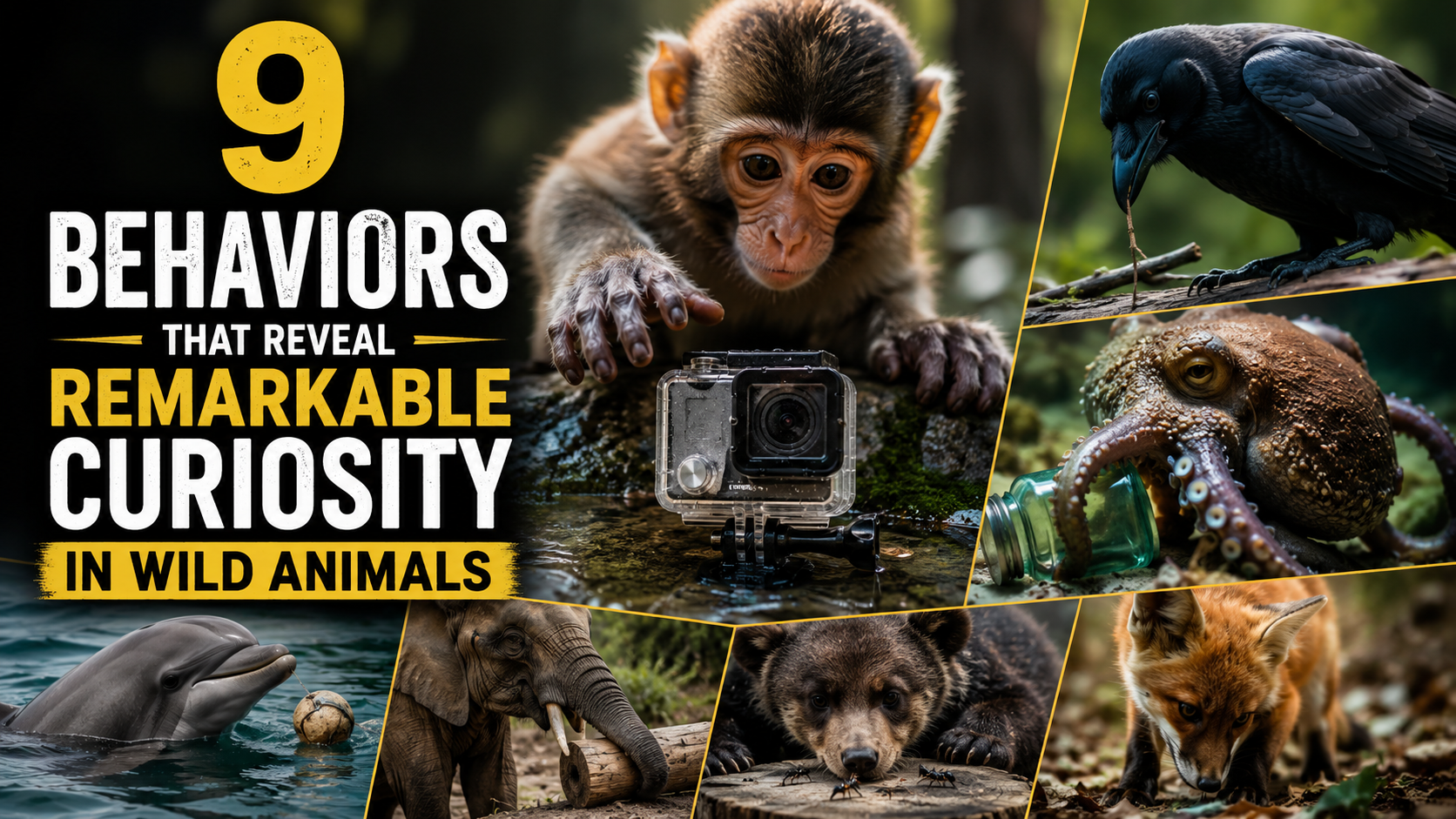
Curiosity is often considered one of humanity’s defining traits. It drives exploration, fuels innovation, and helps us understand the world around us. Yet humans are far from the only creatures that display a desire to investigate the unknown.
Across forests, oceans, deserts, and grasslands, wild animals regularly engage in behaviors that suggest an eagerness to explore, learn, and solve problems. From intelligent birds experimenting with tools to dolphins investigating unfamiliar objects, nature is filled with examples of animals showing an impressive interest in their surroundings.
Scientists continue to study animal cognition, and while animals do not think exactly like humans, research increasingly suggests that many species possess a remarkable capacity for learning and exploration. Curiosity helps animals locate food, avoid danger, adapt to changing environments, and improve their chances of survival.
More importantly, these behaviors reveal that the natural world is far more mentally complex than many people realize.
Here are nine fascinating behaviors that demonstrate remarkable curiosity in wild animals.
1. Investigating New Objects in Their Environment
One of the clearest signs of curiosity is the willingness to approach something unfamiliar.
Many wild animals show a strong interest in objects they have never encountered before. Researchers have observed crows examining discarded tools, dolphins investigating floating debris, and primates carefully inspecting unusual items introduced into their habitats.
Rather than immediately ignoring or avoiding these objects, curious animals often spend time observing, touching, sniffing, or manipulating them.
This behavior serves an important purpose. By gathering information about unfamiliar things, animals can better understand whether they represent food, danger, shelter, or potential opportunities.
The willingness to investigate the unknown is one of the strongest indicators of exploratory thinking.
2. Experimenting With Tools
Tool use is among the most impressive examples of curiosity in the animal kingdom.
Certain species don’t simply use tools instinctively—they experiment with them.
New Caledonian crows are famous for shaping sticks into hooks to retrieve insects from hard-to-reach places. Chimpanzees modify branches to gather termites, while sea otters use rocks to crack open shellfish.
What makes these behaviors particularly fascinating is that animals often refine their techniques through trial and error.
They test different approaches, learn from experience, and improve their methods over time.
This willingness to experiment reflects a curiosity-driven desire to discover more effective solutions.
3. Exploring Areas Beyond Immediate Needs
Animals are often assumed to focus only on survival, but many species regularly explore areas that provide no obvious immediate reward.
Young wolves roam beyond familiar territory. Dolphins investigate underwater structures. Elephants travel long distances to inspect new locations.
These exploratory journeys may not always lead directly to food or safety, but they expand the animal’s knowledge of its environment.
Scientists believe such exploration can help animals identify future resources, migration routes, water sources, and safe shelters.
Curiosity encourages discovery, and discovery often increases survival opportunities.
4. Learning Through Play
Play is one of the strongest indicators of intelligence and curiosity.
Many young animals engage in playful activities that appear unrelated to immediate survival. Foxes chase leaves, dolphins create bubble rings, ravens slide down snowy slopes, and lion cubs wrestle with one another.
While these behaviors seem entertaining, they also serve important developmental functions.
Play allows animals to practice physical skills, social interactions, coordination, and problem-solving in a low-risk environment.
The desire to engage in playful exploration often reflects a natural curiosity about how the world works.
5. Observing and Mimicking Others
Curious animals frequently learn by watching.
Many species carefully observe the actions of others before attempting similar behaviors themselves.
Young chimpanzees watch adults use tools. Juvenile birds observe foraging techniques. Orcas learn hunting strategies by studying experienced members of their pods.
This process of observation and imitation demonstrates more than simple instinct.
Animals that pay close attention to others are actively gathering information, analyzing outcomes, and applying what they learn.
Such behavior reveals a strong interest in understanding the actions and experiences of those around them.
6. Solving Unexpected Problems
Curiosity often becomes most visible when animals encounter obstacles.
Instead of giving up, some species display remarkable persistence while searching for solutions.
Researchers have documented parrots unlocking complex puzzle boxes, raccoons opening latches, octopuses escaping enclosures, and crows solving multi-step challenges.
These animals frequently try multiple approaches before succeeding.
Their willingness to continue experimenting suggests an intrinsic motivation to understand how things work rather than relying solely on instinctive responses.
Problem-solving and curiosity are closely connected because both involve exploring possibilities.
7. Interacting With Humans in Unexpected Ways
Wild animals occasionally display curiosity toward people.
Dolphins approach boats. Foxes observe human activity from surprisingly close distances. Certain birds investigate cameras and scientific equipment placed in their habitats.
In many cases, these interactions are cautious rather than aggressive.
Animals appear interested in gathering information about unfamiliar creatures and objects entering their environment.
While excessive human interaction can be harmful to wildlife, carefully documented observations often reveal that curiosity motivates many of these encounters.
The desire to understand unfamiliar beings is not uniquely human.
8. Returning Repeatedly to Investigate Something Interesting
Curious animals often revisit objects, locations, or situations that capture their attention.
Elephants have been observed returning to specific sites. Ravens revisit unusual objects. Dolphins repeatedly investigate new structures in the ocean.
This repeated behavior suggests more than a brief reaction.
Instead of simply noticing something once and moving on, animals continue gathering information over time.
Scientists view repeated investigation as a strong indicator of sustained curiosity because it reflects an ongoing interest in learning.
The animal appears motivated not merely by instinct but by a desire for additional understanding.
9. Adapting Quickly to New Challenges
Perhaps the most impressive sign of curiosity is adaptability.
Animals living in rapidly changing environments often display extraordinary flexibility when encountering new situations.
Urban crows learn to use traffic patterns to crack nuts. Monkeys adapt to changing food sources. Some birds modify nesting behaviors in response to human development.
Curiosity plays a major role in these adjustments.
Animals willing to explore new possibilities are often better equipped to thrive when conditions change.
Their openness to learning allows them to discover opportunities that less adaptable individuals might miss.
Why Curiosity Matters in the Animal World
Curiosity is not simply an entertaining trait. It serves practical functions that can significantly improve an animal’s chances of survival.
Exploration helps animals locate food and water.
Observation improves learning.
Problem-solving increases adaptability.
Experimentation leads to innovation.
In many species, curiosity acts as a powerful tool for navigating complex environments.
Animals that gather more information about their surroundings may be better prepared to respond to challenges and opportunities alike.
What Scientists Have Learned About Animal Intelligence
For much of history, people underestimated the mental abilities of animals.
Modern research has dramatically changed that perspective.
Studies increasingly show that many species possess sophisticated cognitive abilities, including memory, communication, planning, social learning, and problem-solving.
While intelligence varies widely across species, curiosity appears in a surprising number of animals.
Researchers now recognize that exploration and learning are not limited to humans or a handful of highly intelligent mammals.
Even species once considered simple may display behaviors suggesting a desire to investigate and understand their environments.
The Connection Between Curiosity and Survival
Curiosity can sometimes involve risk.
Exploring unfamiliar places or objects may expose animals to danger. However, avoiding all novelty carries risks as well.
Animals that never explore may miss food sources, safe habitats, or opportunities to adapt to changing conditions.
Evolution often favors a balance between caution and curiosity.
The most successful animals are frequently those capable of investigating new possibilities while remaining aware of potential threats.
This balance allows species to innovate without becoming reckless.
Why Humans Find Curious Animals So Fascinating
People are naturally drawn to stories about intelligent and curious animals because these behaviors feel surprisingly familiar.
When a crow solves a puzzle, a dolphin investigates an object, or an elephant explores a new environment, we recognize something that resembles our own desire to learn.
These moments challenge long-held assumptions about the separation between humans and other animals.
They remind us that curiosity may be a much broader feature of life than previously believed.
Observing curiosity in wildlife creates a sense of wonder and encourages deeper appreciation for the complexity of the natural world.
Final Thoughts
Curiosity is one of nature’s most powerful forces.
It drives discovery, encourages learning, and helps animals adapt to constantly changing environments. From experimenting with tools and solving puzzles to exploring unfamiliar places and observing others, wild animals demonstrate remarkable curiosity in countless ways.
These nine behaviors reveal that many species are not merely reacting to the world around them. They are actively investigating it.
The more scientists study animal behavior, the clearer it becomes that curiosity extends far beyond humanity. It exists throughout nature, shaping how animals learn, survive, and interact with their environments.
And perhaps that’s what makes these behaviors so fascinating. They remind us that the desire to explore and understand the world may be one of life’s most universal traits.







