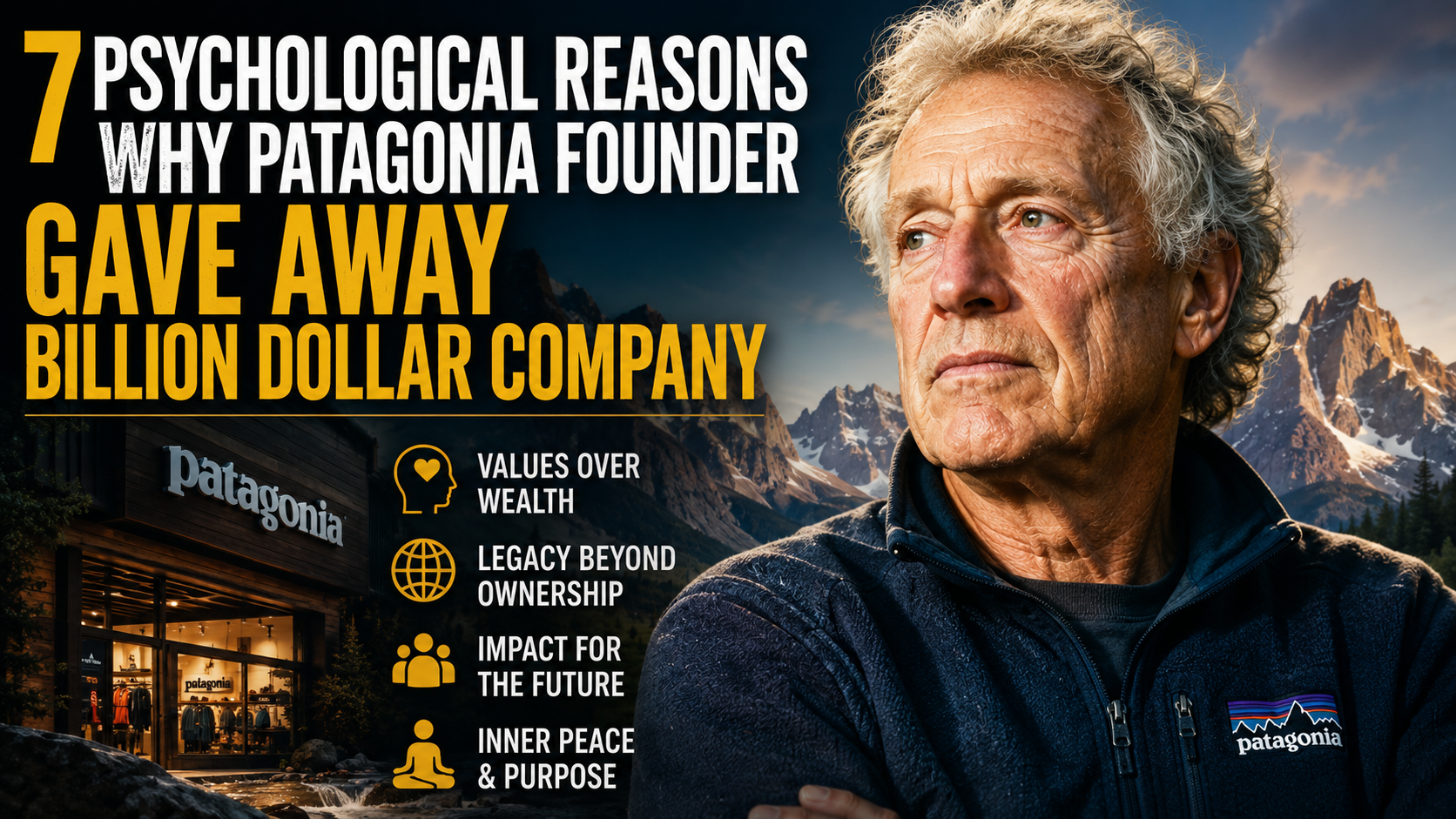
In the business world, success is often measured by how much wealth a person accumulates. Billion-dollar companies are typically seen as the ultimate symbol of achievement, power, and legacy. That’s why the decision by Patagonia’s founder, Yvon Chouinard, to give away ownership of his company surprised so many people.
Instead of selling the outdoor apparel brand or passing it down as a traditional inheritance, Chouinard chose to transfer ownership in a way that prioritizes environmental protection and long-term sustainability. His decision redirected company profits toward fighting climate change and preserving the natural world.
While the move was widely discussed as a business strategy, it also reveals something deeper: the psychological mindset behind letting go of immense personal wealth for a larger purpose.
Here are seven psychological reasons that help explain why Patagonia’s founder made such an unconventional and impactful decision.
1. A Strong Sense of Purpose Beyond Wealth
One of the most powerful psychological drivers in human behavior is purpose.
For many entrepreneurs, the early stages of building a business are fueled by passion—solving problems, creating products, or challenging the status quo. But as financial success grows, motivation can shift toward profit and expansion.
In Chouinard’s case, his connection to nature and environmental protection remained central throughout his life. Wealth never replaced that core purpose.
Psychologically, when individuals experience a strong alignment between their values and actions, money often becomes secondary. Purpose begins to outweigh possession.
This helps explain why giving away a billion-dollar company was not seen as a loss, but rather as a continuation of his original mission.
2. Rejection of Traditional Success Metrics
Society often defines success through financial accumulation, status, and ownership. However, not everyone subscribes to this framework.
Chouinard’s decision reflects a psychological rejection of conventional success metrics.
Instead of asking, “How much can I own?” the mindset shifts to, “What impact can I create?”
This cognitive reframing is important. It changes the focus from personal gain to collective benefit.
For individuals who adopt this perspective, wealth is no longer the end goal—it becomes a tool that can be directed toward meaningful outcomes.
3. Deep Connection to Environmental Identity
Psychologically, people form identities based on what they value most. For Chouinard, that identity is deeply tied to the natural world.
As an outdoor climber, surfer, and environmental advocate, his life experiences shaped a strong emotional bond with nature.
When identity is strongly linked to a cause, decision-making often reflects that connection. Protecting the environment becomes not just a goal, but part of who the person is.
This identity-based motivation helps explain why Patagonia’s structure was redesigned to prioritize environmental action over private ownership.
The company’s future is now directly tied to protecting the very landscapes that inspired its creation.
4. Aversion to Concentrated Wealth and Power
Another psychological factor at play is discomfort with excessive concentration of wealth and authority.
As companies grow, founders often gain significant control over resources, employees, and influence. While this can be empowering, it can also create internal conflict for those who question the fairness of extreme wealth distribution.
Chouinard has expressed concerns about inequality and the environmental impact of unchecked capitalism.
From a psychological standpoint, this reflects a desire to reduce cognitive dissonance—the tension between personal wealth and broader social or environmental concerns.
By redistributing ownership, he resolved that internal conflict in a meaningful way.
5. Long-Term Thinking Over Short-Term Gain
Humans are naturally inclined toward short-term rewards. However, some individuals develop strong long-term thinking skills, especially when motivated by legacy or impact.
Chouinard’s decision reflects this long-term perspective.
Instead of focusing on immediate financial value, he considered what would happen decades into the future.
Patagonia’s restructuring ensures that profits continue to support environmental causes long after the founder is gone.
This kind of thinking aligns with psychological concepts of generativity—the desire to contribute something lasting to future generations.
For Chouinard, the long-term health of the planet outweighed short-term financial outcomes.
6. Intrinsic Motivation Over External Validation
Many business leaders are driven by external rewards such as recognition, wealth, or social status. These are known as extrinsic motivators.
However, intrinsic motivation—driven by personal values and internal satisfaction—often leads to more meaningful decisions.
Chouinard’s actions suggest a strong reliance on intrinsic motivation.
His choices were not made to gain approval or admiration. In fact, giving away a billion-dollar company challenges conventional expectations of success.
Psychologically, individuals who are guided by internal values tend to make decisions that feel personally meaningful, even if they are unconventional or misunderstood by others.
This internal alignment likely played a key role in Patagonia’s ownership transition.
7. Desire to Create a Self-Sustaining Legacy
Legacy is a powerful psychological motivator, especially later in life. Many individuals begin to think deeply about what they will leave behind.
For Chouinard, legacy is not defined by wealth or personal recognition, but by impact.
By transferring ownership of Patagonia to a trust and nonprofit structure, he ensured that the company’s environmental mission would continue independently of any single individual.
This creates what psychologists often refer to as symbolic immortality—the idea that one’s values and influence continue beyond their lifetime.
Instead of leaving behind a traditional inheritance, he created a system that continues to act in alignment with his beliefs.
8. Redefining the Role of Business in Society
Beyond personal psychology, Chouinard’s decision reflects a broader philosophical shift in how businesses can function.
Traditionally, corporations are designed to maximize shareholder value. Patagonia’s new structure challenges that assumption.
This shift suggests that businesses can also exist to serve environmental and social goals, not just financial ones.
From a psychological perspective, this represents a change in worldview—from competition and accumulation to stewardship and responsibility.
It reframes business success as something that includes ethical and environmental accountability.
9. Emotional Satisfaction From Letting Go
Letting go of ownership, especially on such a large scale, can bring a unique form of emotional relief.
Psychologically, attachment to wealth and control can create pressure and responsibility. Releasing that control can reduce stress and increase feelings of freedom.
For individuals deeply connected to their values, giving away resources for a meaningful cause can also generate a sense of fulfillment that surpasses financial gain.
In Chouinard’s case, the emotional reward likely came from knowing that Patagonia’s resources would actively contribute to environmental preservation.
This emotional alignment often plays a larger role in decision-making than external observers realize.
10. Influence of a Countercultural Mindset
Chouinard has long been associated with a countercultural approach to business. From the beginning, Patagonia was built with values that challenged traditional corporate norms.
This mindset encourages questioning established systems and exploring alternative ways of operating.
Psychologically, individuals with countercultural thinking styles are more likely to challenge mainstream expectations, even when those expectations involve wealth or success.
This perspective helped shape Patagonia’s evolution into a company that prioritizes environmental responsibility over profit maximization.
Why This Decision Matters Beyond One Company
Patagonia’s ownership transition is not just a business story—it is also a psychological case study in values, identity, and purpose.
It challenges the assumption that success must be measured by accumulation. Instead, it suggests that success can also be defined by impact, alignment, and contribution.
The decision also raises broader questions about the role of wealth in society and how individuals choose to use their resources.
While not every business leader will follow the same path, the psychological motivations behind this choice offer insight into how deeply values can influence even the largest financial decisions.
Final Thoughts
Yvon Chouinard’s decision to give away Patagonia reflects more than generosity—it reflects a mindset shaped by purpose, identity, and long-term thinking.
By prioritizing environmental protection over personal ownership, he redefined what it means to build and leave behind a successful company.
The psychological drivers behind this choice—purpose, identity, legacy, and intrinsic motivation—offer a powerful reminder that wealth is not always the final goal. For some, it is simply a tool to create lasting change.
And in this case, that change extends far beyond business. It touches the future of the planet itself.







