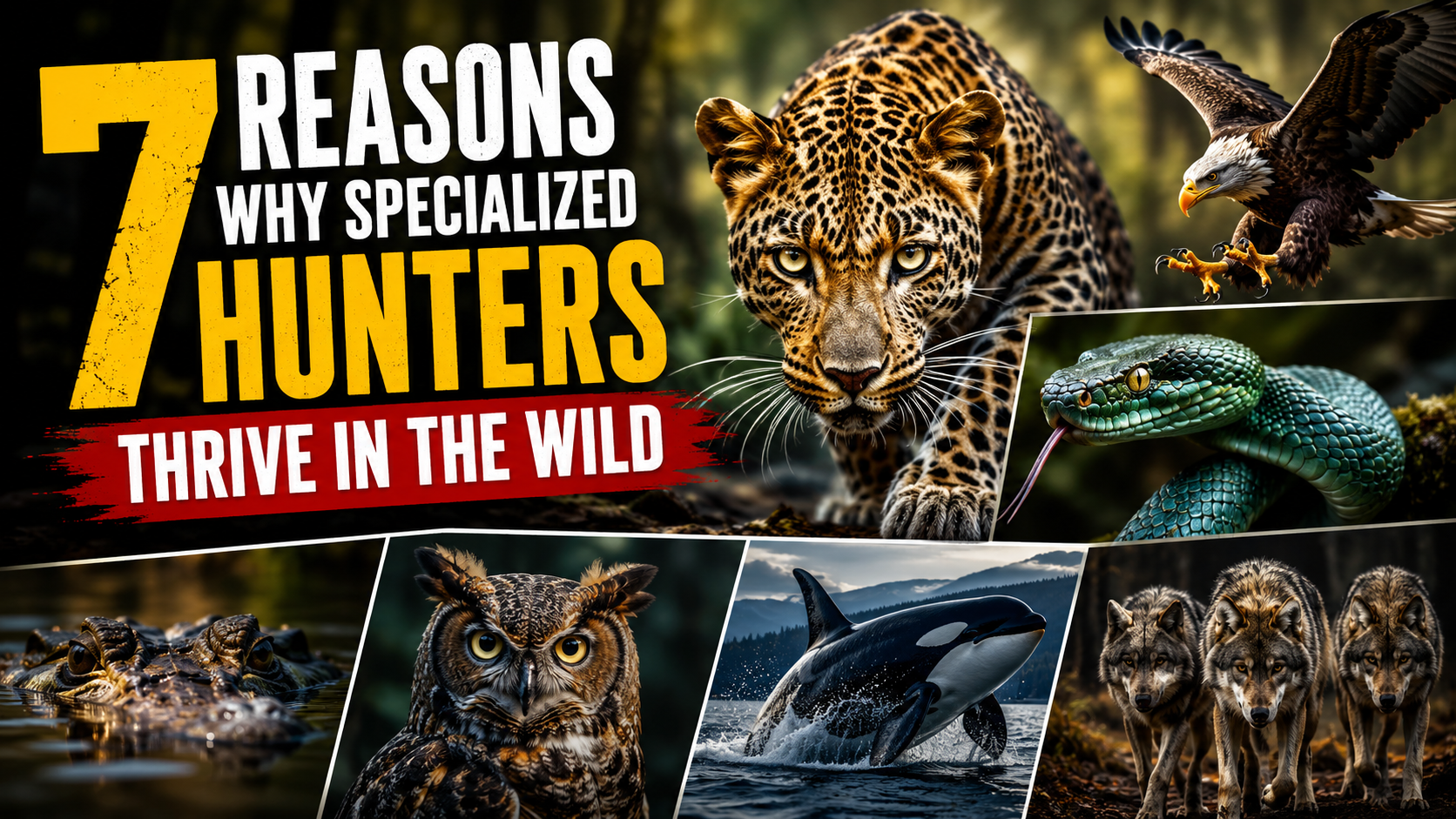
Nature is often portrayed as a world where the strongest, fastest, or most aggressive animals dominate. Lions chase antelope across grasslands, eagles swoop down from the sky, and sharks patrol the oceans in search of prey. These dramatic images have shaped the way many people think about survival in the wild.
But nature tells a much more complex story.
Some of the most successful predators on Earth don’t rely on speed, size, or brute force. Instead, they thrive because they have become highly specialized. Over millions of years, evolution has equipped these animals with unique skills, body structures, and hunting strategies designed for a very specific purpose.
From snakes that feed almost exclusively on snails to birds that use tools to extract insects from tree bark, specialized hunters demonstrate that success in nature isn’t always about overpowering competitors. Often, it comes from mastering a narrow niche better than anyone else.
Scientists are fascinated by these animals because they reveal how adaptation, efficiency, and ecological balance shape the natural world.
Here are seven important reasons why specialized hunters continue to thrive in the wild.
1. They Face Less Competition for Food
One of the biggest challenges any predator faces is competition.
When many species hunt the same prey, resources become limited. Animals must constantly compete for food, which can reduce survival rates and increase stress.
Specialized hunters avoid much of this competition.
Instead of targeting common prey sought by dozens of other predators, they focus on food sources that relatively few animals exploit. By developing the skills necessary to capture a specific type of prey, they create their own ecological niche.
Consider animals that feed primarily on snails, termites, sea urchins, or ants. While these food sources may not seem attractive to most predators, they can provide a reliable and abundant supply of nutrition.
By specializing, these hunters gain access to resources that others often ignore.
This strategy allows them to thrive where generalist predators may struggle.
2. Evolution Helps Them Become Extremely Efficient
Specialization allows evolution to fine-tune an animal’s abilities over countless generations.
When a species consistently feeds on the same type of prey, natural selection favors traits that improve hunting success.
Over time, these adaptations can become remarkably sophisticated.
Some birds develop specialized beaks designed to extract insects from tiny crevices. Certain snakes evolve jaw structures that make consuming specific prey easier. Deep-sea predators may develop unique sensory systems capable of detecting subtle movements in darkness.
Every adaptation improves efficiency.
Instead of being moderately effective at hunting many different prey species, specialized hunters become exceptionally good at capturing one particular target.
This efficiency often translates into greater survival and reproductive success.
3. They Reduce Energy Waste
In nature, energy is a valuable resource.
Every movement, chase, dive, climb, and attack requires calories. Animals that waste energy unnecessarily may struggle to survive.
Specialized hunters often use remarkably efficient strategies that minimize energy expenditure.
Rather than engaging in long pursuits, many rely on patience, camouflage, precision, or highly targeted hunting techniques.
A snail-eating snake, for example, doesn’t need to chase fast-moving prey across large distances. Instead, it uses specialized methods to locate and consume a food source that moves slowly and requires relatively little effort to capture.
By reducing energy costs while maximizing nutritional gains, specialized hunters improve their chances of survival.
Nature often rewards efficiency more than aggression.
4. Their Adaptations Make Them Masters of Their Environment
Specialized predators frequently possess traits perfectly suited to the habitats they occupy.
These adaptations may involve body shape, coloration, sensory abilities, feeding mechanisms, or behavioral patterns.
Camouflage provides an excellent example.
Many specialized hunters blend seamlessly into their surroundings, allowing them to remain undetected by both prey and potential predators.
Others develop heightened senses that help them navigate environments where vision is limited.
Some species can detect vibrations, chemical signals, temperature differences, or subtle changes in water movement.
Because their survival depends on mastering specific environments, these animals often become exceptionally well adapted to local conditions.
Their specialized skills give them an advantage that generalist species may not possess.
5. They Play Important Roles in Ecosystem Balance
Every ecosystem depends on balance.
Predators help regulate prey populations, preventing any one species from becoming too dominant.
Specialized hunters often perform highly specific ecological functions.
For example, animals that feed primarily on certain insects can help control pest populations. Predators that target sea urchins contribute to the health of kelp forests. Snail-eating species may influence the abundance and distribution of mollusks within their ecosystems.
Without these specialized predators, ecological imbalances can develop.
When a single prey species grows unchecked, it may alter habitats, reduce biodiversity, and disrupt food webs.
Scientists study specialized hunters because they often serve as key components of healthy ecosystems.
Their influence may be far greater than their size suggests.
6. Specialization Encourages Evolutionary Innovation
Some of nature’s most fascinating adaptations arise through specialization.
As species become increasingly focused on particular food sources or habitats, evolution may produce extraordinary traits that seem almost unbelievable.
Researchers have documented animals with elongated tongues designed for extracting insects, highly specialized teeth for crushing shells, and sensory organs capable of detecting prey hidden underground.
These adaptations provide valuable insight into how evolution works.
Specialized hunters serve as natural experiments, showing how environmental pressures shape biological diversity over time.
Studying these species helps scientists understand the processes that generate the incredible variety of life found on Earth today.
In many cases, specialized predators represent some of evolution’s most creative solutions.
7. They Demonstrate That Success Comes in Many Forms
Perhaps the most important lesson specialized hunters teach us is that survival doesn’t depend on following a single formula.
Nature rewards many different strategies.
Some predators succeed through speed. Others rely on strength. Some hunt in groups. Others work alone.
Specialized hunters demonstrate that expertise can be just as powerful as versatility.
Rather than trying to excel at everything, they become exceptionally skilled in one area.
This principle extends beyond biology.
In many fields, individuals and organizations achieve success by developing deep expertise rather than attempting to compete in every possible area.
Specialized hunters remind us that mastery often creates opportunities that broad competition cannot.
The Difference Between Specialists and Generalists
To better understand specialized hunters, it helps to compare them with generalist predators.
Generalists consume a wide variety of foods and can adapt to changing conditions more easily. Examples include foxes, raccoons, and many bird species.
Specialists, on the other hand, focus on a narrow range of prey or resources.
Each approach has advantages.
Generalists benefit from flexibility. If one food source disappears, they can often switch to another.
Specialists benefit from efficiency. Their adaptations allow them to exploit resources more effectively than competitors.
Neither strategy is inherently superior. Success depends on environmental conditions and available resources.
Nature supports both approaches because each solves survival challenges in different ways.
Challenges Specialized Hunters Face
While specialization offers many benefits, it also comes with risks.
The biggest challenge is dependence.
When a species relies heavily on a specific food source, environmental changes can create problems.
If prey populations decline due to habitat loss, climate change, pollution, or disease, specialized predators may struggle to adapt.
This vulnerability explains why some specialist species face greater conservation challenges than generalist animals.
Scientists monitor specialized hunters closely because they often serve as indicators of ecosystem stability.
Changes affecting their prey can quickly affect the predators that depend on them.
What Researchers Continue to Learn
Modern technology is helping scientists uncover new details about specialized predators.
Advanced tracking systems, motion-sensitive cameras, genetic analysis, and behavioral studies provide deeper insight into how these animals survive and interact with their environments.
Researchers continue exploring questions such as:
- How do specialized hunting behaviors evolve?
- What environmental factors encourage specialization?
- How resilient are specialist species to climate change?
- What role do they play in maintaining biodiversity?
- How can conservation efforts protect vulnerable specialist populations?
Each new discovery contributes to a broader understanding of ecology and evolution.
Lessons Humans Can Learn From Specialized Hunters
Although humans live very different lives from wild animals, there are interesting parallels.
Specialized hunters demonstrate the value of focusing on strengths, developing expertise, and finding unique opportunities rather than competing directly in crowded spaces.
Their success highlights the importance of adaptation, patience, and efficiency.
In both nature and human endeavors, specialization can create advantages that are difficult for competitors to match.
This doesn’t mean specialization is always the best strategy, but it shows how mastery can become a powerful tool for long-term success.
Final Thoughts
Specialized hunters represent some of the most remarkable examples of adaptation in the natural world. Through millions of years of evolution, these animals have developed unique skills that allow them to exploit resources with extraordinary efficiency.
By reducing competition, conserving energy, mastering specific environments, and maintaining ecological balance, they demonstrate that survival isn’t always about strength or speed. Often, success comes from becoming exceptionally good at one thing.
Scientists continue studying specialized predators because they reveal important truths about evolution, biodiversity, and ecosystem health. Their stories remind us that nature rewards creativity in many forms.
Whether it’s a snail-eating rainforest snake, a tool-using sea otter, or an insect-hunting bird with a perfectly adapted beak, specialized hunters prove that there are countless paths to survival—and some of the most effective are also the most fascinating.







