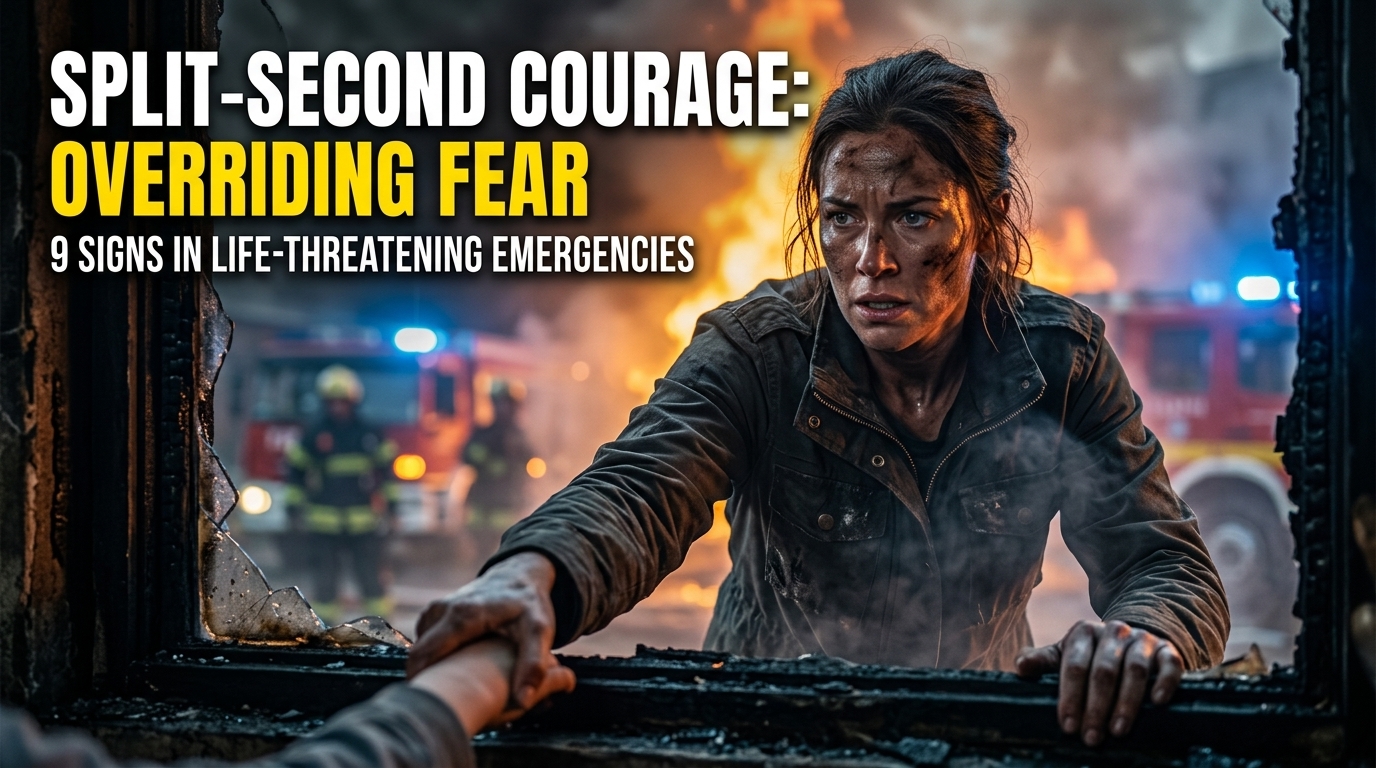
In moments of extreme danger, human behavior can shift in ways that seem almost unbelievable. People who may consider themselves fearful or cautious in everyday life sometimes discover an unexpected strength when faced with life-threatening situations. Whether it’s a natural disaster, a car accident, a fire, or another sudden emergency, the brain can trigger rapid responses that override fear and focus entirely on survival or protection of others.
This kind of “split-second courage” is not about the absence of fear. Instead, it is about action happening despite fear. Psychologists often describe this as a combination of instinct, training, emotional regulation, and deeply rooted survival mechanisms.
While not everyone reacts the same way, there are certain signs that indicate when courage takes over in critical moments. These signs reveal how ordinary people can perform extraordinary actions under pressure.
Here are nine key signs that split-second courage can override fear during life-threatening emergencies.
1. Immediate Shift From Panic to Purposeful Action
One of the clearest signs of courage in an emergency is the rapid transition from shock or panic to focused action.
In dangerous situations, the brain initially reacts with fear. This is part of the body’s natural “fight, flight, or freeze” response. However, some individuals quickly move beyond this initial reaction.
Instead of becoming immobilized, they begin to assess the situation and take steps to respond. This might include calling for help, moving others to safety, or addressing the immediate threat.
This shift happens in seconds, and it often determines whether the situation escalates or is brought under control.
2. Heightened Awareness of Surroundings
Another sign of split-second courage is an intense increase in situational awareness.
During emergencies, some people experience a sharp focus where they notice details they might normally overlook. Exits, obstacles, sounds, and movements become more noticeable.
This heightened awareness allows them to make quick decisions based on real-time information.
Psychologically, this is linked to adrenaline activation, which sharpens perception and temporarily enhances attention. Instead of being overwhelmed, the individual becomes highly alert and responsive.
3. Ability to Prioritize Others Over Self
A powerful indicator of courage is the instinct to protect others even when personal safety is at risk.
In emergencies, some individuals immediately shift their focus to children, family members, coworkers, or even strangers nearby. Their first concern becomes ensuring someone else’s safety before their own.
This behavior is often driven by strong empathy, social bonding, or protective instincts.
In psychological terms, it reflects a temporary suppression of self-preservation in favor of collective survival. It is one of the clearest expressions of human courage under pressure.
4. Rapid Decision-Making Without Overthinking
Fear often leads to hesitation. People may become stuck weighing options, which can delay action in critical situations.
Courage, however, often appears as fast and decisive thinking.
Individuals who demonstrate split-second bravery tend to make quick decisions based on available information, even when uncertainty is high. They do not wait for perfect clarity before acting.
This ability is not reckless—it is efficient. It allows them to respond in time-sensitive situations where delay could lead to greater harm.
In emergencies, speed often matters as much as accuracy.
5. Controlled Emotional Response Despite Chaos
Another important sign of courage is emotional control in the middle of chaos.
While fear is natural, some individuals are able to keep their emotions from overwhelming their actions. They may still feel fear internally, but they do not allow it to dictate their behavior.
Instead of freezing or panicking, they maintain enough emotional stability to function effectively.
This type of control often comes from prior experience, mental resilience, or an instinctive ability to compartmentalize emotions during crises.
It allows individuals to remain effective even when everything around them feels unstable.
6. Physical Response That Matches Urgency
During emergencies, the body often reacts automatically through adrenaline release. However, courageous individuals tend to channel this physical response into coordinated action.
Instead of becoming disoriented or overwhelmed, they use heightened energy to move quickly, assist others, or escape danger.
Their actions become purposeful rather than chaotic.
This alignment between physical response and mental clarity is a strong indicator that courage is overriding fear in real time.
7. Willingness to Take Calculated Risks
In life-threatening situations, avoiding all risk is not always possible. Courage often involves making difficult choices that carry uncertainty.
Some individuals step into dangerous situations to help others, such as entering a burning building to rescue someone or intervening during an accident.
These actions are not impulsive—they are often rapid but calculated based on immediate judgment of risk versus reward.
The willingness to act despite danger reflects a temporary shift in priorities where helping or surviving becomes more important than personal safety concerns.
8. Focus on Problem-Solving Rather Than Fear
Fear tends to narrow thinking and create mental paralysis. Courage, on the other hand, often expands problem-solving ability.
People who act decisively in emergencies focus on what can be done rather than what might go wrong.
Instead of dwelling on fear, they shift attention toward solutions: how to escape, how to assist others, or how to reduce immediate danger.
This solution-focused mindset is crucial in high-pressure situations, where clear thinking can significantly change outcomes.
It reflects a strong cognitive shift from emotional reaction to practical reasoning.
9. Automatic Activation of Learned Skills or Instincts
In many cases, courageous behavior during emergencies is supported by prior knowledge or instinctive learning.
For example, someone trained in first aid, firefighting basics, swimming, or emergency response may automatically recall and apply those skills under pressure.
Even without formal training, people often rely on instinctual behaviors such as shielding others, calling emergency services, or moving toward exits.
This automatic activation of skills reduces hesitation and increases effectiveness during critical moments.
It demonstrates how preparation—whether conscious or unconscious—can significantly influence behavior under stress.
The Psychology Behind Split-Second Courage
Courage in emergencies is not the absence of fear. In fact, fear is almost always present. The difference lies in how the brain processes that fear and whether action overrides hesitation.
When the body is exposed to danger, the amygdala triggers an immediate stress response. Adrenaline floods the system, sharpening senses and preparing the body for action. In some individuals, the prefrontal cortex—the part of the brain responsible for decision-making—remains engaged enough to guide behavior constructively.
This balance between instinct and reasoning allows people to act quickly without becoming paralyzed by fear.
Environmental factors, past experiences, training, and personality traits all influence how someone responds. However, even individuals who consider themselves fearful in everyday life may still act courageously when circumstances demand it.
Real-Life Examples of Sudden Courage
History is filled with stories of ordinary people performing extraordinary acts under pressure.
Bystanders pulling strangers from burning vehicles, parents lifting heavy objects to protect children, and individuals stepping in during dangerous situations all reflect this phenomenon.
What makes these actions remarkable is not that the individuals were fearless, but that they acted despite fear.
These moments reveal the hidden strength that can emerge when survival and protection become immediate priorities.
Can Courage Be Strengthened?
While split-second courage often feels instinctive, certain factors can increase the likelihood of courageous action.
Training, preparation, and exposure to emergency scenarios can improve response times and decision-making. Learning basic safety skills, first aid, or emergency protocols can make individuals more confident under pressure.
Emotional resilience and stress management also play a role. People who practice staying calm in difficult situations are often better equipped to act when real emergencies occur.
Although no one can fully predict their behavior in a crisis, preparation increases the chances of responding effectively.
Final Thoughts
Split-second courage is one of the most fascinating aspects of human behavior. It reveals how quickly the mind and body can adapt when faced with danger.
The nine signs outlined above show that courage is not a single trait but a combination of awareness, decision-making, emotional control, and instinctive action.
In life-threatening moments, fear is natural—but it does not always have the final word. Sometimes, courage rises faster, guiding people to act decisively when it matters most.
And in those moments, ordinary individuals often become capable of extraordinary things.







