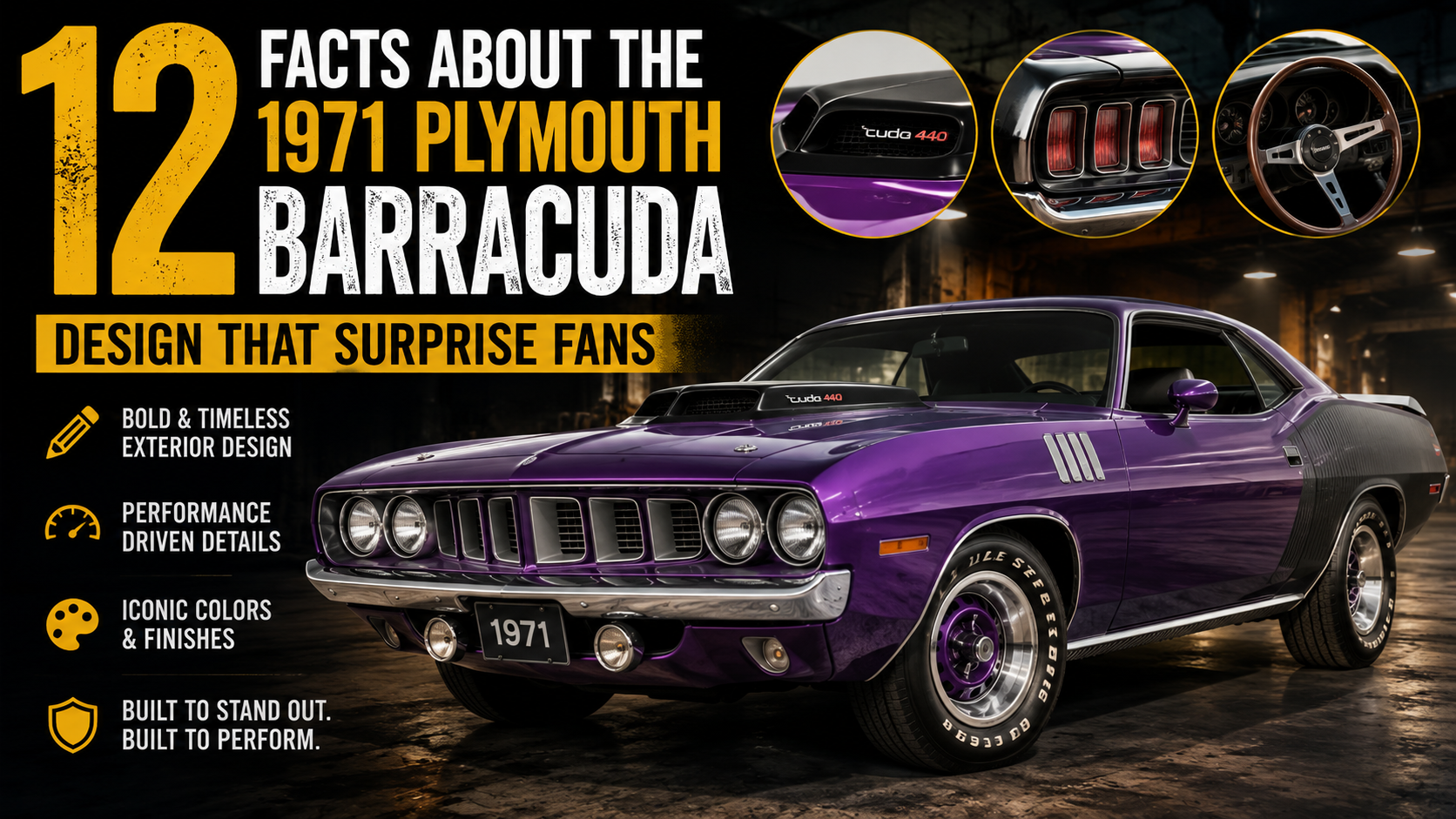
The 1971 Plymouth Barracuda stands as one of the most distinctive and memorable muscle cars of the early 1970s. By the time it reached its final redesign, the Barracuda had evolved far beyond its earlier compact-car roots into a bold, aggressive performance machine built to compete in the golden era of American muscle.
While many enthusiasts recognize its iconic long hood, bold styling, and high-performance reputation, there are still plenty of lesser-known design details that often surprise even longtime fans.
The 1971 model year marked a major turning point for the Barracuda, introducing a completely new platform, more muscular proportions, and some of the most dramatic styling choices ever seen in the pony car segment.
Here are 12 fascinating design facts about the 1971 Plymouth Barracuda that reveal why it continues to captivate collectors and muscle car enthusiasts today.
1. It Was the First Year of a Completely New Platform
One of the most important facts about the 1971 Barracuda is that it was built on an all-new platform, shared with the Plymouth E-body architecture.
This redesign allowed engineers and designers to create a more aggressive stance, wider proportions, and improved performance capabilities compared to earlier versions.
The shift marked a clear departure from the original compact-based Barracuda, transforming it into a true muscle car competitor.
2. The Body Was Wider and More Aggressive Than Ever Before
The 1971 model featured significantly wider bodywork, giving it a more planted and muscular appearance on the road.
This wider stance was not just for looks—it also improved handling stability and allowed for larger engine options.
The design helped the Barracuda visually compete with rivals like the Ford Mustang and Chevrolet Camaro, both of which were also evolving rapidly during this era.
3. The Famous “Coke Bottle” Styling Was Fully Embraced
The 1971 Barracuda is one of the most recognizable examples of “coke bottle” styling in automotive history.
This design language featured a narrow midsection with flared fenders at the front and rear, resembling the shape of a classic glass soda bottle.
It created a sense of motion and power even when the car was standing still, giving the Barracuda a dramatic and athletic silhouette.
4. The New Grille Design Gave It a More Aggressive Face
The front end of the 1971 Barracuda underwent a major redesign, featuring a wider and more intimidating grille.
Depending on the trim level, the grille design could vary, but all versions emphasized a bold, forward-facing stance.
The headlights were integrated into the design in a way that enhanced the car’s “angry” expression, a key element of muscle car aesthetics at the time.
5. Convertible Styling Became More Refined and Integrated
The convertible version of the 1971 Barracuda was designed with smoother proportions and better structural balance than earlier models.
The soft top blended more naturally into the body, giving the car a cleaner and more cohesive look when the roof was down.
This made the convertible especially appealing to buyers who wanted both performance and open-air driving style.
6. The Rear Design Was Heavily Influenced by Aerodynamics
While aerodynamics were not as advanced in the early 1970s as they are today, designers still considered airflow when shaping the rear of the 1971 Barracuda.
The tail panel featured a wide, squared-off design that helped create visual stability and a strong road presence.
Tail lights were integrated in a way that emphasized width, reinforcing the car’s powerful stance.
7. The “Shaker Hood” Option Changed the Visual Identity
One of the most iconic design features available on the 1971 Barracuda was the shaker hood.
This performance-oriented option allowed the air intake to protrude through the hood and “shake” with engine movement.
It wasn’t just functional—it also became a visual statement that instantly signaled high performance.
For many fans, the shaker hood is one of the defining elements of the Barracuda’s design legacy.
8. Interior Design Focused on Driver-Centered Simplicity
Inside the cabin, the 1971 Barracuda featured a straightforward, driver-focused layout.
Controls were positioned for easy access, and the instrument cluster emphasized readability over luxury styling.
While not overly luxurious by modern standards, the interior reflected the car’s performance-first philosophy.
This minimalist approach helped keep drivers focused on the road and the driving experience.
9. High-Performance Models Had Unique Visual Cues
Performance versions like the ‘Cuda stood out with distinct design elements that set them apart from standard models.
These included bold hood graphics, unique striping packages, and aggressive badging.
Some models also featured rear spoilers and functional air intakes, reinforcing the car’s performance identity.
These visual upgrades made it easy to distinguish high-performance variants at a glance.
10. Color Options Played a Huge Role in Its Personality
Plymouth offered the 1971 Barracuda in a wide range of vibrant and bold colors, many of which became iconic in muscle car culture.
Bright oranges, deep blues, high-impact greens, and striking purples helped define the car’s personality.
Combined with optional graphics and trim packages, these colors allowed buyers to personalize the Barracuda in dramatic fashion.
Today, certain factory color combinations are highly sought after by collectors.
11. The Long Hood, Short Deck Proportion Was Carefully Engineered
One of the most important design principles behind the Barracuda was its classic “long hood, short deck” layout.
This proportion was essential to the muscle car identity, signaling power and performance even at a glance.
The design also helped accommodate large V8 engines while maintaining a compact rear profile, giving the car its unmistakable silhouette.
12. It Was Designed to Compete in a Rapidly Evolving Muscle Car Era
By 1971, the American muscle car market was at its peak—but also beginning to change due to rising insurance costs and stricter regulations.
The Barracuda’s design reflects this transitional moment, balancing extreme styling with practical considerations.
It was engineered to remain competitive in a crowded performance segment while still pushing visual boundaries.
This makes the 1971 model not just a design achievement, but also a historical snapshot of the muscle car era at its peak.
Why the 1971 Barracuda Still Stands Out Today
More than five decades later, the 1971 Plymouth Barracuda remains one of the most admired muscle cars ever produced.
Its bold styling, aggressive stance, and performance-focused design continue to attract collectors and enthusiasts around the world.
Unlike many cars that fade with time, the Barracuda’s design has aged into a classic form of automotive art.
It represents a moment when designers were encouraged to be bold, expressive, and unapologetically creative.
Final Thoughts
The 1971 Barracuda was more than just a performance car—it was a statement of design ambition during one of the most exciting periods in automotive history.
From its coke bottle curves to its shaker hood and wide stance, every detail contributed to a cohesive and unforgettable identity.
Even today, it continues to surprise fans with the depth of thought behind its design and the lasting impact it has had on muscle car culture.
For enthusiasts, the Barracuda is not just a classic—it’s a reminder of an era when style and performance went hand in hand without compromise.