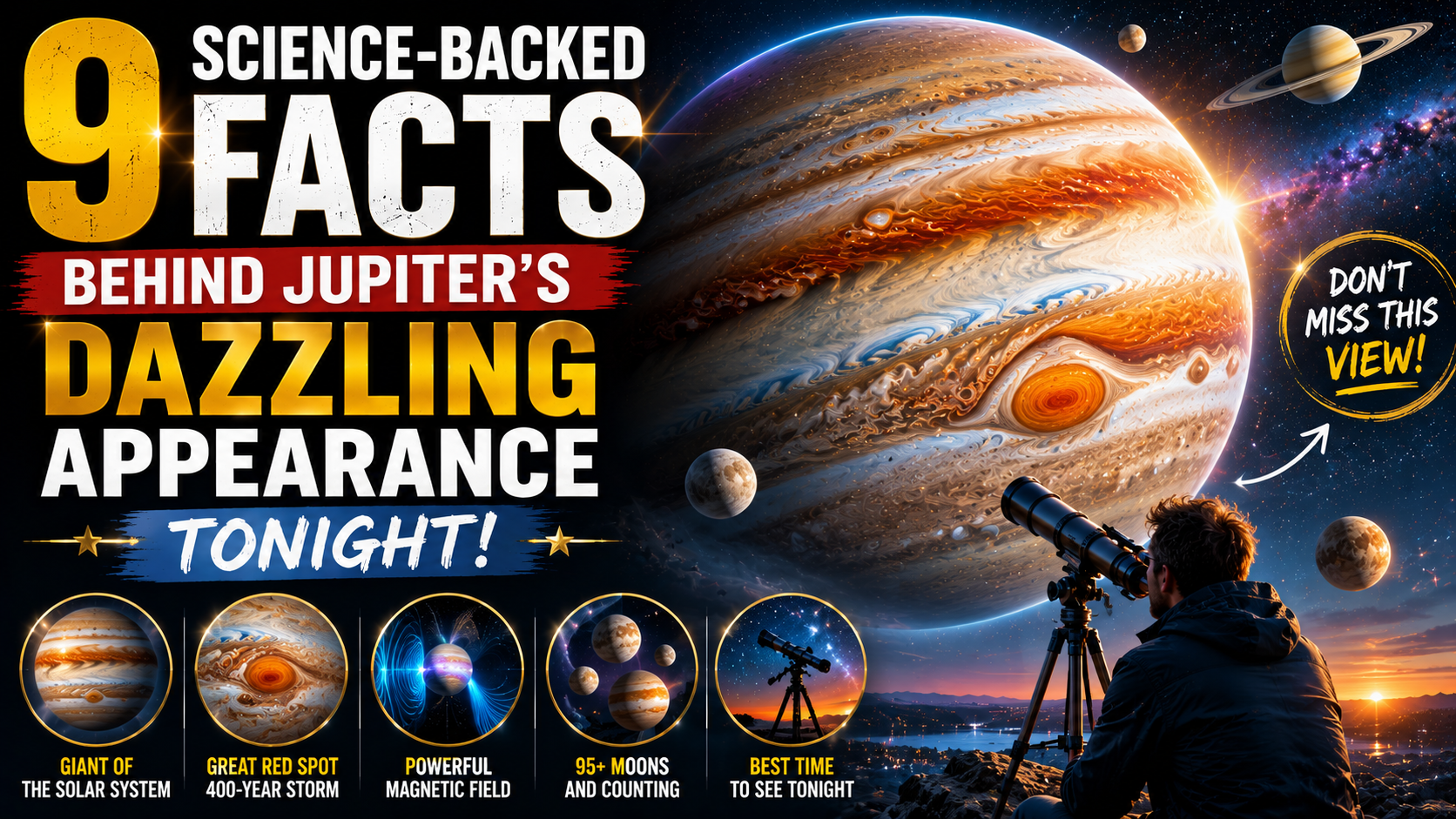
Jupiter has a way of standing out in the night sky like almost no other object. Even without a telescope, it often appears as a bright, steady point of light that outshines most stars. When conditions are right, it can become one of the most striking features visible from Earth, drawing the attention of skywatchers around the world.
While it may look like just another bright “star,” Jupiter is actually a massive gas giant with fascinating physical properties that explain its brilliance. Its visibility is not random—it is the result of size, composition, orbital position, and how it interacts with sunlight.
Understanding why Jupiter appears so dazzling reveals much more than just astronomy. It also highlights how light behaves in space, how planetary systems work, and why some celestial objects dominate the night sky.
Here are nine science-backed facts that explain why Jupiter shines so brightly tonight.
1. Jupiter Is the Largest Planet in the Solar System
One of the most important reasons Jupiter is so bright is its sheer size.
Jupiter is more than 11 times wider than Earth, and its volume could contain over 1,300 Earths. This enormous scale means it has a large surface area to reflect sunlight.
Even though it is a gas giant without a solid surface, its thick cloud layers act like a giant mirror in space, bouncing sunlight back toward Earth.
Its size alone makes it one of the most visible objects in the solar system.
2. Its Cloud Tops Reflect a Huge Amount of Sunlight
Jupiter’s atmosphere is made mostly of hydrogen and helium, with clouds of ammonia, methane, and water vapor.
These cloud layers are highly reflective, especially the bright upper clouds that cover much of the planet.
Because sunlight bounces off these clouds, Jupiter acts like a giant reflector in the sky.
This high reflectivity, known as albedo, is one of the key reasons it appears so bright from Earth.
3. Jupiter Is Closer to Earth Than Most Planets at Certain Times
Jupiter’s brightness also depends on its position in orbit.
Like all planets, it follows an elliptical path around the Sun, which means its distance from Earth changes over time.
When Jupiter is at opposition—directly opposite the Sun from Earth—it is closest to us and appears significantly brighter in the sky.
During these periods, it can outshine nearly every object in the night sky except the Moon and Venus.
4. It Has Powerful Atmospheric Storms That Enhance Its Appearance
Jupiter is famous for its massive atmospheric storms, including the Great Red Spot.
These storms create complex cloud patterns that increase contrast across its surface.
While these features are not visible to the naked eye in detail, they contribute to the planet’s overall brightness and visual complexity when viewed through a telescope.
The constant motion of these storms also means Jupiter’s appearance is always subtly changing.
5. Its Rapid Rotation Affects Its Shape and Light Reflection
Jupiter rotates incredibly fast, completing a full spin in just under 10 hours.
This rapid rotation causes the planet to bulge at the equator, giving it an oblate shape.
This shape slightly affects how sunlight is reflected across its surface, contributing to subtle variations in brightness.
The fast rotation also drives strong atmospheric winds, further enhancing cloud movement and reflectivity.
6. It Produces Its Own Heat and Emits Infrared Energy
Unlike Earth, Jupiter does not rely solely on sunlight for energy.
It actually emits more heat than it receives from the Sun due to internal gravitational compression and leftover heat from its formation.
While this heat is mostly in the infrared spectrum and not visible to the human eye, it plays a role in the planet’s atmospheric dynamics.
This internal energy helps drive storms and cloud movement, indirectly influencing how bright Jupiter appears.
7. Its Position in the Sky Affects How Bright It Looks
Jupiter’s brightness from Earth is also influenced by its position relative to the horizon.
When it is high in the sky, its light passes through less of Earth’s atmosphere, making it appear clearer and brighter.
When it is near the horizon, atmospheric distortion can slightly dim or color-shift its appearance.
This is why Jupiter sometimes appears especially brilliant on crisp, clear nights when it is high overhead.
8. It Outshines Most Stars Due to Reflected Sunlight
Many people are surprised to learn that Jupiter does not produce its own visible light.
Instead, its brightness comes entirely from sunlight reflecting off its clouds.
Despite this, it often appears brighter than most stars in the night sky.
This is because stars are incredibly far away, while Jupiter is relatively close in astronomical terms. Its proximity makes reflected sunlight much more noticeable.
9. Its Visibility Has Helped Shape Human Astronomy for Centuries
Jupiter has been observed since ancient times, long before telescopes were invented.
Early astronomers tracked its movement across the sky and noticed its predictable motion relative to the stars.
In 1610, Galileo’s observations of Jupiter’s moons provided groundbreaking evidence that not everything orbits Earth, helping to transform our understanding of the solar system.
Even today, Jupiter continues to be a major focus of scientific study and public fascination.
Why Jupiter Looks So Dazzling Tonight
Jupiter’s brilliance is the result of a combination of natural factors: its massive size, highly reflective cloud layers, favorable orbital position, and strong atmospheric activity.
When these conditions align, Jupiter becomes one of the brightest objects in the night sky, easily visible even from light-polluted cities.
Its steady glow often makes it one of the first “stars” people notice after sunset.
Final Thoughts
Jupiter’s dazzling appearance is more than just a visual spectacle—it is a reminder of the complexity and scale of our solar system.
From its giant size to its dynamic atmosphere and historical significance, every aspect of the planet contributes to its striking visibility.
For skywatchers, seeing Jupiter shine brightly is not just an astronomical event—it is an opportunity to connect with one of the most powerful and influential planets in our cosmic neighborhood.
And as science continues to explore it through spacecraft and telescopes, Jupiter remains a constant source of wonder in the night sky.