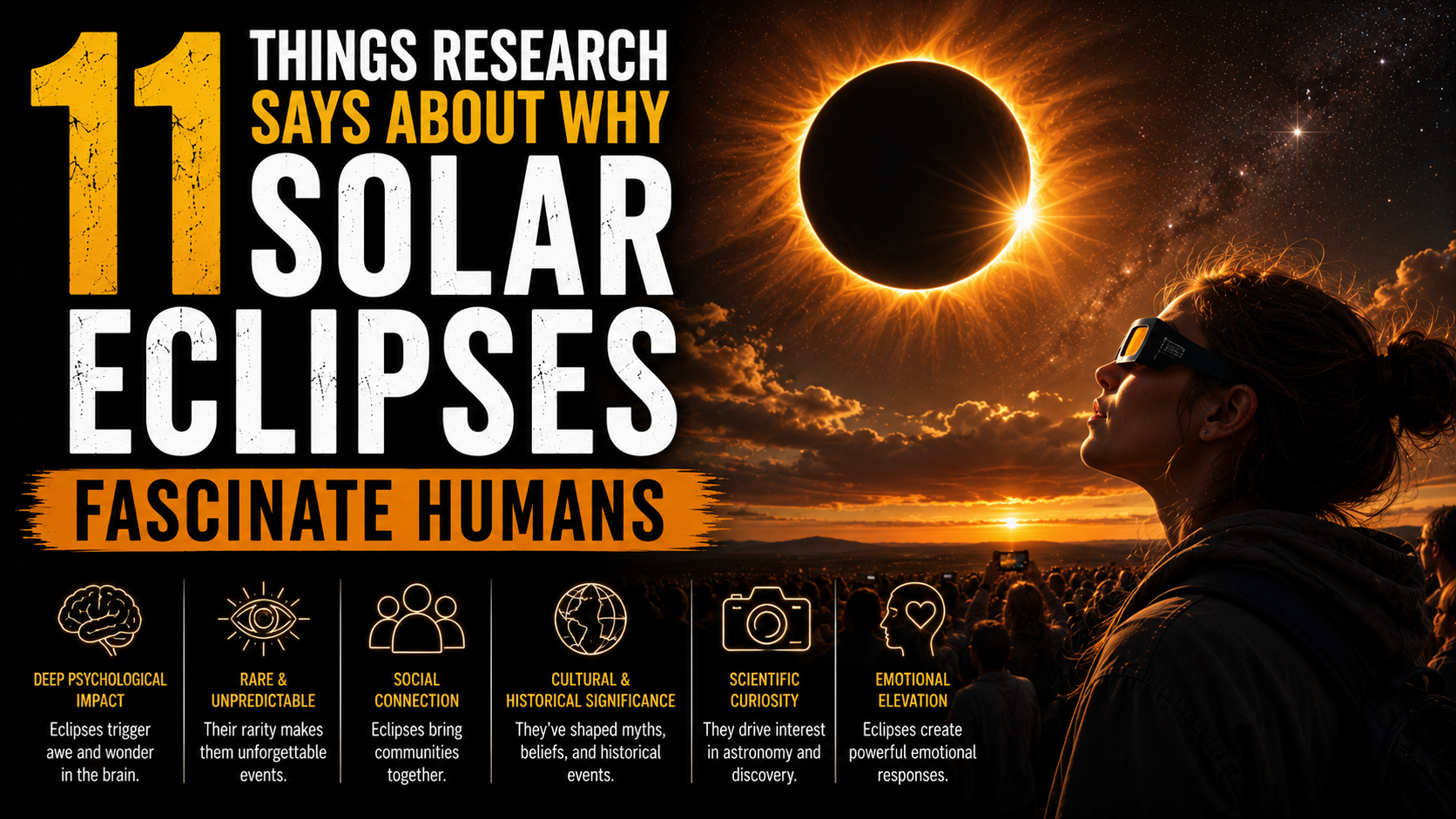
Solar eclipses are among the most awe-inspiring events in nature. For a few brief moments, the Moon moves in front of the Sun, turning day into twilight and revealing the Sun’s outer atmosphere in a way that is normally impossible to see. Across cultures and centuries, eclipses have inspired fear, curiosity, storytelling, and scientific discovery.
Even today, with all our modern knowledge of astronomy, solar eclipses still draw massive public attention. People travel across continents to witness them, scientists deploy research teams, and social media fills with images of the darkened sky.
But why are humans so fascinated by solar eclipses? Research in psychology, anthropology, and neuroscience offers some fascinating explanations.
Here are 11 science-backed insights into why solar eclipses continue to captivate us so deeply.
1. They Disrupt Our Sense of Normal Reality
One of the most powerful reasons eclipses fascinate us is that they temporarily break the normal rules of the day.
When the Sun suddenly disappears in the middle of daylight, our brains struggle to process what is happening. This disruption creates a strong emotional response because it challenges our expectations of how the world should behave.
Humans are naturally drawn to moments that defy routine patterns, and eclipses deliver exactly that.
2. They Trigger a Deep Evolutionary Response
From an evolutionary perspective, sudden changes in daylight could once signal danger.
Early humans may have associated unexpected darkness with threats such as storms or environmental instability.
Even though we now understand eclipses scientifically, some of that instinctive response may still linger, contributing to feelings of awe or unease.
3. They Combine Beauty With Rarity
Psychological studies show that humans are especially drawn to rare events, particularly when they are visually striking.
Solar eclipses are both uncommon and visually dramatic. A total eclipse at a given location may only occur once in several decades.
This combination of rarity and beauty makes the experience feel special and meaningful.
4. They Create a Shared Global Experience
Unlike many natural phenomena, solar eclipses are experienced collectively by large groups of people at the same time.
Communities gather, schools organize viewing events, and entire cities pause to observe the moment.
This shared experience strengthens social bonds and creates a sense of unity among observers.
Research suggests that collective awe can increase feelings of connection and cooperation among people.
5. They Evoke Strong Emotional Awe
Awe is a powerful emotional state triggered by something vast and beyond normal understanding.
Solar eclipses are a textbook example of awe-inspiring events.
Studies show that experiencing awe can reduce stress, increase feelings of humility, and even improve overall well-being.
During an eclipse, many people report feeling small yet connected to something much larger.
6. They Offer a Rare Visual Transformation of the Sky
Humans are highly visual creatures, and the sudden transformation of the sky during an eclipse is unforgettable.
Daylight fades, temperatures drop, and the Sun’s corona becomes visible as a glowing halo.
This dramatic shift in the environment engages multiple senses at once, making the experience more immersive and memorable.
7. They Connect Us to Ancient History and Mythology
Throughout history, eclipses have been recorded in myths, legends, and early scientific observations.
Ancient civilizations often interpreted eclipses as signs from the gods, omens, or cosmic events of great significance.
Even today, knowing that people thousands of years ago witnessed the same phenomenon creates a powerful sense of historical continuity.
This connection to the past adds emotional depth to the experience.
8. They Stimulate Curiosity and Scientific Thinking
Solar eclipses are not just emotional experiences—they are also powerful educational moments.
They encourage people to learn about orbital mechanics, celestial motion, and the relationship between Earth, the Moon, and the Sun.
Research shows that real-world astronomical events can increase interest in science and improve public understanding of space.
For many people, an eclipse becomes a gateway to deeper scientific curiosity.
9. They Create a Sense of Temporary Disorientation
During a total solar eclipse, the sudden darkness can confuse both humans and animals.
Birds may stop singing, insects may behave differently, and temperature changes can be felt almost immediately.
This temporary disruption of natural rhythms creates a sense of disorientation that heightens attention and emotional intensity.
The brain becomes highly alert during this unusual environmental shift.
10. They Are Visually Rare in Any One Location
While solar eclipses occur somewhere on Earth a few times a year, any specific location may only experience one every several decades.
This geographical rarity makes them feel like once-in-a-lifetime events for many people.
Psychological research suggests that scarcity increases perceived value, making rare experiences more emotionally significant.
11. They Reinforce Humanity’s Place in the Cosmos
Perhaps the most profound reason eclipses fascinate us is that they remind us of our place in the universe.
Watching the Moon perfectly cover the Sun reveals the precise alignment and scale of celestial bodies.
It creates a moment of perspective where people become aware of the vast mechanics of the solar system.
This realization often leads to feelings of humility, wonder, and curiosity about the universe beyond Earth.
Why Solar Eclipses Continue to Capture Human Attention
Solar eclipses are more than astronomical events—they are psychological and cultural experiences that engage both emotion and intellect.
They combine rarity, beauty, unpredictability, and scientific meaning in a way few natural phenomena can match.
Whether viewed through the lens of ancient mythology or modern science, eclipses continue to inspire awe across generations.
Final Thoughts
Research shows that our fascination with solar eclipses is deeply rooted in how humans perceive change, rarity, and cosmic scale.
These events challenge our expectations, stimulate emotional responses, and connect us to both history and science.
Most importantly, they remind us that the universe is dynamic, structured, and far more intricate than everyday life suggests.
In the brief moments of an eclipse, people around the world share the same sky—and the same sense of wonder—proving that some experiences truly transcend time, culture, and geography.