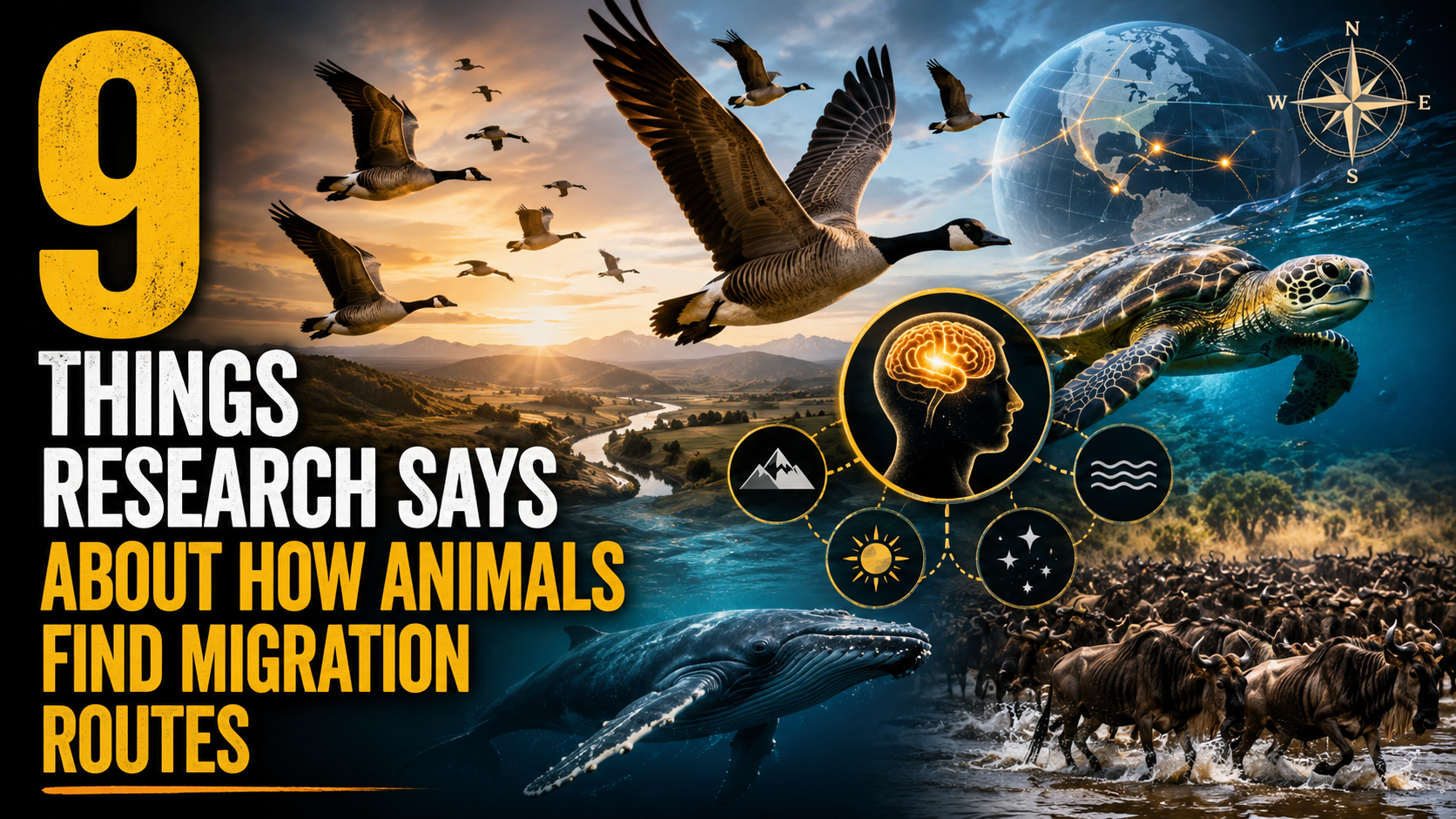
Every year, some of the world’s most remarkable journeys take place without maps, GPS devices, road signs, or travel guides. Birds cross entire continents, whales navigate vast oceans, butterflies travel thousands of miles, and large mammals move across landscapes with astonishing precision.
For centuries, these migrations puzzled scientists. How could animals consistently find the same destinations year after year? How do young animals often complete journeys they’ve never made before? And how do species navigate across environments that appear almost identical in every direction?
Modern research has revealed that animal migration is far more sophisticated than once imagined. Scientists now know that many species rely on a combination of biological instincts, environmental cues, memory, and even Earth’s magnetic field to find their way.
Although researchers continue to uncover new details, several fascinating discoveries have transformed our understanding of animal navigation.
Here are nine things science says about how animals find migration routes.
1. Many Animals Can Detect Earth’s Magnetic Field
One of the most extraordinary discoveries in migration research is that many animals appear capable of sensing Earth’s magnetic field.
Scientists believe this natural ability functions like an internal compass.
Birds, sea turtles, salmon, whales, and several other species have shown evidence of magnetic navigation. By detecting subtle variations in Earth’s magnetic field, animals may be able to determine direction and maintain a course during long journeys.
Researchers are still investigating exactly how this ability works. Some studies suggest specialized cells or molecules within animals may react to magnetic fields, providing orientation information.
Whatever the mechanism, the evidence continues to suggest that Earth’s magnetic field serves as a crucial navigation tool for many migratory species.
2. The Sun Helps Guide Movement
Long before humans invented compasses, the sun provided a reliable source of directional information.
Many animals appear to use the sun’s position as a navigational reference point.
Migratory birds are among the best-studied examples. Scientists have found that some species adjust their direction based on the movement of the sun across the sky.
This process requires more than simply recognizing sunlight. Animals must also account for the time of day because the sun’s position changes continuously.
Research suggests that internal biological clocks help animals compensate for these changes, allowing them to maintain accurate travel routes.
It’s a remarkably sophisticated system that combines environmental observation with biological timing.
3. Stars Play an Important Role for Some Species
When daylight disappears, certain animals switch to an entirely different navigation system.
Research has shown that some migratory birds use stars to orient themselves during nighttime travel.
Experiments conducted in controlled environments have demonstrated that birds can recognize patterns in the night sky and use them to determine direction.
Young birds appear capable of learning star patterns early in life, helping them navigate during future migrations.
The ability to use celestial cues allows many species to travel long distances even when visual landmarks are unavailable.
For centuries, humans relied on stars to navigate oceans. Nature appears to have discovered that strategy long before people did.
4. Landmarks Help Animals Stay on Course
While long-distance navigation often depends on large-scale environmental cues, local navigation frequently involves recognizable landmarks.
Animals may use mountains, rivers, coastlines, forests, and other landscape features as reference points.
Birds flying over familiar territory often follow geographic features that simplify navigation. Similarly, marine animals may use underwater structures, coastlines, or ocean currents as orientation aids.
Scientists increasingly believe migration involves multiple navigation systems working together rather than a single method.
Landmarks provide valuable confirmation that an animal remains on the correct route.
This flexibility improves accuracy and increases survival rates during demanding journeys.
5. Smell Can Guide Navigation
For some species, the nose plays a surprisingly important role.
Salmon provide one of the most famous examples.
After spending years in the ocean, many salmon return to the exact streams where they were born. Researchers have found strong evidence that smell helps them locate these specific waterways.
Young salmon appear to memorize unique chemical signatures associated with their home rivers.
Years later, they use those scent memories to identify the correct route back.
Other species may also rely on smell to varying degrees, particularly when navigating local environments.
This ability demonstrates how migration often depends on highly specialized sensory information.
6. Genetics Provide Built-In Travel Instructions
One of the most fascinating questions in migration research involves animals making journeys they have never experienced before.
How do first-time migrants know where to go?
Scientists have discovered that genetics play a major role.
Certain migratory behaviors appear to be inherited. Young animals may possess instinctive information about direction, timing, distance, and movement patterns.
For example, some bird species begin migration without guidance from older individuals. Despite lacking prior experience, they often travel toward appropriate seasonal destinations.
These inherited navigation programs provide a starting framework for successful migration.
However, genetics alone rarely explain the entire process.
Experience and environmental learning also contribute significantly.
7. Memory Improves Navigation Over Time
Just as humans become more confident navigating familiar routes, animals often improve through experience.
Research suggests many migratory species develop increasingly accurate travel patterns as they age.
Older animals may remember important landmarks, feeding locations, resting sites, and environmental conditions encountered during previous journeys.
This accumulated knowledge can improve efficiency and reduce risk.
Studies of birds, whales, elephants, and other long-lived species indicate that experienced individuals often play important roles in guiding group movements.
In some populations, migration knowledge may be passed between generations through social learning.
Memory transforms migration from a purely instinctive behavior into a sophisticated learned skill.
8. Environmental Conditions Influence Route Choices
Migration routes are not always fixed.
Scientists have found that animals frequently adjust their paths in response to changing environmental conditions.
Factors such as:
- Weather patterns
- Wind direction
- Ocean currents
- Food availability
- Water levels
- Temperature changes
can all influence migration decisions.
Birds may alter routes to take advantage of favorable winds. Marine animals may follow productive feeding zones. Large mammals often respond to seasonal vegetation growth.
These adjustments demonstrate remarkable adaptability.
Rather than blindly following predetermined routes, many animals actively respond to real-time conditions.
This flexibility helps improve survival and reproductive success.
9. Migration Is Often a Combination of Multiple Systems
Perhaps the most important finding from modern research is that migration rarely depends on a single navigation method.
Instead, animals appear to combine several systems simultaneously.
A migratory bird, for example, may use:
- Earth’s magnetic field
- The sun
- Star patterns
- Visual landmarks
- Weather conditions
- Previous experience
all during the same journey.
If one source of information becomes unavailable, another may compensate.
This layered approach creates a highly reliable navigation system capable of functioning across diverse environments and changing conditions.
Scientists increasingly describe migration as one of nature’s most impressive examples of biological problem-solving.
Why Migration Continues to Fascinate Scientists
Despite decades of research, migration remains one of the greatest mysteries in biology.
Every new discovery reveals additional layers of complexity.
Researchers continue studying questions such as:
- How magnetic sensing works at the molecular level
- How animals integrate multiple navigation cues
- How climate change affects migration routes
- How migration knowledge spreads through populations
- How young animals learn complex travel behaviors
Advances in satellite tracking, GPS technology, genetics, and animal-borne sensors are providing unprecedented insights into these questions.
Each year, scientists gain a clearer understanding of migration’s remarkable sophistication.
How Migration Supports Ecosystems
Animal migration is not only important for individual species.
It also plays a crucial role in maintaining healthy ecosystems.
Migratory animals help:
- Distribute nutrients
- Spread seeds
- Support food webs
- Regulate populations
- Connect distant habitats
For example, migrating fish transport nutrients between oceans and rivers. Birds contribute to seed dispersal across vast regions. Large mammals influence vegetation patterns and ecosystem structure.
These movements create ecological connections that benefit countless species.
Protecting migration routes therefore supports biodiversity on a much broader scale.
Challenges Facing Migratory Species
While migration has evolved over millions of years, modern environmental changes present new challenges.
Many migratory animals now encounter:
- Habitat loss
- Urban development
- Fences and barriers
- Pollution
- Artificial lighting
- Climate change
- Altered food availability
These obstacles can disrupt traditional routes and make navigation more difficult.
Conservation efforts increasingly focus on preserving migration corridors and reducing barriers that interfere with natural movement patterns.
Protecting migration is often essential for long-term species survival.
What Migration Teaches Us About Nature
Animal migration offers a powerful reminder of nature’s complexity.
The ability of birds to cross oceans, whales to navigate entire ocean basins, salmon to return home after years at sea, and mammals to travel thousands of miles demonstrates an extraordinary level of biological sophistication.
These journeys are not random.
They reflect millions of years of evolutionary adaptation, sensory development, learning, and environmental interaction.
Every migration season reveals just how much remains to be discovered about the natural world.
Final Thoughts
The study of migration continues to uncover some of the most remarkable abilities found in nature. Research shows that animals rely on a combination of magnetic sensing, solar navigation, star patterns, landmarks, smell, genetics, memory, and environmental awareness to find their way across enormous distances.
Rather than depending on a single navigation tool, many species use multiple systems working together to guide their journeys with astonishing accuracy.
As scientists continue exploring the mysteries of migration, one thing becomes increasingly clear: animal navigation is far more advanced than most people realize.
These incredible journeys not only support the survival of countless species but also reveal the extraordinary intelligence and adaptability that exist throughout the natural world.