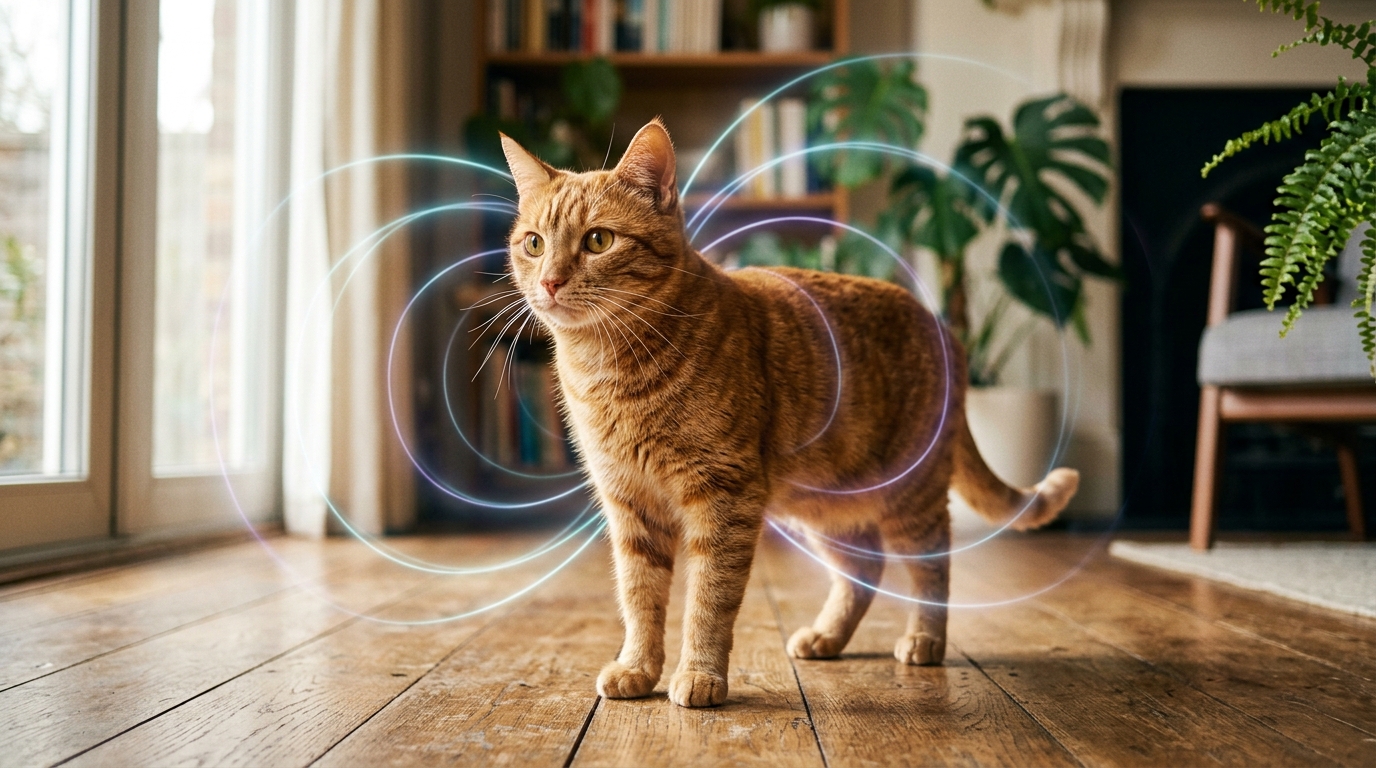
Cats have fascinated humans for thousands of years. Known for their independence, agility, and mysterious behavior, they often seem to possess abilities that are difficult to explain. From always finding their way home to choosing peculiar sleeping spots, cats continue to surprise both pet owners and scientists alike.
One particularly intriguing area of research involves the possibility that cats can sense Earth’s magnetic field. While this ability is best documented in birds, sea turtles, and certain insects, growing evidence suggests that many mammals—including domestic cats—may also be influenced by the planet’s invisible magnetic forces.
Although researchers are still uncovering exactly how this works, the findings raise fascinating questions about how animals perceive the world around them.
Here are 12 things most people don’t know about cats and their possible connection to Earth’s magnetic field.
1. Earth Is Surrounded by an Invisible Magnetic Field
Our planet generates a vast magnetic field that extends far into space. Created by the movement of molten metals deep within Earth’s core, this field acts like a giant protective shield against harmful solar radiation.
While humans generally cannot detect it directly, many animals appear capable of sensing magnetic cues that help them navigate their environment.
2. Scientists Call This Ability Magnetoreception
The ability to detect magnetic fields is known as magnetoreception.
Researchers have confirmed this sense in numerous species, including migratory birds, sea turtles, salmon, bats, and some insects. Scientists suspect that many mammals may possess similar capabilities, though the mechanisms involved remain an active area of study.
3. Cats May Use Magnetic Cues for Orientation
Some researchers believe cats may use Earth’s magnetic field as an additional source of spatial information.
While vision, smell, hearing, and memory remain their primary navigational tools, magnetic signals could provide another layer of environmental awareness, helping them orient themselves in unfamiliar surroundings.
4. Their Homing Ability Has Long Puzzled Scientists
Stories of cats traveling remarkable distances to return home have been reported for decades.
Although many of these journeys can likely be explained by scent trails, memory, and environmental landmarks, some scientists have wondered whether magnetic sensitivity may also contribute to a cat’s ability to navigate over long distances.
The exact explanation remains a topic of ongoing investigation.
5. Researchers Have Observed Magnetic Alignment in Animals
Various animal species display a behavior known as magnetic alignment, in which they position their bodies along Earth’s magnetic north-south axis.
Studies have documented this phenomenon in animals ranging from deer and cattle to foxes and rodents. Researchers continue exploring whether domestic cats exhibit similar tendencies under certain conditions.
6. Cats Sometimes Choose Sleeping Positions Consistently
Many cat owners notice that their pets often seem to favor particular sleeping orientations.
Although comfort, temperature, light, and safety are likely the most important factors, scientists have investigated whether magnetic alignment may subtly influence resting positions in some animals.
The results remain intriguing but not yet conclusive.
7. Magnetic Storms Can Affect Animal Behavior
Earth’s magnetic field is not constant. Solar activity can trigger geomagnetic disturbances that temporarily alter magnetic conditions.
Research on various species suggests that magnetic storms may affect navigation and orientation behaviors. Scientists are studying whether similar effects occur in mammals, including domestic cats.
8. Cats Possess Highly Advanced Sensory Systems
Even without considering magnetoreception, cats experience the world very differently from humans.
Their hearing can detect frequencies beyond our range, their whiskers provide detailed information about nearby objects, and their night vision greatly exceeds our own. If cats can sense magnetic fields, it would simply add another remarkable capability to an already sophisticated sensory toolkit.
9. The Mechanism Remains a Mystery
One of the biggest questions surrounding magnetoreception is how animals detect magnetic fields.
Some theories suggest specialized cells containing microscopic magnetic particles may act like biological compasses. Others propose that chemical reactions within the eyes could help animals perceive magnetic information.
Researchers are still working to determine whether either mechanism applies to cats.
10. Navigation Is Often a Multi-Sensory Process
Scientists generally agree that animals rarely rely on a single sense when navigating.
Instead, they combine information from sight, smell, sound, memory, landmarks, and potentially magnetic cues. If cats do use Earth’s magnetic field, it is likely only one part of a much larger navigational system.
11. Domestic Cats May Share Ancient Survival Traits
The ancestors of modern domestic cats evolved as highly skilled hunters that depended on acute awareness of their surroundings.
Many behaviors seen in house cats today—including stalking, territorial patrols, and route memorization—reflect adaptations that helped wild felines survive. Sensitivity to environmental cues, including magnetic information, could be part of this evolutionary legacy.
12. Scientists Are Still Making New Discoveries
Despite living alongside humans for thousands of years, cats continue to surprise researchers.
Advances in animal behavior studies, tracking technology, and neuroscience are helping scientists uncover new insights into how cats perceive and interact with the world. Future research may reveal whether Earth’s magnetic field plays a greater role in feline behavior than currently understood.
Why This Research Matters
Understanding how animals navigate can provide valuable insights into biology, neuroscience, and evolution. If cats possess some degree of magnetic sensitivity, it could help scientists better understand how mammals process environmental information.
Such discoveries may also contribute to broader research into navigation systems used by other species, including migratory animals that travel thousands of miles with remarkable accuracy.
The study of magnetoreception remains one of the most fascinating frontiers in animal science because it explores a sensory world that humans can barely perceive.
A Reminder of How Extraordinary Cats Are
Cats often appear mysterious because much of their behavior is driven by senses that operate differently from our own. Their ability to detect subtle sounds, movements, scents, and environmental changes already sets them apart from humans.
Whether or not future studies confirm a strong connection between cats and Earth’s magnetic field, the possibility highlights how much there is still to learn about these beloved companions.
Final Thoughts
The idea that cats may sense Earth’s magnetic field sounds like something from science fiction, yet it is rooted in a growing body of scientific research exploring animal navigation and magnetoreception.
While many questions remain unanswered, evidence from other species suggests that magnetic sensitivity is more common in nature than once believed. Cats may use a combination of senses—including some we do not fully understand—to navigate and interpret their surroundings.
As scientists continue their investigations, one thing remains certain: the humble house cat is far more remarkable than most people realize. Every new discovery adds another layer to the mystery of these intelligent, adaptable, and endlessly fascinating animals.







