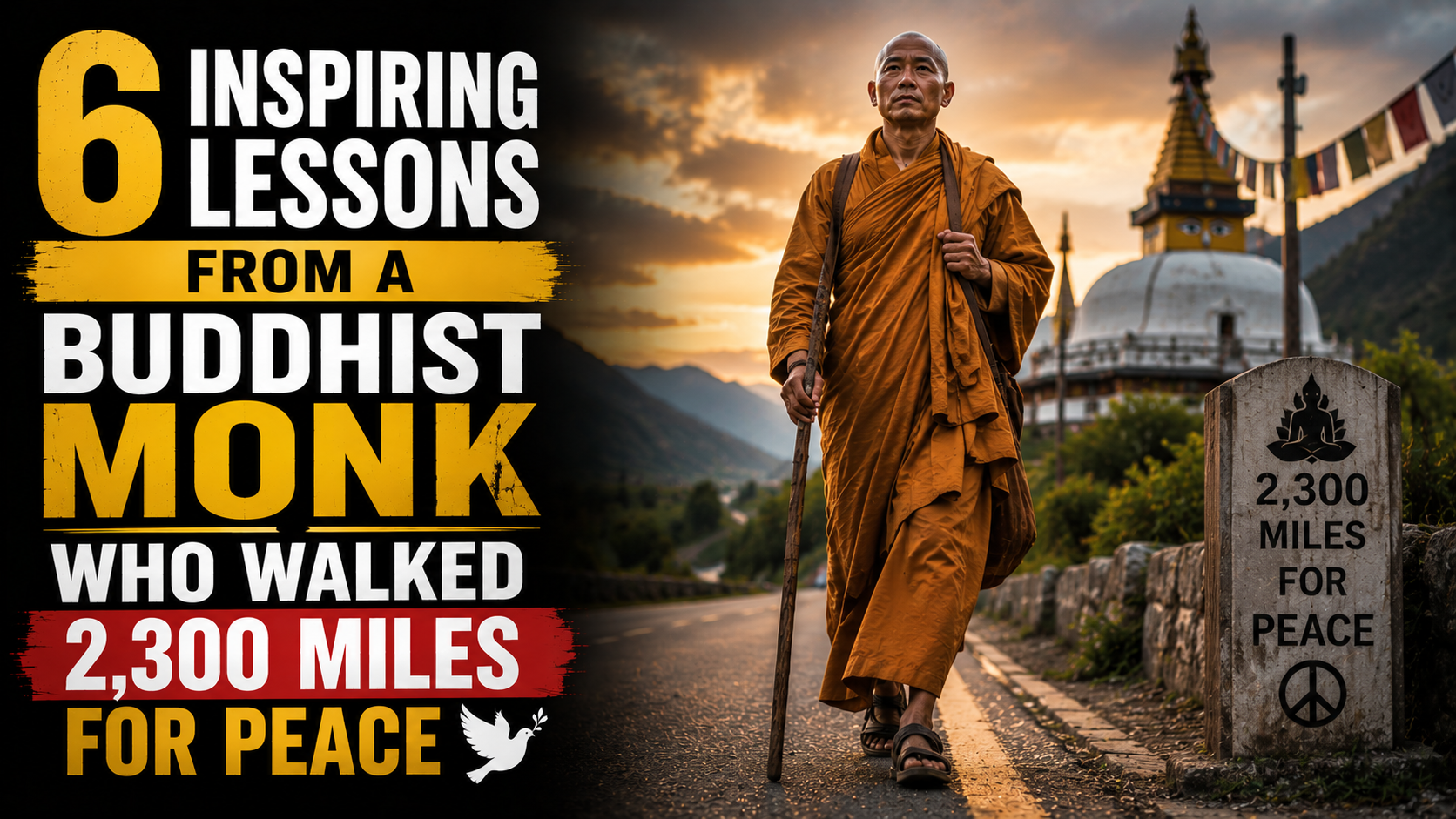
Stories of long-distance journeys often carry a special kind of meaning, especially when they are tied to spiritual practice and personal discipline. One such remarkable story is that of a Buddhist monk who walked an estimated 2,300 miles in pursuit of peace. While accounts of such journeys may vary in detail depending on tradition and retelling, the symbolism behind the story has inspired countless people around the world.
At its core, the journey is not just about physical distance. It is about endurance, mindfulness, simplicity, and the pursuit of inner calm in a noisy world. Walking thousands of miles on foot becomes a meditation in motion—each step a reminder of patience, awareness, and intention.
In a modern era defined by speed and constant distraction, this story stands out as a powerful contrast. It invites reflection on what it truly means to live with purpose and clarity.
Here are six inspiring lessons we can learn from the journey of a Buddhist monk who walked 2,300 miles for peace.
1. Every Step Can Be a Form of Meditation
One of the most profound lessons from this journey is the idea that walking itself can become meditation.
Instead of rushing toward a destination, the monk’s approach emphasizes awareness of each step, breath, and moment.
This practice transforms a simple physical act into a deeply spiritual experience. It teaches that mindfulness is not limited to sitting in silence—it can be practiced in motion, in daily life, and even in hardship.
When attention is placed fully on the present moment, even long and difficult journeys become more peaceful.
2. Simplicity Creates Mental Freedom
A journey of this nature requires a radical embrace of simplicity.
Carrying few possessions and focusing only on essential needs reduces mental clutter and emotional distraction.
This simplicity allows the mind to remain clear and focused on the present path rather than being weighed down by material concerns.
In modern life, where excess often creates stress, this lesson highlights the value of living with less in order to experience more inner peace.
3. Endurance Is Built Through Patience, Not Speed
Walking 2,300 miles is not something accomplished quickly. It requires patience over long periods of time.
Rather than focusing on how fast the journey can be completed, the emphasis is placed on steady, consistent progress.
This mindset reflects a deeper truth: meaningful goals are achieved through persistence, not haste.
By embracing patience, even the most challenging paths become manageable.
4. Challenges Become Part of the Practice
Long journeys inevitably include discomfort—weather changes, physical fatigue, and unexpected obstacles.
Instead of avoiding these challenges, the monk’s approach treats them as part of the practice itself.
Difficulties are not interruptions; they are opportunities for growth, reflection, and resilience.
This perspective transforms hardship into a teacher rather than an obstacle.
5. Inner Peace Is Not Dependent on External Conditions
One of the most powerful lessons from the journey is that peace does not depend on surroundings.
Whether walking through remote landscapes or busy areas, the monk’s focus remains inward.
This teaches that true calm is cultivated internally rather than found externally.
Even in difficult or unpredictable environments, it is possible to maintain a sense of balance and clarity through mindful awareness.
6. Purpose Gives Direction to Every Mile
A journey of 2,300 miles would be impossible to complete without a strong sense of purpose.
For the monk, the walk represents a deeper spiritual intention connected to peace and understanding.
Purpose transforms physical effort into meaningful action. It gives direction, motivation, and emotional strength.
When individuals are guided by purpose, even long and uncertain journeys feel more meaningful and achievable.
Why This Journey Resonates With Modern Audiences
In today’s fast-paced world, stories like this resonate because they offer an alternative way of living.
Many people feel overwhelmed by speed, noise, and constant digital stimulation. The image of a monk walking slowly and intentionally across great distances offers a striking contrast.
It suggests that life does not always need to be rushed. Instead, it can be experienced with awareness, patience, and simplicity.
This is why such stories continue to inspire people far beyond their original cultural or spiritual context.
The Symbolism Behind the Journey
While the physical reality of the journey is impressive, its symbolic meaning is even more powerful.
The walk represents a path toward inner peace rather than a literal destination. Each mile becomes a metaphor for personal growth, discipline, and mindfulness.
In this sense, the journey is less about geography and more about transformation.
It reflects the idea that peace is not something found at the end of a path—it is something cultivated along the way.
Final Thoughts
The story of a Buddhist monk walking 2,300 miles for peace offers more than an account of endurance. It provides a set of timeless lessons about how to live with intention, awareness, and simplicity.
From mindfulness in every step to the importance of purpose, the journey highlights principles that remain relevant in modern life.
Ultimately, it reminds us that peace is not achieved through speed or accumulation, but through patience, presence, and steady movement forward.
In a world that often moves too quickly, this story encourages us to slow down, breathe, and recognize the value of each step we take.







