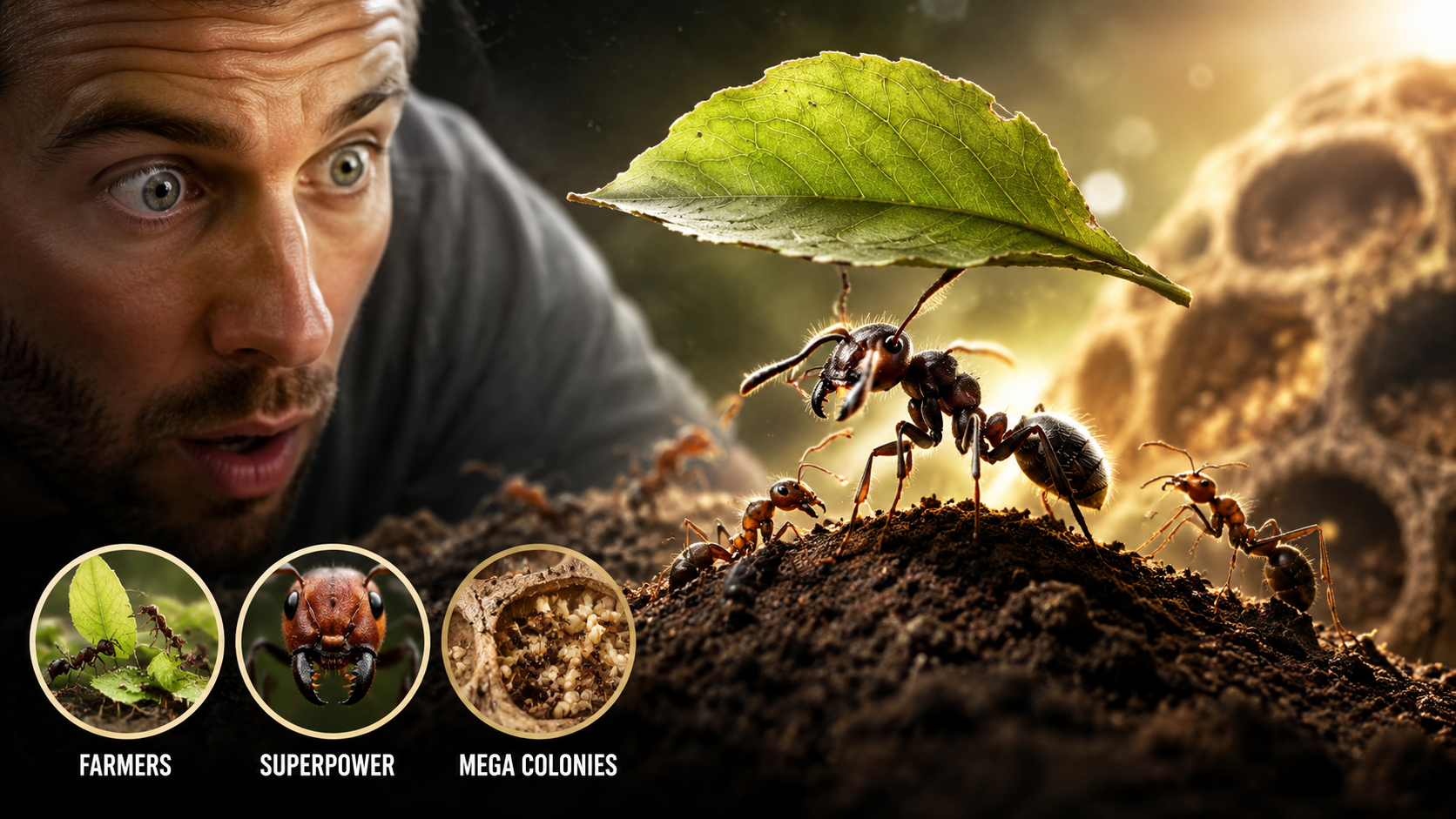
Ants are among the most familiar creatures on Earth. We see them marching across sidewalks, carrying crumbs many times their size, or building intricate nests in the ground. Because they are so common, it’s easy to overlook just how extraordinary these tiny insects really are.
Scientists have spent decades studying ants, and their discoveries have revealed behaviors that seem almost unbelievable. Ants can communicate in sophisticated ways, organize massive societies, and solve complex problems collectively. In many respects, these tiny insects challenge our assumptions about intelligence, cooperation, and social organization.
Here are 10 surprising facts about ants that may completely change the way you think about them.
1. Ants Wage Organized Wars
Many people think of ants as simple creatures that spend their days gathering food. In reality, some ant species engage in highly organized conflicts that resemble warfare.
Colonies may send out scouts to locate rival nests and then launch coordinated attacks involving thousands of workers. Some species defend territory, compete for food resources, and even take prisoners.
These conflicts demonstrate that ants can organize large groups toward shared objectives with remarkable efficiency.
2. Some Ants Farm Other Insects
Believe it or not, certain ants practice a form of agriculture.
Many species protect and care for aphids, tiny insects that produce a sugary substance called honeydew. The ants defend the aphids from predators and may even move them to better feeding locations.
In return, the ants harvest the honeydew as a valuable food source. This mutually beneficial relationship resembles farming in ways that seem astonishingly advanced for insects.
3. Ant Colonies Can Function Like a Superorganism
Scientists often describe ant colonies as superorganisms because the colony behaves almost like a single living entity.
Individual ants perform specialized roles, including gathering food, caring for young, defending the nest, and maintaining the colony. No single ant directs the entire operation, yet together they create highly coordinated systems.
This collective behavior challenges the idea that complex organization always requires centralized leadership.
4. Some Ants Practice Agriculture With Fungi
Long before humans cultivated crops, certain ant species were already farming.
Leafcutter ants gather pieces of leaves not for direct consumption but to grow fungi inside their nests. The cultivated fungus serves as their primary food source.
This sophisticated partnership between ants and fungi has existed for millions of years and represents one of nature’s most remarkable examples of agriculture.
5. Ants Can Build Living Structures
Some ant species use their own bodies as building materials.
Army ants, for example, can link themselves together to create bridges, protective shelters, and floating rafts. Each ant responds to local conditions and adjusts its position to support the colony’s needs.
These living structures can assemble and disassemble as circumstances change, demonstrating extraordinary cooperation and adaptability.
6. Certain Ants Can Recognize Colony Members by Smell
Ant societies depend heavily on chemical communication.
Ants produce and detect specific chemical signals that allow them to identify members of their own colony. These scent signatures help them distinguish friends from intruders.
Despite their tiny brains, ants can navigate highly complex social environments using chemical information that humans cannot directly perceive.
7. Ants Have Been Around Longer Than Humans by a Vast Margin
Ants are ancient creatures.
Scientists estimate that ants first appeared more than 100 million years ago, meaning they shared the planet with dinosaurs. Over this immense span of time, they have survived dramatic environmental changes and evolved into thousands of different species.
Their extraordinary longevity demonstrates an incredible capacity for adaptation and resilience.
8. Some Ants Can Perform Emergency Medical Care
Researchers have observed certain ant species engaging in behaviors that resemble first aid.
When injured ants return from dangerous encounters, nestmates may clean their wounds and remove debris. Studies suggest that these actions can improve survival rates for injured individuals.
Such behavior challenges traditional ideas about how sophisticated social care can be among insects.
9. Ant Colonies Make Collective Decisions
Ants frequently face complex choices, such as selecting new nesting sites or determining where to search for food.
Rather than relying on a single leader, they often make decisions collectively. Individual ants gather information and communicate through chemical signals and interactions with nestmates.
Through this decentralized process, colonies can arrive at remarkably effective solutions that emerge from the combined actions of many individuals.
10. Ants Are Among Earth’s Greatest Ecological Engineers
Although tiny, ants have an enormous impact on ecosystems.
They aerate soil, disperse seeds, recycle nutrients, control certain insect populations, and influence plant growth. In some environments, their activities significantly shape the surrounding ecosystem.
Because of their abundance and ecological roles, ants help maintain the health and balance of countless habitats around the world.
Why Ants Continue to Fascinate Scientists
The more researchers learn about ants, the more surprising these insects become. They farm, communicate through complex chemical systems, build living structures, care for injured nestmates, and create societies that function with remarkable efficiency.
Perhaps the most fascinating lesson ants teach us is that size does not determine significance. Despite possessing tiny bodies and brains, they demonstrate levels of cooperation and organization that continue to challenge scientific assumptions about intelligence and social behavior.
The next time you notice a line of ants crossing the ground, remember that you are witnessing descendants of an ancient and incredibly successful group of creatures whose hidden world is far more complex and astonishing than most people ever imagine.