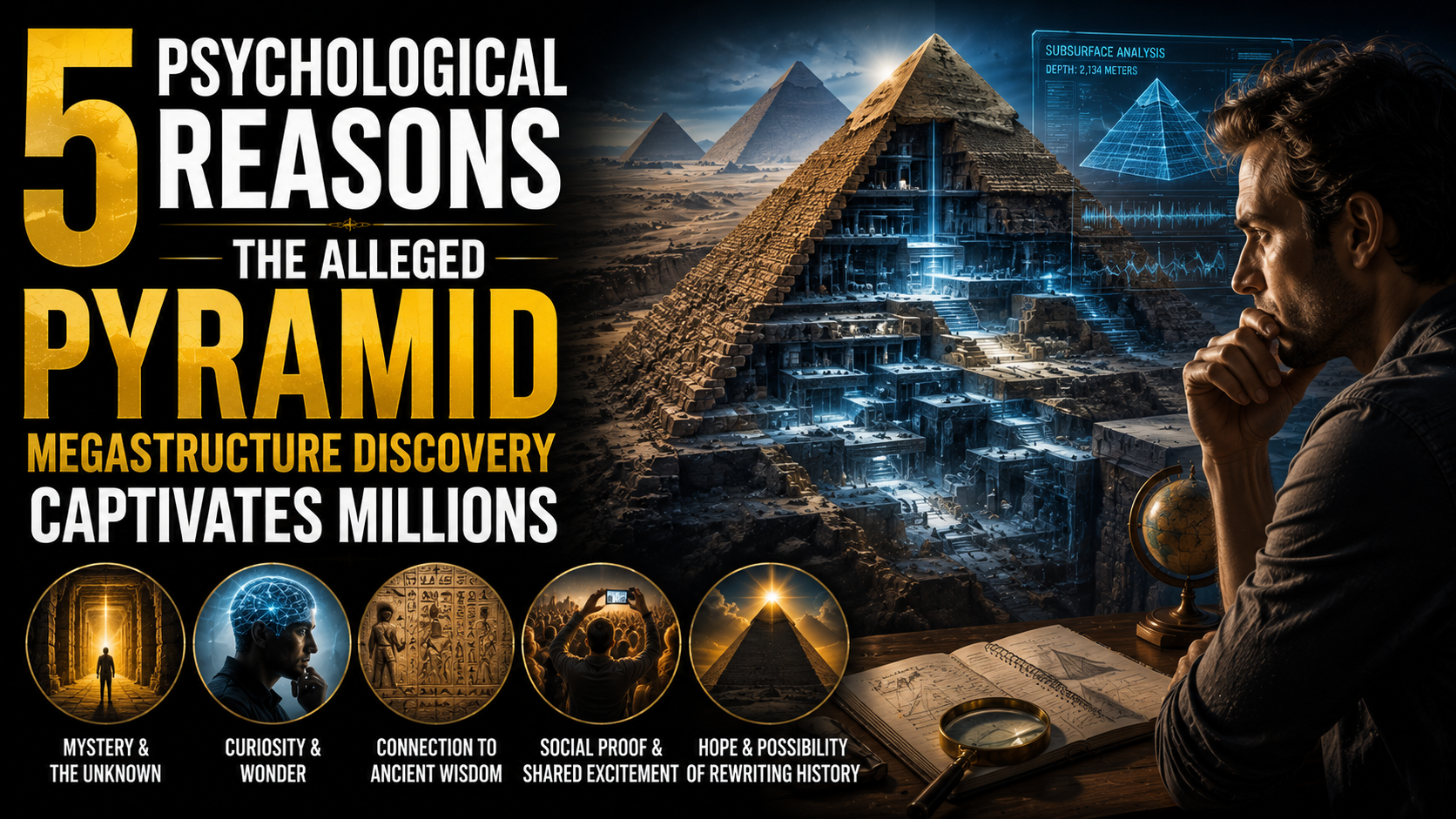
Few topics spread across the internet as quickly as claims about hidden structures beneath or inside ancient pyramids. Whether discussed in documentaries, social media threads, or speculative research articles, the idea of a “pyramid megastructure discovery” tends to generate massive global attention almost instantly.
Even when details are uncertain or still under scientific review, the fascination remains strong. Part of this interest comes from archaeology, part from imagination, and part from the way the human brain responds to mystery and possibility.
While researchers continue to separate verified findings from speculation, the psychological pull behind these stories is clear. Humans are naturally drawn to puzzles, ancient history, and the idea that something significant may still be hidden beneath one of the world’s most studied monuments.
Here are five psychological reasons the alleged pyramid megastructure discovery captivates millions.
1. The Brain Is Wired to Respond to Mystery and Incomplete Information
One of the strongest psychological triggers behind viral archaeological stories is uncertainty.
When people encounter incomplete or partially explained discoveries, the brain naturally tries to fill in the gaps.
This creates curiosity loops, where the mind keeps returning to the question of “what if?”
Ancient pyramids, already full of unanswered questions, amplify this effect even further.
2. Ancient Structures Activate Deep Evolutionary Curiosity
Human beings have always been drawn to ancient environments and long-lost civilizations.
From an evolutionary perspective, understanding the past helps people make sense of identity and survival.
Large stone structures like pyramids symbolize permanence and intelligence from civilizations far removed in time.
When new “discoveries” are suggested, they trigger a powerful sense of historical curiosity and wonder.
3. Scale and Monumentality Enhance Emotional Impact
The sheer size of pyramids plays a major role in emotional response.
Large, complex structures naturally create feelings of awe, which psychologists link to cognitive expansion and heightened attention.
When the idea of hidden megastructures is introduced, that sense of scale becomes even more powerful.
The mind struggles to fully comprehend something so massive and potentially complex.
4. Social Media Amplifies Curiosity Through Repetition
Modern psychology is heavily influenced by digital environments.
When a topic appears repeatedly across platforms, it gains perceived importance through repetition alone.
Even without full verification, exposure across videos, posts, and discussions makes the idea feel more credible.
This phenomenon, known as the “illusory truth effect,” helps explain why pyramid-related claims spread so quickly.
5. The Desire for Hidden Knowledge Feels Personally Engaging
One of the most powerful psychological drivers is the appeal of hidden or secret knowledge.
People are naturally attracted to the idea that there is something “more” to discover than what is publicly known.
Alleged discoveries beneath pyramids tap into this sense of exclusivity and wonder.
It creates a feeling that the viewer is witnessing or learning something extraordinary and not widely understood.
Why Pyramid Mysteries Spread So Easily
Beyond individual psychology, pyramid stories also spread because they combine multiple powerful narrative elements: ancient history, advanced engineering, mystery, and the possibility of lost knowledge.
This combination makes them ideal for storytelling, even when scientific confirmation is still pending.
The pyramids themselves already carry cultural weight, so any new claim attached to them automatically gains attention.
The Role of Scientific Caution
While public fascination grows quickly, archaeologists and researchers often approach such claims carefully.
Modern technology, including ground-penetrating radar and satellite imaging, has indeed revealed new details about ancient structures.
However, experts emphasize the importance of peer review and verification before drawing conclusions about large-scale hidden systems.
This balance between discovery and skepticism is essential in responsible research.
Final Thoughts
The fascination with alleged pyramid megastructure discoveries is not just about archaeology—it is deeply rooted in human psychology.
From curiosity and pattern-seeking to emotional responses to scale and mystery, the mind is naturally drawn to unexplained possibilities.
Even when details remain unconfirmed, the story itself becomes powerful enough to capture global attention.
In the end, pyramids continue to serve as more than ancient monuments—they are mirrors of human imagination, constantly inspiring questions about what might still be hidden beneath the surface of history.







