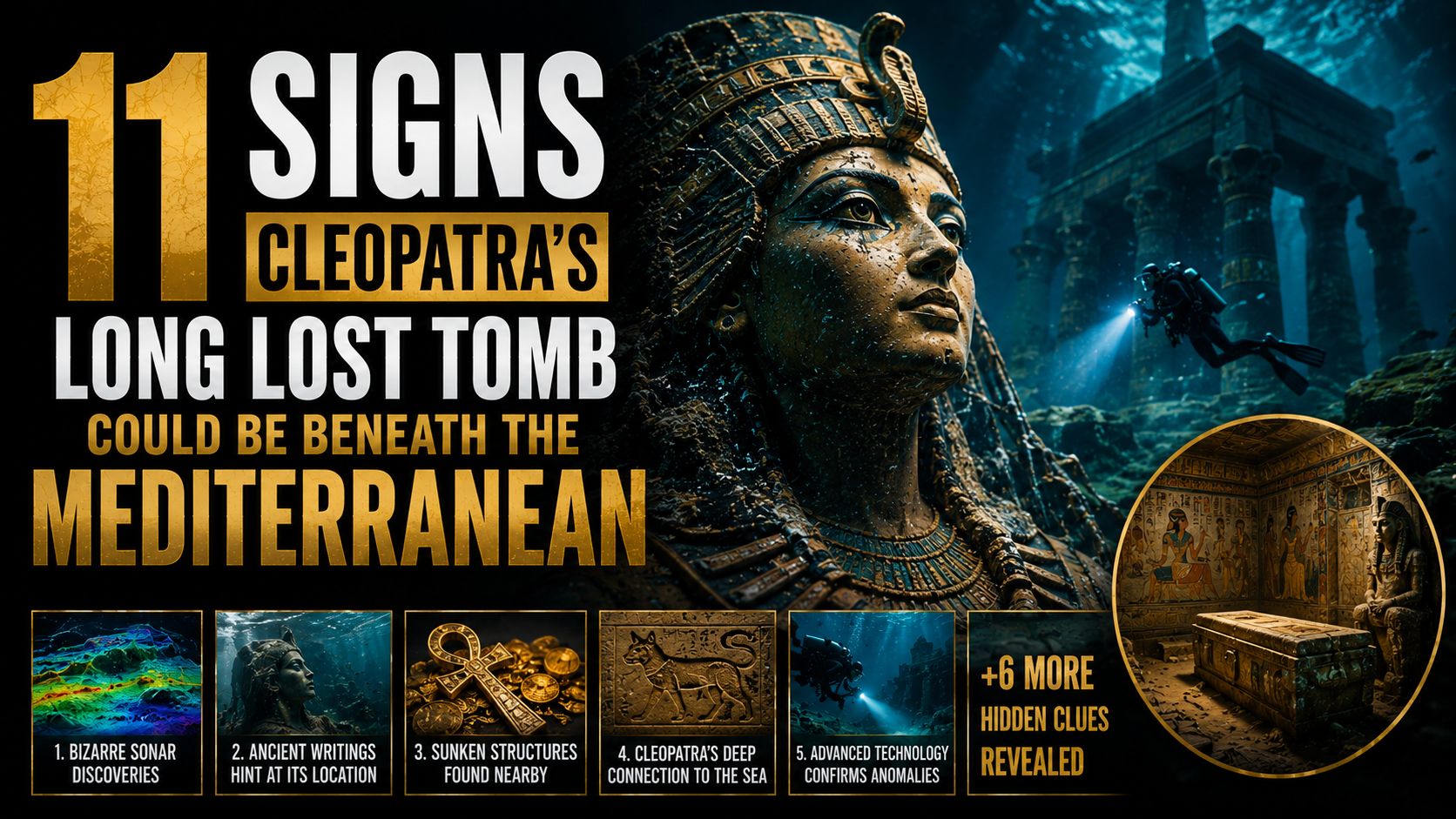
Few historical mysteries capture the imagination like the final resting place of Cleopatra VII, the last active ruler of Ancient Egypt. Despite her immense influence in politics, culture, and diplomacy, her burial site has never been confirmed. For centuries, historians and archaeologists have searched for clues, with theories ranging from hidden desert tombs to submerged coastal sites.
One of the most intriguing modern ideas suggests that Cleopatra’s tomb may lie beneath the Mediterranean Sea. This theory is not based on speculation alone—various archaeological findings, ancient records, and geological patterns have led some researchers to consider the possibility seriously.
While no definitive proof has been discovered, several compelling indicators continue to fuel investigation.
Here are 11 signs Cleopatra’s long-lost tomb could be beneath the Mediterranean.
1. Ancient Alexandria Has Partly Submerged Over Time
Historical records show that Cleopatra ruled from Alexandria, a city built along the Mediterranean coast.
Over the centuries, natural disasters, earthquakes, and rising sea levels have caused parts of the ancient city to sink.
Archaeologists have already discovered submerged ruins just offshore.
This suggests that important structures from Cleopatra’s time may now lie underwater.
2. Earthquake Activity Changed the Region’s Landscape
The eastern Mediterranean is a geologically active zone.
Major earthquakes during antiquity significantly reshaped coastal areas of Egypt.
Some ancient temples and royal districts are believed to have collapsed or been submerged.
Such seismic events could have affected burial sites as well.
3. Ancient Texts Suggest a Coastal Royal Burial
Some historical writings describe royal burial practices near sacred or symbolic locations.
Cleopatra was known for aligning herself with both Egyptian and Hellenistic traditions.
Certain interpretations of ancient accounts suggest a burial site near water or temple complexes close to the coast.
These references are open to debate but remain important clues.
4. Submerged Temples Have Already Been Found Nearby
Archaeological teams have discovered underwater ruins near Alexandria.
These include columns, statues, and building foundations.
The presence of these structures confirms that parts of Cleopatra’s world now lie beneath the sea.
This increases the possibility that undiscovered royal sites may also be submerged.
5. Cleopatra’s Political Connections Point to Strategic Burial Choices
Cleopatra was not only a ruler but also a skilled political strategist.
Her alliances with Julius Caesar and Mark Antony influenced her legacy and image.
Some historians believe she may have chosen a burial location symbolically tied to power, protection, or secrecy.
A coastal or submerged tomb could have served that purpose.
6. Ancient Port Structures Suggest a Larger Submerged Complex
Excavations have revealed remains of ancient harbor systems near Alexandria.
These ports were heavily used during Cleopatra’s reign.
Over time, shifting land and sinking ground may have submerged surrounding structures.
If royal complexes were nearby, they could now be underwater.
7. Satellite Imaging Reveals Unusual Coastal Anomalies
Modern satellite technology has detected irregular formations along parts of Egypt’s Mediterranean coast.
Some researchers interpret these patterns as possible man-made structures beneath sediment layers.
While not confirmed, these anomalies continue to attract scientific interest.
Further underwater exploration is needed to verify their origin.
8. Ancient Burial Customs Included Hidden or Protected Tombs
In Cleopatra’s era, burial sites for royalty were often carefully concealed.
This was done to protect tombs from looting and desecration.
Secretive burial practices increase the difficulty of locating her final resting place.
An underwater site would naturally offer protection from ancient grave robbers.
9. Geological Sediment Layers Suggest Buried Urban Zones
Studies of sediment buildup along the Mediterranean coast show evidence of buried ancient settlements.
These layers indicate that entire districts may now be covered by sand, silt, or water.
Such geological shifts support the idea that royal areas could have been displaced or submerged.
This strengthens the underwater tomb theory.
10. Ongoing Underwater Archaeology Has Not Yet Fully Explored the Region
Despite advances in marine archaeology, large sections of the Mediterranean seabed remain unexplored.
Limited visibility, shifting sediments, and depth challenges make excavation difficult.
As technology improves, more targeted searches are becoming possible.
This leaves open the possibility that Cleopatra’s tomb may still be undiscovered.
11. The Mystery of Cleopatra’s Burial Location Remains Unsolved
Perhaps the strongest reason the theory persists is simple: no confirmed tomb has ever been found.
Despite centuries of searching, Cleopatra’s burial site remains one of archaeology’s greatest mysteries.
The absence of evidence keeps all plausible theories alive—including underwater locations.
Until definitive proof emerges, the question remains open.
Why the Search for Cleopatra’s Tomb Matters
Cleopatra is one of the most iconic figures in ancient history.
Finding her tomb would provide unprecedented insight into her life, death, and the political world of ancient Egypt.
It could also reshape understanding of Ptolemaic burial traditions and ancient Mediterranean geography.
Beyond history, it represents one of archaeology’s most compelling unresolved mysteries.
The Role of Modern Technology in the Search
Today’s archaeologists use advanced tools such as sonar mapping, satellite imaging, and underwater drones.
These technologies allow researchers to explore areas that were previously inaccessible.
As exploration continues, more submerged structures may come to light.
Each discovery brings scholars closer to solving the mystery.
Final Thoughts
The idea that Cleopatra’s tomb could lie beneath the Mediterranean is still a theory, not a confirmed fact.
However, the combination of submerged ruins, geological changes, historical clues, and ongoing discoveries keeps the possibility alive.
Whether her tomb rests underwater or remains hidden on land, the search continues to captivate historians and explorers alike.
In the end, Cleopatra’s final resting place remains one of history’s most enduring mysteries—waiting beneath layers of time, sand, and sea.







