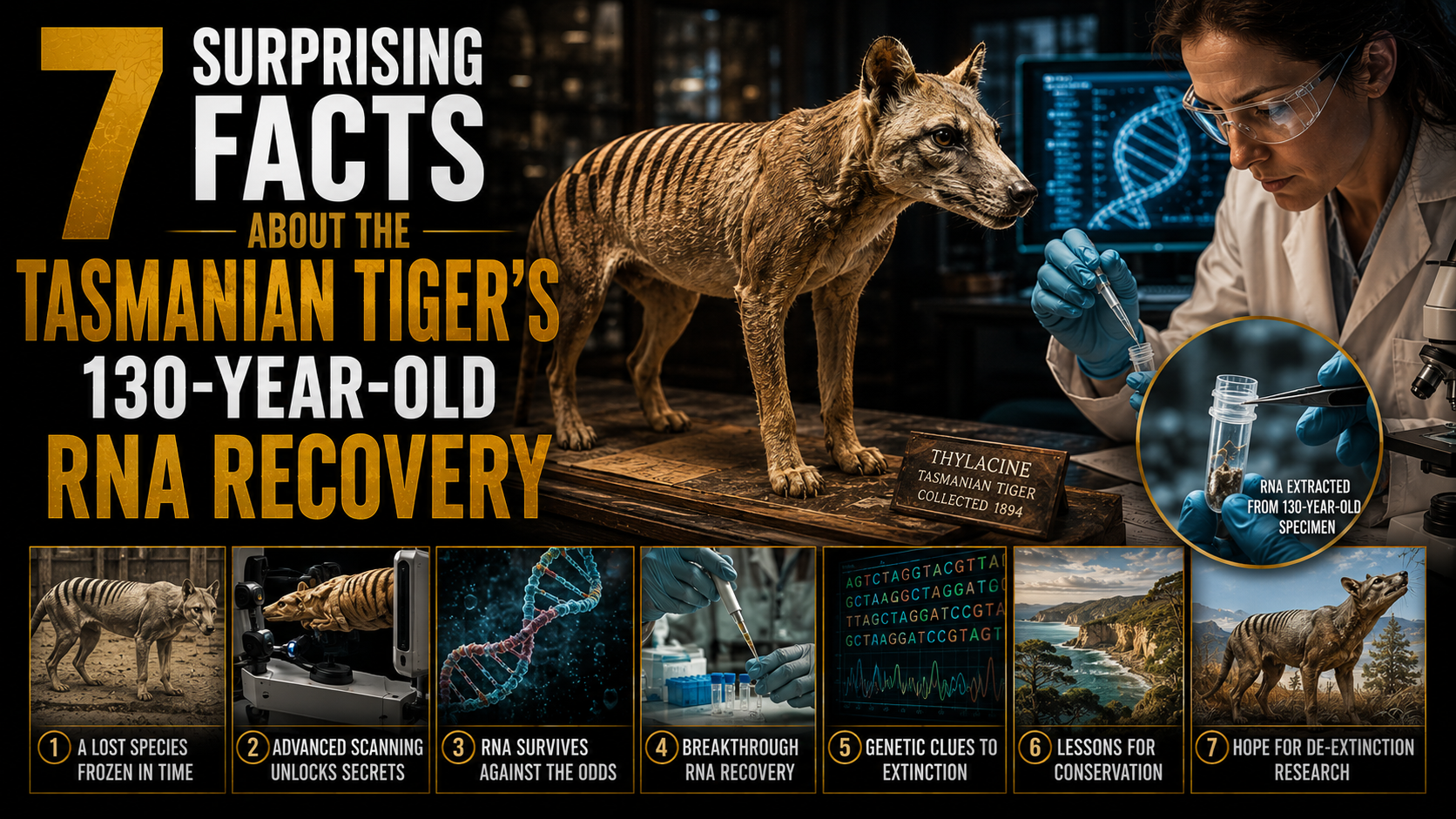
The Tasmanian tiger, or thylacine, is one of the most haunting examples of recent extinction. Officially declared extinct in the 20th century, this striped, dog-like marsupial once roamed Tasmania and parts of Australia before disappearing due to hunting, habitat loss, and human conflict.
For decades, the thylacine has symbolized both ecological loss and scientific curiosity. But in a groundbreaking development, researchers recently managed to recover fragments of RNA from a 130-year-old preserved specimen. This achievement has stunned the scientific community, as RNA is far more fragile than DNA and typically degrades quickly after death.
This discovery opens new doors in genetics, evolutionary biology, and conservation science, offering a rare molecular snapshot of a lost species.
Here are seven surprising facts about the Tasmanian tiger’s 130-year-old RNA recovery.
1. RNA Is Far More Fragile Than DNA
One of the most astonishing aspects of this discovery is the preservation of RNA itself.
Unlike DNA, RNA breaks down extremely quickly after an organism dies.
Recovering it after more than a century was once considered nearly impossible.
This makes the thylacine sample scientifically extraordinary.
2. The Specimen Was Exceptionally Well Preserved
The success of RNA recovery is largely due to the condition of the preserved specimen.
Stored in controlled museum environments, the sample avoided extreme heat and moisture.
These stable conditions slowed molecular degradation over time.
Without this preservation, RNA fragments would have been completely lost.
3. The Recovery Offers Insight Into Gene Activity, Not Just Genetic Code
While DNA shows genetic instructions, RNA reveals which genes were actively being expressed.
This means scientists can now study how the Tasmanian tiger’s body functioned at a molecular level.
It provides a more dynamic picture of biology than DNA alone.
This includes information about metabolism, stress response, and tissue function.
4. It Helps Reconstruct the Tasmanian Tiger’s Biology More Accurately
The RNA data contributes to a more complete understanding of the thylacine’s physiology.
Researchers can compare gene expression patterns with modern marsupials.
This helps clarify how the species moved, hunted, and adapted to its environment.
It also refines earlier assumptions based only on skeletal remains.
5. The Discovery May Improve De-Extinction Research
One of the most debated areas in modern science is de-extinction—the idea of bringing extinct species back through genetic engineering.
RNA adds a new layer of biological detail that could support such efforts.
It helps scientists understand not just the genetic blueprint but also how genes functioned in real time.
While revival remains theoretical, this discovery brings science a step closer to understanding feasibility.
6. The Thylacine’s Extinction Timeline Can Be Studied More Precisely
The RNA analysis may help refine the biological timeline leading up to extinction.
By examining gene activity, researchers can infer health, stress levels, and environmental adaptation.
This may reveal how the species responded to increasing human pressure.
It adds molecular evidence to historical records of decline.
7. It Highlights the Power of Museum Collections
Perhaps the most important takeaway is the value of preserved specimens in museums.
What was once considered a static display item has now become a source of cutting-edge genetic research.
This shows that museum collections are not just historical archives—they are active scientific resources.
Future discoveries may emerge from specimens already stored in archives worldwide.
Why This Discovery Matters
The recovery of RNA from a 130-year-old Tasmanian tiger specimen is more than a technical achievement—it is a breakthrough in understanding extinct life.
It bridges the gap between past and present, allowing scientists to study not just what the animal looked like, but how it functioned at a molecular level.
This kind of data was previously thought to be lost forever.
Now, it offers hope that other extinct species may also yield hidden biological information.
The Role of Modern Genetic Technology
Advances in sequencing technology have made it possible to detect and analyze extremely degraded genetic material.
High-sensitivity tools can isolate tiny fragments of RNA and reconstruct meaningful biological patterns.
These techniques are transforming paleogenetics and evolutionary science.
As methods continue to improve, even older and more fragile samples may become accessible.
Final Thoughts
The Tasmanian tiger’s 130-year-old RNA recovery is one of the most remarkable scientific achievements in modern genetics.
It provides a rare molecular glimpse into a lost species and expands what scientists thought was possible with ancient biological material.
From gene activity to evolutionary insight, each discovery brings the thylacine back into scientific focus.
Although the species is gone, its biological legacy continues to teach us about evolution, extinction, and the fragility of life on Earth.







