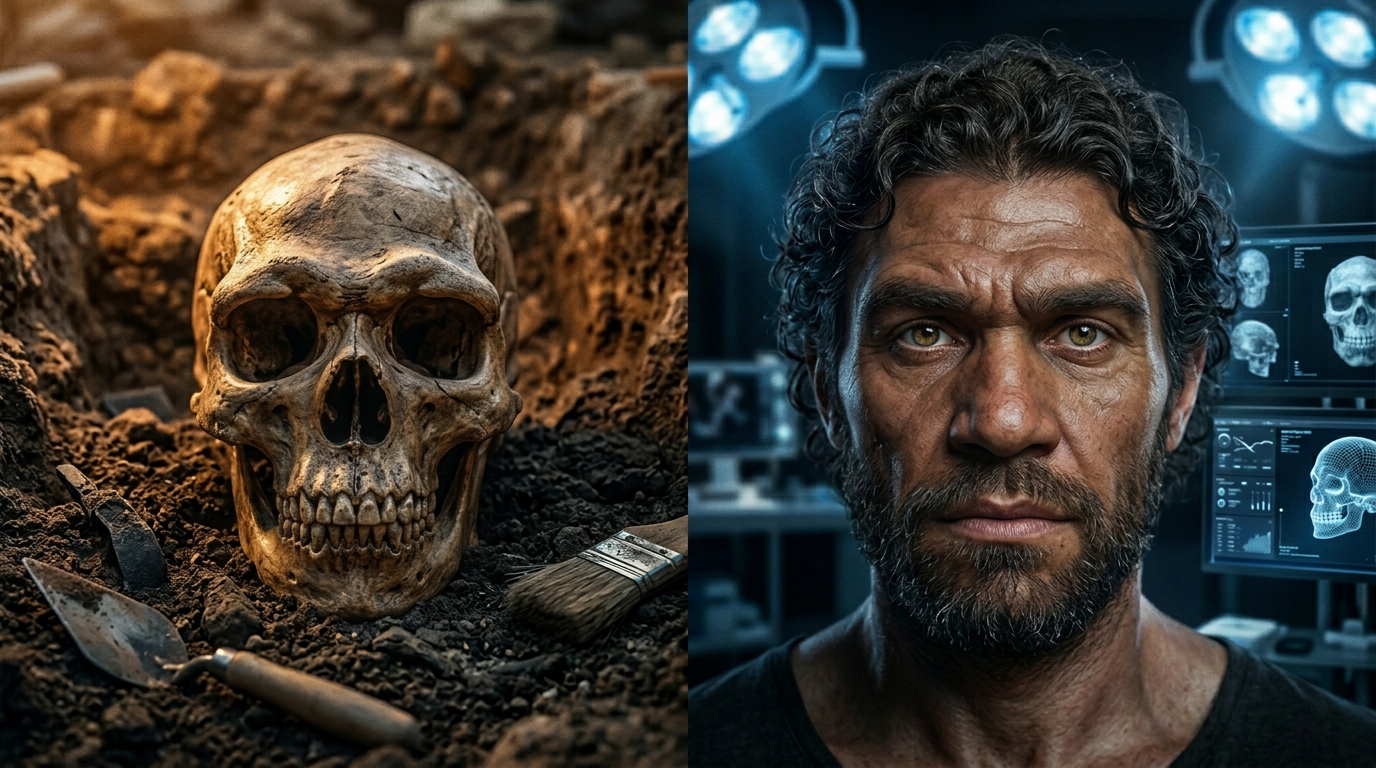
Human history stretches back far beyond written records, ancient civilizations, and even the earliest monuments. Long before cities, agriculture, and modern technology, our distant ancestors were already living, adapting, and evolving in dramatically different environments. One of the most captivating scientific efforts today involves reconstructing the faces of humans who lived approximately 300,000 years ago.
Using fossil remains, advanced imaging techniques, and forensic methods, researchers can create remarkably detailed representations of what some of our earliest known ancestors may have looked like. These reconstructions do more than satisfy curiosity—they provide valuable insights into human evolution and help bridge the enormous gap between the modern world and our prehistoric origins.
Here are twelve reasons why reconstructing 300,000-year-old human faces continues to fascinate scientists.
1. It Makes Deep History Feel Real
Numbers like 300,000 years are almost impossible for most people to fully comprehend.
Facial reconstructions transform abstract timelines into something personal and relatable. Instead of imagining anonymous prehistoric individuals, people can look into reconstructed faces and see beings who appear recognizably human.
These visual representations make deep history feel immediate and tangible.
2. It Helps Scientists Better Understand Human Evolution
The human face has changed significantly over hundreds of thousands of years.
Studying ancient skulls allows researchers to examine how features such as brow ridges, jaw structures, and facial proportions evolved over time. These changes provide important clues about the evolutionary journey that eventually led to modern humans.
Each reconstruction contributes another piece to the story of our species.
3. It Combines Multiple Scientific Disciplines
Reconstructing ancient faces requires expertise from many different fields.
Paleoanthropologists, archaeologists, forensic artists, anatomists, and imaging specialists often work together to produce these reconstructions. Modern technology allows researchers to analyze fossils with remarkable precision and create highly detailed visual models.
The collaborative nature of the process makes it scientifically exciting.
4. Ancient Faces Often Look Surprisingly Familiar
One of the most striking aspects of these reconstructions is how human many ancient faces appear.
Although certain features may differ from those commonly seen today, reconstructed individuals frequently display expressions and characteristics that feel recognizable. This familiarity creates an emotional connection between modern people and their distant ancestors.
The reconstructions remind us that humanity shares extraordinarily deep roots.
5. They Reveal How Diverse Early Humans May Have Been
Human evolution was not a simple, linear process.
Ancient populations likely displayed a wide range of physical characteristics shaped by genetics and environmental conditions. Facial reconstructions help researchers appreciate this diversity and avoid oversimplified ideas about what early humans looked like.
The findings highlight the complexity of our evolutionary history.
6. Technology Has Revolutionized the Reconstruction Process
Modern tools have transformed what scientists can learn from ancient remains.
High-resolution scanning, three-dimensional modeling, and digital imaging techniques allow researchers to study fossils in extraordinary detail. These technologies can reveal information that would have been impossible to obtain only a few decades ago.
Advances in technology continue improving both accuracy and scientific understanding.
7. The Reconstructions Encourage New Scientific Questions
Every reconstruction generates additional areas of inquiry.
Researchers may ask how environmental pressures influenced facial structures, whether certain traits offered evolutionary advantages, or how different ancient populations were related to one another.
The process often opens new avenues for research rather than simply providing final answers.
8. They Help Communicate Science to the Public
Human faces are naturally compelling.
Complex scientific concepts involving evolution and fossil evidence become easier to understand when accompanied by realistic reconstructions. Seeing a face from the distant past can spark curiosity and encourage people to learn more about anthropology and human origins.
These images serve as powerful educational tools.
9. They Highlight the Remarkable Survival of Fossils
The fact that researchers can reconstruct faces from remains that are hundreds of thousands of years old is astonishing.
Fossil preservation depends on an extraordinary combination of circumstances. The survival of ancient bones allows scientists to investigate periods of human history that would otherwise remain inaccessible.
Each fossil represents an invaluable connection to our prehistoric past.
10. They Challenge Assumptions About Early Humans
Popular portrayals sometimes depict ancient humans as primitive or fundamentally different from modern people.
Facial reconstructions often reveal individuals who appear thoughtful, expressive, and unmistakably human. These images encourage people to reconsider simplistic stereotypes and appreciate the sophistication of early human populations.
The reconstructions remind us that our ancestors were real people with complex lives and experiences.
11. They Strengthen Our Sense of Shared Humanity
Looking at reconstructed faces from hundreds of thousands of years ago can be surprisingly moving.
Despite vast differences in time, environment, and culture, these individuals were part of the same long evolutionary journey that eventually produced all people living today.
The reconstructions foster a deeper appreciation for the interconnectedness of human history.
12. They Remind Us How Much Remains Unknown
Perhaps the most fascinating aspect of reconstructing ancient faces is that every discovery also highlights the limits of our knowledge.
Scientists continue debating many questions about early human populations, including aspects of appearance, behavior, migration, and relationships among different groups. New fossils and technologies regularly reshape existing interpretations.
Each reconstructed face represents both an impressive scientific achievement and an invitation to keep exploring the mysteries of human origins.
Final Thoughts
Reconstructing 300,000-year-old human faces captivates scientists because it transforms distant evolutionary history into something vivid and relatable. These efforts combine cutting-edge technology, interdisciplinary collaboration, and remarkable fossil discoveries to provide glimpses into the appearance of some of humanity’s earliest known ancestors.
More importantly, these reconstructions remind us that modern humans are part of an extraordinarily long and complex story. The faces emerging from ancient bones belong to individuals who lived, adapted, and survived in worlds vastly different from our own, yet they remain connected to us through a shared evolutionary heritage.
In many ways, looking into the reconstructed face of a person who lived 300,000 years ago is also an opportunity to look back at the earliest chapters of ourselves.







