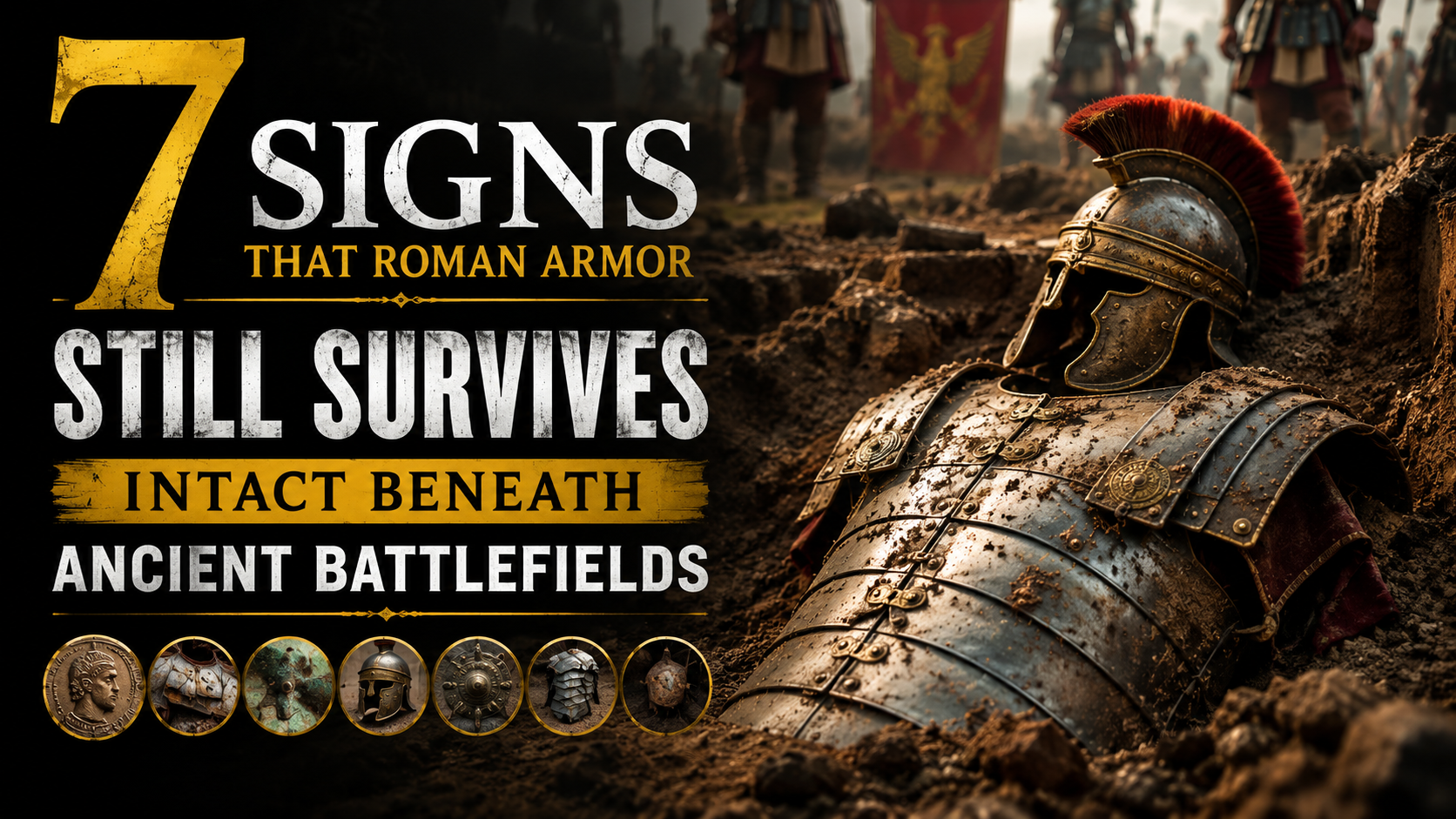
Roman armies once dominated vast regions of Europe, North Africa, and the Middle East, leaving behind more than just ruins and written records. Beneath ancient battlefields, traces of their military presence still surface today—sometimes in the form of remarkably well-preserved armor and equipment.
Archaeologists continue to uncover evidence that hints at how Roman soldiers fought, lived, and were equipped. In certain conditions, fragments of armor can survive for centuries, offering a rare glimpse into the past.
Here are seven signs that Roman armor may still be preserved beneath ancient battlefields.
1. Corrosion Layers That Preserve Metal Shapes
One of the clearest indicators of buried Roman armor is the presence of corrosion “shells.”
When iron or bronze corrodes slowly in low-oxygen soil, it can form a protective layer around the original object.
Instead of completely breaking down, the armor’s shape can remain preserved beneath mineral deposits.
This process sometimes allows archaeologists to identify armor outlines even before full excavation.
2. Waterlogged Soil Conditions That Slow Decay
Soil composition plays a major role in preservation.
In waterlogged environments, oxygen levels are extremely low, which slows down metal deterioration.
Roman armor buried in marshes, river valleys, or flooded battlefield zones can survive far longer than in dry, oxygen-rich soil.
These conditions act like a natural preservation chamber.
3. Discovery of Associated Military Artifacts
Armor is rarely found in isolation.
When archaeologists uncover Roman weapons, tools, or military fittings nearby, it increases the likelihood that armor fragments may also be present.
Items such as spearheads, belt buckles, and shield fittings often indicate the presence of a larger military deposit.
These clusters help researchers map out ancient battlefield activity.
4. Soil Discoloration Patterns From Ancient Burial Sites
Changes in soil color can signal the decomposition of organic materials and the corrosion of metal objects.
Darkened or rust-stained soil layers often point to long-term metal burial.
These subtle visual clues can guide archaeologists toward deeper excavation zones where armor fragments may still exist.
5. Magnetic Survey Anomalies Underground
Modern archaeology often relies on non-invasive technology.
Magnetometry can detect disturbances in the soil caused by buried metal objects.
Roman armor, particularly iron-based pieces, can create measurable magnetic anomalies.
These readings help researchers locate potential armor sites without disturbing the ground.
6. Fragmented but Recognizable Metal Pieces
Even when full suits of armor are not preserved, fragments often survive.
Pieces such as segmented plates, chainmail rings, or helmet components can endure centuries underground.
These fragments may be heavily corroded but still identifiable through shape and composition.
Together, they provide valuable insights into Roman military design.
7. Evidence of Rapid Battlefield Burial Conditions
Battlefields that experienced sudden abandonment or mass casualties are more likely to preserve artifacts.
When soldiers fell quickly and were not immediately stripped of equipment, armor had a greater chance of being buried intact.
Natural events such as landslides, floods, or rapid sediment buildup also help preserve battlefield remains.
These conditions essentially “sealed” armor beneath layers of earth.
Why Roman Armor Still Matters Today
Roman armor is more than just ancient metalwork—it is a direct link to one of history’s most influential civilizations.
Each discovery helps historians better understand military organization, technology, and daily life in the Roman Empire.
Even small fragments can reveal information about manufacturing techniques and battlefield strategies.
The Role of Modern Archaeology
Advancements in technology have transformed how ancient battlefields are studied.
Tools like ground-penetrating radar, 3D mapping, and chemical soil analysis allow researchers to locate buried artifacts with greater precision.
These methods reduce the need for large-scale excavation while improving discovery accuracy.
As a result, more Roman military sites continue to be identified and studied in detail.
Challenges in Preserving Ancient Armor
Despite favorable conditions in some locations, preservation is never guaranteed.
Soil acidity, groundwater movement, and agricultural activity can all damage buried metal over time.
Even when armor survives, it is often fragile and requires careful conservation after excavation.
This makes each discovery both valuable and delicate.
What These Discoveries Reveal About Roman Soldiers
Every piece of armor recovered adds depth to our understanding of Roman life.
It reveals details about rank, unit structure, and even regional differences in equipment.
Some findings show how armor evolved over centuries to adapt to changing warfare tactics.
These insights help historians reconstruct ancient military history with greater accuracy.
Final Thoughts
The survival of Roman armor beneath ancient battlefields is a reminder of how history can remain hidden just below the surface.
Through careful analysis, environmental clues, and modern technology, archaeologists continue to uncover traces of a powerful empire that once shaped much of the known world.
Each discovery not only preserves physical artifacts but also strengthens our connection to the people who once wore them into battle.
In many ways, the ground beneath ancient battlefields is still telling the story of Rome—one fragment of armor at a time.







