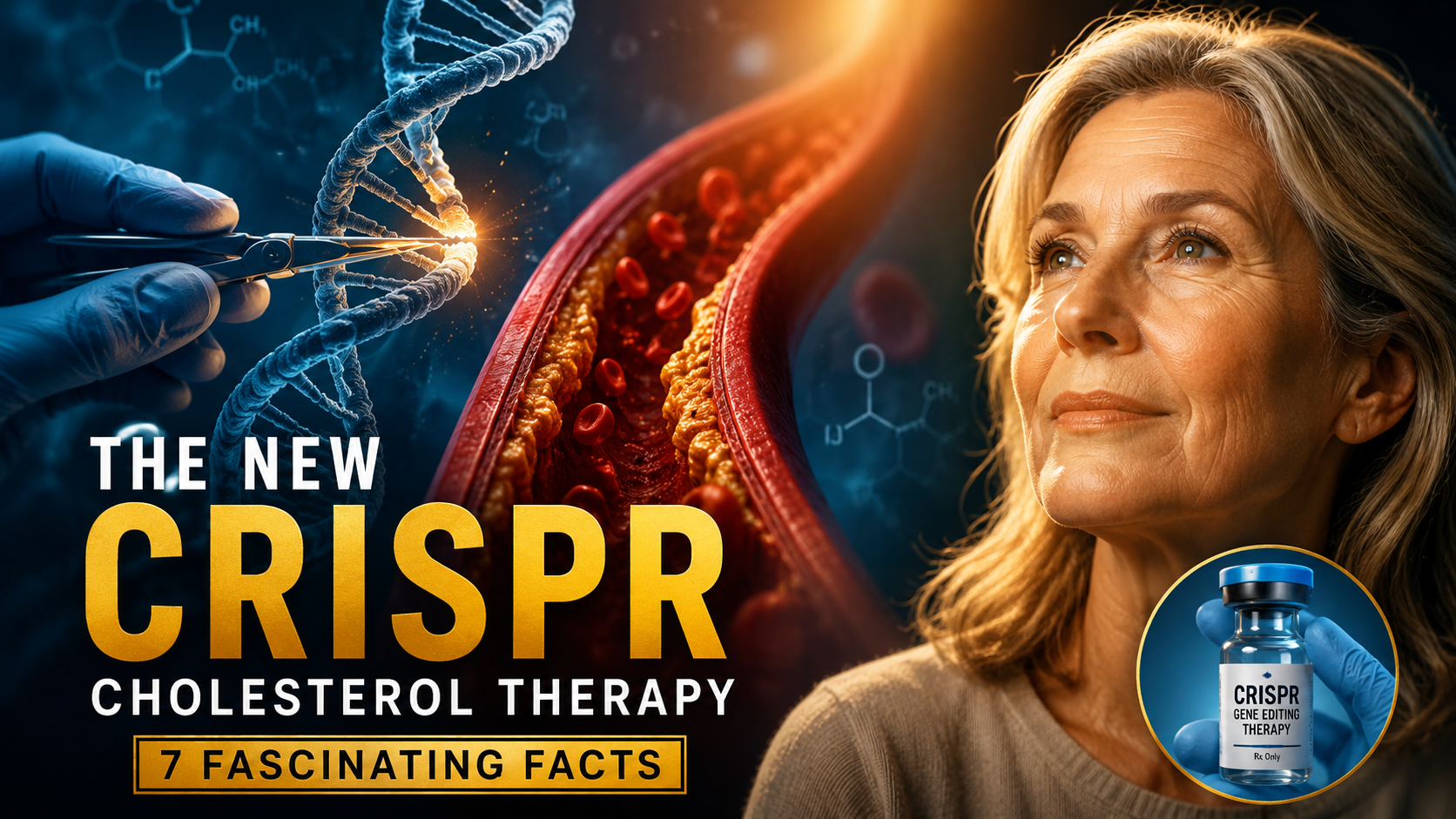
A revolutionary new medical treatment is changing how scientists think about heart disease — and it involves editing human DNA with a single injection.
Researchers are now developing a groundbreaking CRISPR-based cholesterol therapy designed to permanently lower dangerous cholesterol levels with what could become a one-time treatment. Unlike traditional cholesterol medications that often require daily pills or repeated injections for years, this new approach aims to make long-lasting genetic changes inside the body itself.
The technology has captured global attention because cardiovascular disease remains one of the leading causes of death worldwide. Millions of people struggle with high LDL cholesterol, often called “bad cholesterol,” which can silently damage blood vessels for decades before causing heart attacks or strokes.
While statins and other medications have helped countless patients, many people still have difficulty controlling cholesterol or staying consistent with lifelong treatment plans.
That is why scientists believe CRISPR gene editing could represent one of the most important shifts in cardiovascular medicine in decades.
Here are seven fascinating facts about the emerging one-time CRISPR cholesterol therapy and why experts are watching it so closely.
1. The Therapy Works by Editing DNA Inside the Body
What makes this treatment so remarkable is that it does not simply block cholesterol temporarily — it attempts to permanently change how the body produces it.
The therapy uses CRISPR, a powerful gene-editing technology often described as “molecular scissors.” Scientists can use CRISPR to target and modify specific sections of DNA with extraordinary precision.
In this case, researchers focus on genes involved in cholesterol regulation, particularly a gene called PCSK9.
PCSK9 plays a major role in controlling LDL cholesterol levels in the bloodstream. Some people naturally carry genetic mutations that reduce PCSK9 activity, and these individuals often have very low cholesterol and significantly lower rates of heart disease.
Scientists realized they might be able to mimic this natural protective effect through gene editing.
The treatment works by sending CRISPR instructions into liver cells, where cholesterol regulation largely occurs. Once edited, the cells may continue producing lower cholesterol levels for years — potentially for life.
That is what makes the therapy fundamentally different from traditional medications.
2. It Could Replace Lifelong Cholesterol Medication for Some Patients
Most cholesterol treatments require ongoing maintenance.
Millions of people take statins every day for decades. Others use injectable therapies every few weeks or months. While these medications can be highly effective, maintaining long-term treatment is not always easy.
Some patients forget doses, experience side effects, stop treatment prematurely, or struggle with medication costs over time.
The new CRISPR therapy is designed as a one-time treatment.
If successful, patients may not need constant medication management to control cholesterol levels.
That possibility has enormous implications for healthcare systems and patient quality of life.
A single treatment that permanently lowers cholesterol could simplify care dramatically, especially for people at very high cardiovascular risk.
Researchers believe this approach may be particularly valuable for patients with inherited cholesterol disorders, including familial hypercholesterolemia, a genetic condition that causes dangerously high cholesterol from a young age.
For these individuals, earlier and more effective cholesterol control could significantly reduce lifetime heart disease risk.
3. The Liver Is the Main Target
One reason this therapy has shown promise is because scientists are targeting the liver — the body’s central hub for cholesterol production and regulation.
The liver naturally removes LDL cholesterol from the bloodstream. The PCSK9 gene affects how efficiently this process works.
By editing liver cells directly, researchers hope to create a lasting reduction in harmful cholesterol levels.
Delivering gene-editing tools safely into the body is one of the biggest challenges in genetic medicine. In this therapy, tiny lipid nanoparticles — microscopic fat-like particles — are used to transport the CRISPR components into liver cells.
This delivery system has become increasingly important in modern medicine and was also used in some mRNA vaccine technologies.
Once inside the liver, the CRISPR system makes highly targeted edits designed to reduce PCSK9 activity.
Because liver cells can remain active for many years, the effect could potentially last a very long time after only one treatment.
4. Early Trial Results Have Generated Major Excitement
Although research is still ongoing, early clinical trial results have attracted enormous attention within the medical community.
Some patients receiving experimental CRISPR cholesterol therapies have shown dramatic reductions in LDL cholesterol levels after a single dose.
In certain studies, reductions appeared substantial enough to potentially lower long-term cardiovascular risk if maintained safely over time.
What impressed many researchers is not only the size of the cholesterol reduction but also the durability of the effect.
Traditional medications require constant dosing to maintain results. Gene editing introduces the possibility of a much longer-lasting solution.
Still, scientists remain cautious.
Early-stage success does not guarantee long-term safety or widespread approval. Researchers continue monitoring patients carefully to study durability, side effects, immune responses, and potential unintended genetic changes.
Even so, the early data has been encouraging enough to spark major interest from pharmaceutical companies, investors, and cardiovascular specialists worldwide.
5. It Could Transform Preventive Medicine
One of the most fascinating aspects of this therapy is its potential role in prevention rather than treatment after disease develops.
Heart disease often progresses silently for decades before symptoms appear. By the time someone experiences a heart attack, blood vessels may already contain years of accumulated damage.
That is why lowering LDL cholesterol early and consistently is considered one of the most powerful strategies for preventing cardiovascular disease.
A long-lasting gene-editing therapy could potentially help high-risk individuals maintain healthy cholesterol levels for many years without relying on daily medication routines.
This represents a broader shift happening in medicine.
Instead of repeatedly treating disease symptoms, scientists increasingly hope to intervene earlier and more permanently at the biological level.
In the future, gene editing may become part of preventive healthcare for certain inherited conditions or high-risk populations.
The implications extend beyond cholesterol alone.
Researchers are already exploring CRISPR-based therapies for blood disorders, rare genetic diseases, immune conditions, and even some forms of cancer.
6. Safety Remains the Biggest Question
Despite the excitement, gene editing still raises important medical and ethical questions.
CRISPR technology is powerful, but permanently changing DNA requires extreme caution.
One of the biggest concerns involves “off-target effects,” where edits might accidentally occur in unintended parts of the genome.
Even small unintended changes could potentially create future health risks.
Scientists are also studying immune reactions, long-term durability, and whether edited cells behave predictably over many years.
Because the treatment may create permanent biological changes, regulators and researchers are moving carefully.
Patients in clinical trials continue receiving long-term monitoring to evaluate both effectiveness and safety.
Ethical discussions also continue around how gene-editing technologies should be used in medicine.
Most experts currently support therapeutic use for serious medical conditions while remaining cautious about broader genetic modification applications.
The cholesterol therapy specifically focuses on treating disease risk rather than enhancing human traits, which makes it more widely accepted within the medical community.
Still, the long-term future of gene editing will likely remain one of the most important scientific debates of this century.
7. This May Be the Beginning of a New Era in Medicine
The CRISPR cholesterol therapy represents more than a new drug — it may signal a major turning point in how diseases are treated altogether.
For decades, most medicines have worked by temporarily altering biological processes. Patients typically need repeated doses to maintain effects.
Gene editing introduces a radically different possibility: changing the underlying genetic instructions themselves.
That approach could fundamentally reshape medicine.
Instead of lifelong treatment plans, some conditions may eventually become manageable through single-dose genetic therapies.
Researchers are already exploring this concept across multiple diseases, including sickle cell disease, muscular disorders, inherited blindness, and immune system conditions.
If CRISPR therapies continue proving safe and effective, medicine could gradually move toward more permanent biological interventions.
That does not mean traditional drugs will disappear. Many conditions will still require ongoing treatment and management.
However, gene editing may become one of the defining medical technologies of the 21st century.
Why Cholesterol Still Matters So Much
Some people underestimate the importance of cholesterol management because high cholesterol itself usually causes no immediate symptoms.
But elevated LDL cholesterol contributes to plaque buildup inside arteries over time. This process increases the risk of:
- Heart attacks
- Strokes
- Blocked arteries
- Cardiovascular disease
Heart disease remains one of the leading causes of death globally, which is why researchers continue searching for more effective prevention strategies.
Lowering LDL cholesterol consistently has been repeatedly associated with lower cardiovascular risk.
The challenge is maintaining those reductions long term across large populations.
That is exactly the problem CRISPR-based therapies hope to solve.
Could This Therapy Become Widely Available?
While excitement is growing, the therapy is still undergoing clinical testing and evaluation.
Before widespread approval, researchers must demonstrate:
- Long-term safety
- Consistent effectiveness
- Reliable delivery methods
- Minimal side effects
- Predictable outcomes across different populations
Regulatory agencies will likely review the therapy carefully because gene editing involves permanent biological changes.
Cost is another major consideration.
Advanced genetic therapies are often extremely expensive during early development stages. Over time, prices may decrease as technologies improve and manufacturing expands.
Access and affordability could become major discussions if these therapies eventually reach broader markets.
The Human Side of the Breakthrough
Beyond the science, the emotional impact of this development is significant for many families.
People with inherited cholesterol disorders often spend years managing medications, medical appointments, dietary restrictions, and anxiety about future heart disease risk.
A long-lasting treatment option could dramatically change how patients experience care.
Instead of constantly managing symptoms, some people may eventually gain more freedom and peace of mind regarding their cardiovascular health.
That possibility is one reason the research has generated so much optimism.
Final Thoughts
The new one-time CRISPR cholesterol therapy represents one of the most fascinating developments in modern medicine.
By using gene editing to permanently reduce harmful cholesterol levels, researchers are exploring a future where cardiovascular disease prevention may become far more precise, effective, and long-lasting.
The science is still evolving, and important safety questions remain.
However, early results suggest this technology could eventually transform how doctors approach cholesterol management and heart disease prevention.
More broadly, the therapy offers a glimpse into the future of medicine itself — one where genetic treatments may target disease at its biological roots rather than simply managing symptoms over time.
If successful, this breakthrough could become one of the defining healthcare innovations of the coming decades.







