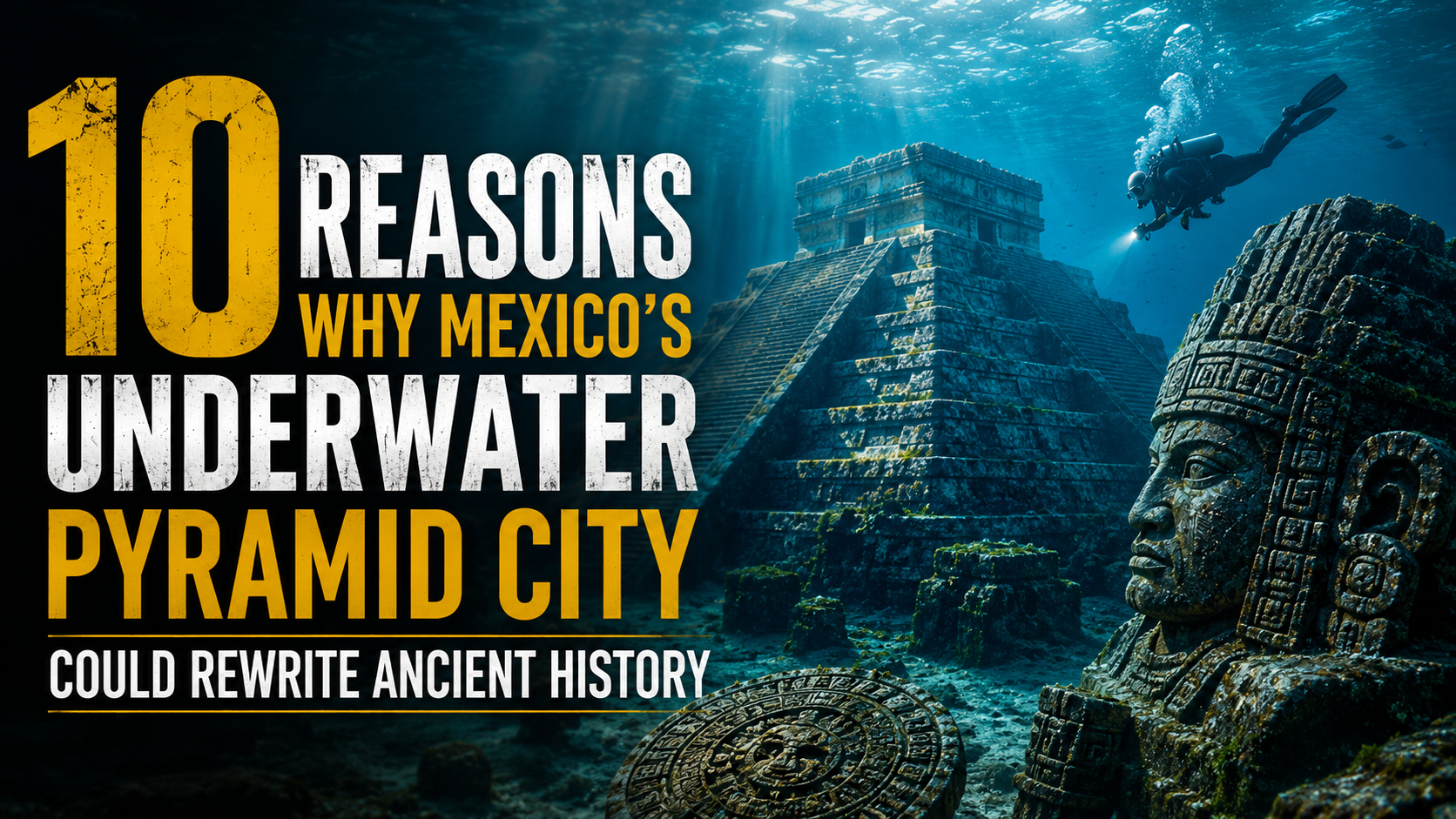
Beneath the surface of the ocean, where sunlight fades and silence dominates, lie mysteries that continue to challenge what we think we know about human history. One of the most intriguing of these is the reported discovery of submerged pyramid-like structures off the coast of Mexico.
While debates continue among archaeologists, geologists, and independent researchers, the idea of an underwater “pyramid city” has captured global attention. If proven to be man-made, such structures could significantly reshape our understanding of ancient civilizations in the Americas.
Here are ten reasons why this discovery could potentially rewrite ancient history.
1. Evidence of Advanced Coastal Civilizations
If these underwater formations are confirmed as man-made, they would suggest that ancient civilizations in the region were more advanced than previously believed.
Such structures could indicate organized societies capable of large-scale architectural planning along coastal zones that are now submerged.
This would expand the known boundaries of early civilization in Mesoamerica.
2. Possible Link to Lost Settlements
Rising sea levels at the end of the last Ice Age may have submerged ancient coastal cities.
If the pyramid-like formations are indeed artificial, they could represent remnants of settlements lost to rising oceans thousands of years ago.
This possibility aligns with theories about submerged prehistoric landscapes around the world.
3. Reconsidering Ancient Sea Level Changes
The presence of structured formations underwater would also prompt scientists to revisit historical sea level timelines.
It could suggest that human occupation of coastal areas occurred earlier than currently documented.
This would have major implications for understanding climate and environmental changes in prehistory.
4. Expanding the Timeline of Human Engineering
Most accepted timelines place large-scale architectural development within certain historical periods.
However, underwater structures could push back those timelines significantly.
If confirmed, they would demonstrate that complex engineering skills existed much earlier than previously thought.
5. Challenging Conventional Archaeological Boundaries
Traditional archaeology relies heavily on land-based discoveries.
Underwater findings challenge the assumption that ancient human activity is limited to current landmasses.
This expands the field of archaeology into submerged environments that remain largely unexplored.
6. Potential Cultural Connections Across Regions
Some researchers suggest similarities between pyramid-like structures across different continents.
If underwater Mexican formations are confirmed as artificial, they could contribute to discussions about cultural diffusion or independent architectural development.
This raises questions about how ancient societies may have shared or developed construction knowledge.
7. Technological Capabilities of Ancient Builders
The construction of pyramid-like structures underwater would imply advanced engineering skills.
It would require knowledge of geometry, materials, and possibly even aquatic environmental adaptation.
Such capabilities would reshape assumptions about technological limits in ancient times.
8. Preservation of Prehistoric Landscapes Underwater
Ocean floors often preserve ancient landscapes better than land environments affected by erosion and development.
If these structures are authentic, they may represent well-preserved snapshots of prehistoric environments.
This would offer researchers a rare opportunity to study ancient human activity in situ.
9. Debates Between Science and Interpretation
Not all experts agree on the interpretation of these formations.
Some argue they are natural geological formations rather than human-made structures.
This debate itself is important, as it highlights the need for careful analysis and multiple lines of evidence before drawing conclusions.
10. The Potential to Rewrite Mesoamerican History
Perhaps the most significant implication is the possibility of rewriting regional history.
If confirmed as man-made, the underwater structures could reshape understanding of early civilizations in Mexico and surrounding areas.
It would force historians to reconsider migration patterns, settlement timelines, and cultural development.
Scientific Caution and Ongoing Research
Despite the excitement surrounding these claims, scientific caution is essential.
Underwater formations can often appear artificial due to erosion patterns, lighting conditions, and geological processes.
Researchers emphasize the need for detailed sonar mapping, sampling, and peer-reviewed studies before drawing conclusions.
Why This Discovery Captures Global Attention
Stories of lost cities and underwater civilizations resonate deeply with human curiosity.
They connect mythology, history, and science in ways that spark imagination.
Whether or not these structures are confirmed as man-made, they highlight how much of Earth’s history remains unexplored beneath the oceans.
The Role of Modern Technology in Exploration
Advances in underwater imaging, sonar scanning, and deep-sea robotics have made it possible to explore areas once inaccessible.
These tools allow scientists to map underwater terrain in unprecedented detail.
As technology improves, more discoveries like this are likely to emerge.
A Reminder of Earth’s Hidden History
The idea of submerged pyramids serves as a reminder that human history may be far more complex than current records suggest.
Sea levels have risen and fallen dramatically over millennia, potentially hiding entire chapters of civilization beneath the waves.
Each new discovery has the potential to change what we believe about the past.
Final Thoughts
Whether the underwater pyramid-like formations off Mexico’s coast are natural or man-made, they represent an important scientific opportunity.
They challenge researchers to question assumptions, refine methods, and explore deeper into Earth’s submerged landscapes.
If future studies confirm human involvement, the implications for ancient history would be profound.
Even in uncertainty, these structures remind us that much of our planet’s story is still waiting to be discovered beneath the surface.







